The Future of Quantum Computing
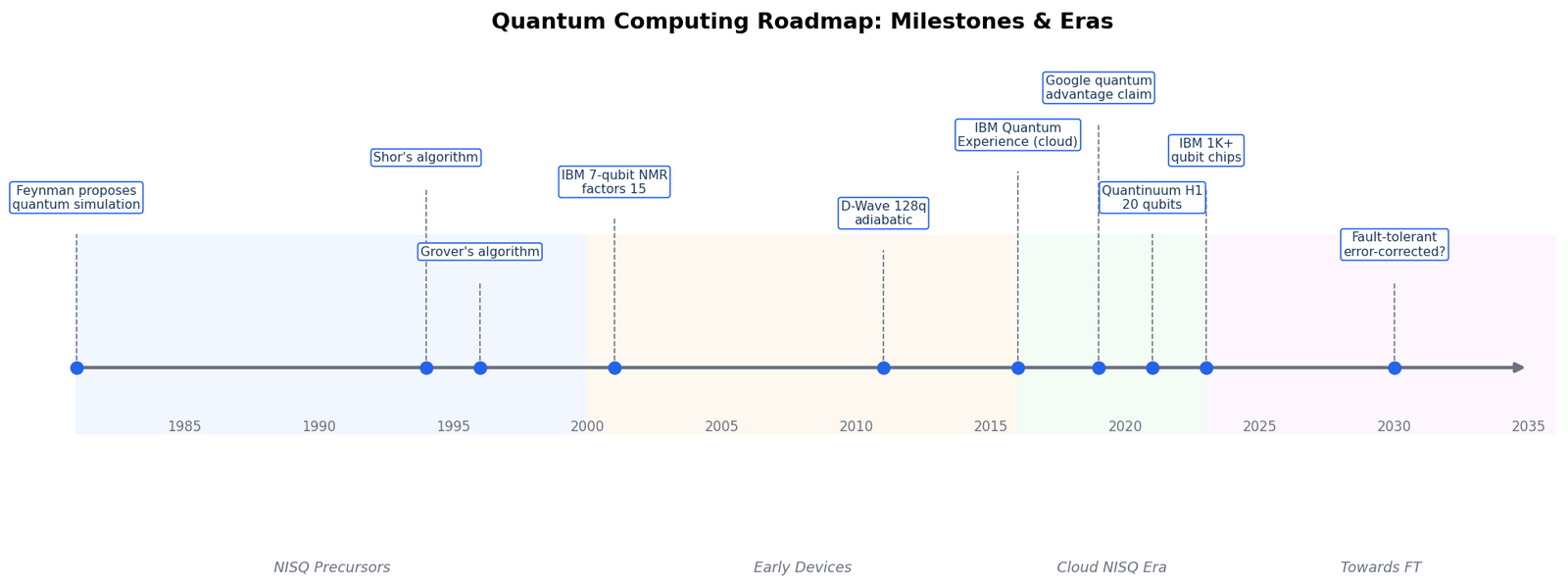
The path forward requires leaving the noisy NISQ era and building fault-tolerant machines with robust error correction
Source: mortalapps.com- The future of quantum computing involves moving beyond today's 'noisy' machines (NISQ era).
- The next major milestone is developing quantum computers with robust quantum error correction.
- Fault-tolerant quantum computers will have many reliable 'logical qubits' for complex algorithms.
- These machines promise breakthroughs in drug discovery, materials science, AI, and climate modeling.
- Quantum computing will enable us to simulate nature at its fundamental level, leading to new scientific discoveries.
- The journey is a long-term endeavor, likely spanning decades, but with immense potential rewards.
- Quantum computers will likely remain specialized, cloud-accessed machines, complementing classical computing.
Why This Matters
We've come a long way in understanding why quantum computing exists, from the limits of classical machines to the weirdness of qubits, their potential, and the challenges they face. Now, as we conclude this introductory section, it's time to look forward. What does the future hold for this groundbreaking technology?
This topic will paint a picture of the exciting possibilities and realistic timelines for quantum computing. We'll explore the vision of fault-tolerant quantum computers, the potential for truly transformative applications, and the long-term impact this technology could have on science, industry, and society.
By the end of this topic, you'll have a clear vision of the quantum computing roadmap, understanding the milestones ahead and feeling inspired by the profound changes this technology promises to bring to our world.
Core Intuition
Imagine the early days of the internet. People could send emails and browse simple websites, but no one could truly envision streaming video, social media, or cloud computing. It was a powerful new technology, but its full potential was still decades away.
Quantum computing is in a similar stage. We have early, 'noisy' machines that can do some impressive things, but the truly transformative applications are still on the horizon. The future involves building 'fault-tolerant' quantum computers – machines that can correct their own errors, making them incredibly reliable, much like today's classical computers.
Think of it as moving from a fragile, experimental prototype airplane to a robust, commercial jetliner. The basic principles are there, but the engineering and reliability need to be perfected. Once we have these robust machines, they won't just solve existing problems faster; they'll enable us to ask and answer entirely new questions, leading to discoveries we can't even imagine today.
Visualization
Technical Explanation
The future of quantum computing is envisioned in several phases, moving from today's 'noisy' machines to powerful, fault-tolerant systems:
1. The NISQ Era (Noisy Intermediate-Scale Quantum): This is where we are today. Current quantum computers have tens to a few hundreds of qubits, but they are noisy and prone to errors. They can perform some computations beyond classical reach (quantum advantage), but their error rates limit their practical applications. Research focuses on finding 'near-term' applications that can tolerate some noise.
2. Error-Corrected Quantum Computers: The next major milestone is the development of quantum computers that can implement quantum error correction. This involves encoding quantum information across many physical qubits to protect it from noise and errors. For example, one 'logical qubit' (a perfectly reliable qubit) might require hundreds or thousands of physical qubits. This will dramatically improve the reliability and allow for much deeper, more complex quantum circuits.
3. Fault-Tolerant Quantum Computers: Once robust error correction is achieved, we will enter the era of fault-tolerant quantum computers. These machines will have a large number of reliable logical qubits, capable of running complex quantum algorithms for extended periods without significant errors. This is the stage where truly transformative applications become feasible.
4. Transformative Applications: With fault-tolerant quantum computers, we can expect breakthroughs in:
- Drug Discovery & Personalized Medicine: Designing new drugs and therapies with unprecedented precision, tailored to individual genetic profiles.
- Advanced Materials: Discovering revolutionary materials with properties like room-temperature superconductivity or highly efficient catalysts.
- Artificial Intelligence: Powering new forms of AI with enhanced learning capabilities, pattern recognition, and data analysis.
- Climate Modeling: Creating more accurate climate models to predict and mitigate environmental changes.
- Secure Communication: Enabling truly unhackable communication networks through quantum cryptography.
5. Long-Term Impact: Beyond specific applications, quantum computing is expected to fundamentally change our understanding of science and engineering. It will allow us to simulate nature at its most fundamental level, leading to new scientific discoveries and technological paradigms that are currently unimaginable. The journey is long, but the potential rewards are immense, promising a future where the 'impossible' becomes computable.