Entanglement Creation
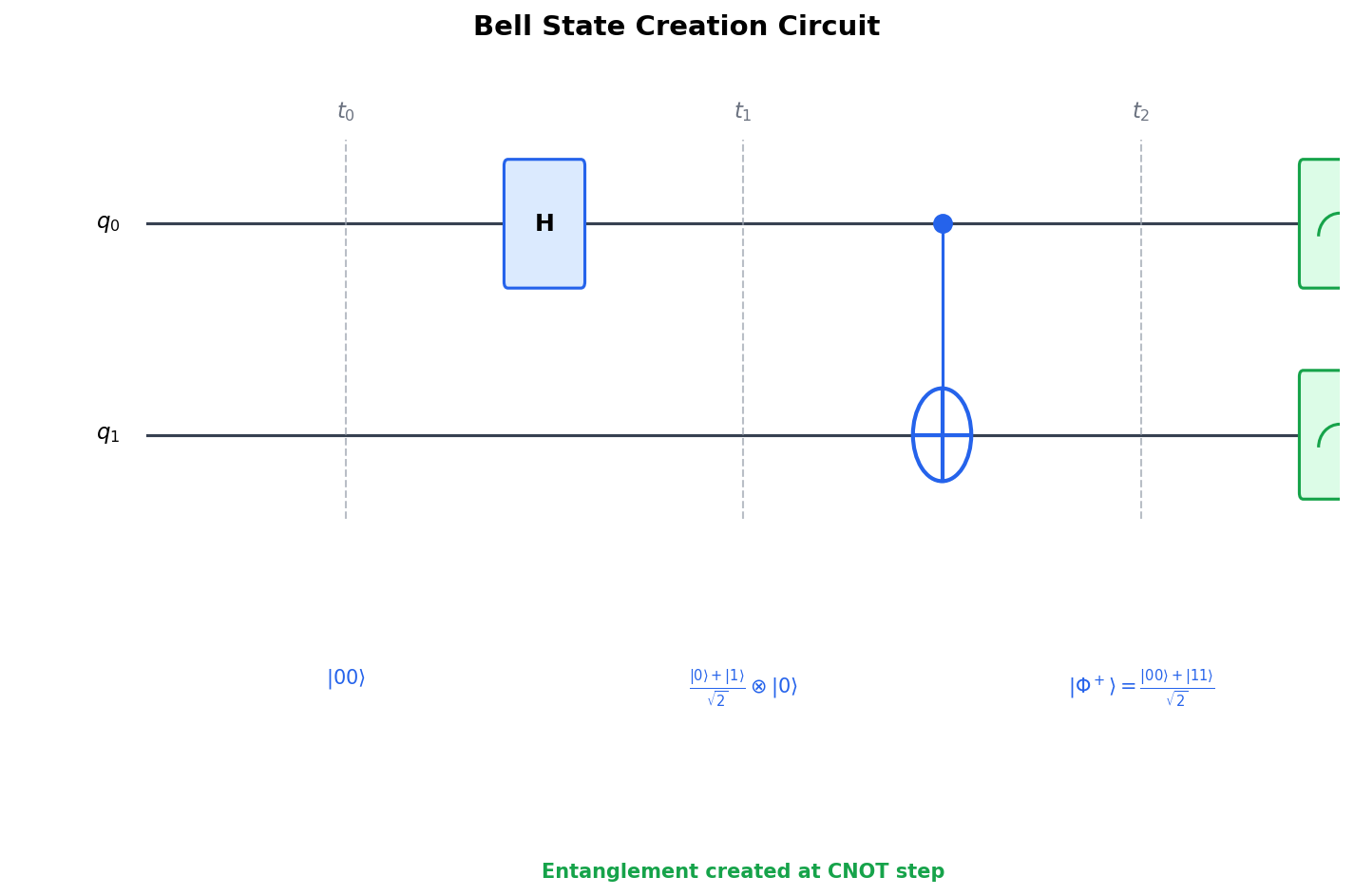
A Hadamard gate followed by a CNOT gate creates a Bell state from two unentangled input qubits
Source: mortalapps.com- Entanglement must be actively engineered using a combination of single-qubit and multi-qubit gates.
- The standard entanglement circuit consists of a Hadamard gate followed by a CNOT gate.
- The Hadamard gate creates a single-qubit superposition, which is still a separable state.
- The CNOT gate distributes the superposition, coupling the qubits and creating the entanglement.
- Starting with |00⟩, the H+CNOT circuit generates the Bell state |Φ⁺⟩.
- By varying the input basis states, the same circuit can generate all four Bell states.
- It is mathematically impossible to create entanglement from a separable state using only single-qubit gates.
Why This Matters
We have studied the Bell states and their remarkable properties, but how do we actually create them? Entanglement does not happen by accident; it must be engineered. In a quantum computer, we generate entanglement by passing unentangled input qubits through a specific sequence of single-qubit and two-qubit gates.
In this topic, we will analyze the standard circuit used to create entanglement. We will dissect the two-gate combination that serves as the universal engine for entanglement: the Hadamard gate followed by a CNOT gate. You will learn how to trace the state vector step-by-step through this circuit, watching the transition from a separable state to a maximally entangled state.
By the end of this topic, you will be able to build circuits that generate any of the four Bell states from standard computational basis inputs, and you will understand the physical mechanism of how gates distribute quantum information across multiple wires.
Core Intuition
Imagine you have two blank sheets of paper (initialized to $|00\rangle$). You want to write a secret message that can only be read when both sheets are placed side-by-side. If you write on them independently, they remain separate.
To link them, you first take the first sheet and paint it with a special, wet, glowing ink that is in a state of 'wet or dry' superposition (applying the Hadamard gate). Now, while the ink is still wet, you press the second sheet firmly against the first sheet (applying the CNOT gate). The wet ink transfers its pattern directly to the second sheet.
Now, the two sheets share a single, mirrored pattern. If you look at one and see glowing ink, you know the other has it too. They are no longer two independent sheets of paper; they are a single, entangled system. The Hadamard gate created the superposition (the wet ink), and the CNOT gate distributed that superposition to the second qubit (the press).
Visualization
Technical Explanation
The standard circuit to create the Bell state $|\Phi^+\rangle$ consists of two qubits initialized to $|00\rangle$. We apply a Hadamard gate to the first qubit (control), and then a CNOT gate with the first qubit as control and the second as target.
Let us trace this mathematically. The initial state is: $$|\Psi_0\rangle = |0\rangle \otimes |0\rangle = |00\rangle$$
First, we apply the Hadamard gate to the top wire. The joint operator is $H \otimes I$: $$|\Psi_1\rangle = (H \otimes I)|00\rangle = (H|0\rangle) \otimes (I|0\rangle) = \left( \frac{1}{\sqrt{2}}(|0\rangle + |1\rangle) \right) \otimes |0\rangle = \frac{1}{\sqrt{2}}(|00\rangle + |10\rangle)$$
Next, we apply the CNOT gate, where the top qubit is the control and the bottom is the target. By linearity, CNOT acts on each term in the superposition: $$|\Psi_2\rangle = \text{CNOT} \left( \frac{1}{\sqrt{2}}(|00\rangle + |10\rangle) \right) = \frac{1}{\sqrt{2}} \left( \text{CNOT}|00\rangle + \text{CNOT}|10\rangle \right)$$
Since $\text{CNOT}|00\rangle = |00\rangle$ and $\text{CNOT}|10\rangle = |11\rangle$, we get: $$|\Psi_2\rangle = \frac{1}{\sqrt{2}}(|00\rangle + |11\rangle) = |\Phi^+\rangle$$
We have successfully generated the Bell state $|\Phi^+\rangle$. By varying the initial input states ($|01\rangle, |10\rangle, |11\rangle$), the same circuit generates the other three Bell states.