Intro to PennyLane
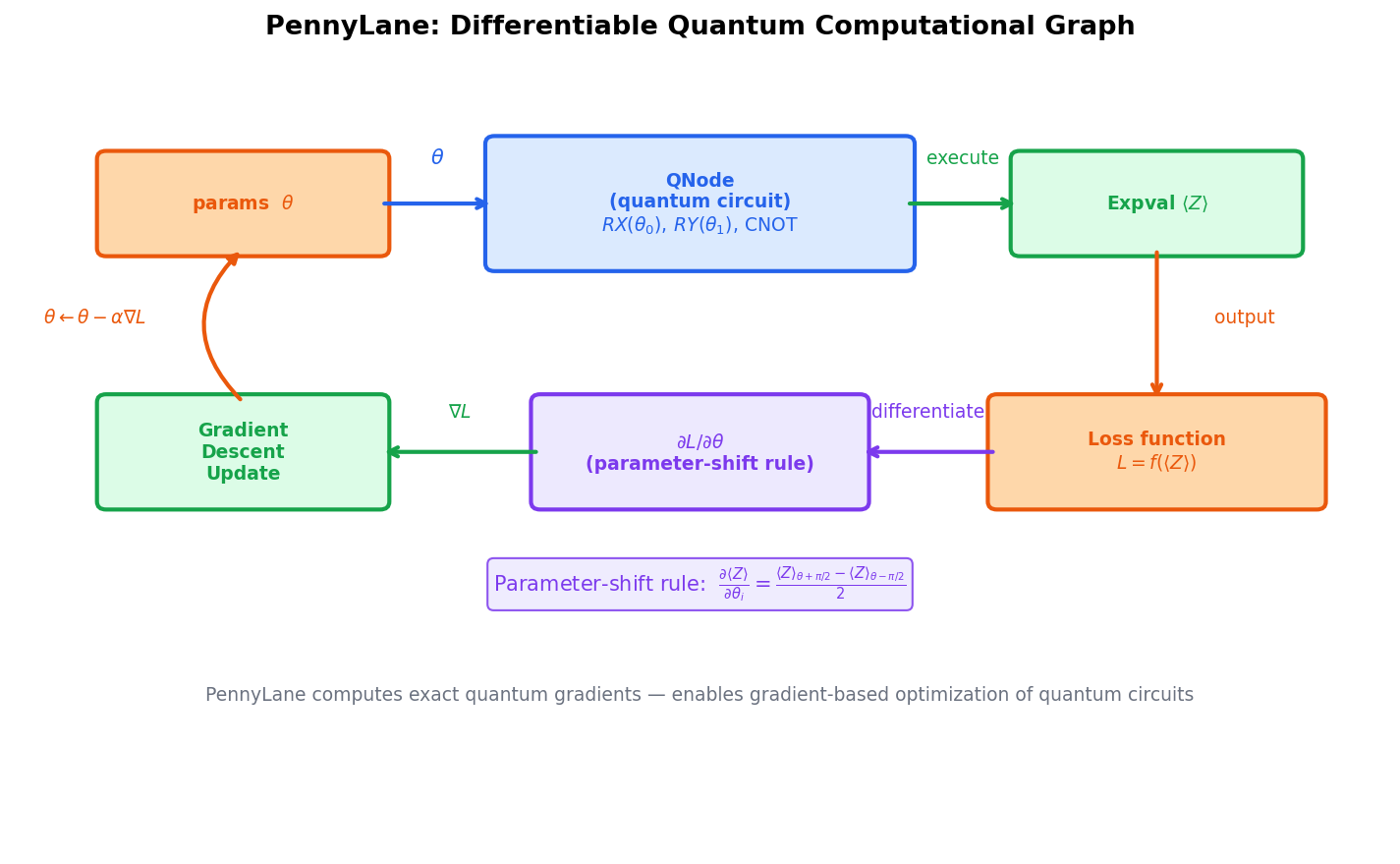
PennyLane treats quantum circuits as differentiable graphs, enabling gradient-based training for quantum ML
Source: mortalapps.com- PennyLane is an open-source framework developed by Xanadu, designed specifically for quantum machine learning and differentiable programming.
- A QNode (Quantum Node) binds a quantum circuit function to a physical or simulated execution Device.
- PennyLane treats quantum circuits as differentiable computational graphs, allowing them to be trained like classical neural networks.
- The parameter-shift rule allows physical quantum hardware to calculate exact analytical gradients without numerical approximation.
- PennyLane integrates seamlessly with classical deep learning libraries like PyTorch, TensorFlow, and Autograd.
- To enable automatic differentiation, you must use PennyLane's wrapped NumPy library and specify
requires_grad=Trueon parameters.
Why This Matters
As quantum computing matures, it is increasingly intersecting with machine learning. This intersection has given rise to Quantum Machine Learning (QML), a frontier research field that explores how quantum computers can accelerate or improve machine learning models. Programming QML applications requires a different paradigm than standard circuit building: we must treat quantum circuits as differentiable computational graphs, much like neural networks in PyTorch or TensorFlow.
The leading software framework for this differentiable quantum programming is PennyLane, developed by Xanadu. PennyLane is an open-source library designed specifically for quantum machine learning, quantum chemistry, and quantum computing. Its core innovation is the concept of 'differentiable quantum circuits', circuits where we can calculate mathematical gradients of measurement outcomes with respect to gate parameters, allowing us to train quantum circuits using standard gradient descent algorithms.
In this topic, you will explore the architecture and syntax of PennyLane. You will learn how PennyLane integrates quantum circuits with classical machine learning libraries, understand the concept of QNodes and devices, and write code to build a parameterized circuit and calculate its gradients. This will complete your quantum programming toolkit, equipping you to participate in frontier QML research.
Core Intuition
Think of PennyLane like a bridge that connects the world of quantum computing with the world of modern artificial intelligence. In classical AI, libraries like PyTorch allow you to build neural networks, calculate gradients automatically, and train the network to recognize images or text. The network is like a complex system of water pipes with adjustable valves (the weights); automatic differentiation calculates exactly how to turn each valve to optimize the water flow.
PennyLane allows you to insert a quantum circuit directly into this classical pipeline, treating the quantum circuit as if it were just another layer of the neural network. The parameterized quantum gates are the adjustable valves. PennyLane's automatic differentiation engine calculates exactly how to adjust the gate angles to minimize a cost function, using a clever mathematical trick called the 'parameter-shift rule'.
Another helpful analogy is a modern hybrid car. The classical machine learning library is the gasoline engine, handling high-speed cruising and overall control. The quantum circuit is the electric motor, providing high-torque acceleration for specific tasks. PennyLane is the sophisticated drivetrain manager that coordinates both power sources, ensuring they work together seamlessly to maximize fuel efficiency (optimize the model).
Visualization
Technical Explanation
The core mathematical challenge in training parameterized quantum circuits is calculating the gradient of an expectation value with respect to a gate parameter $\theta$:
$$\nabla_{\theta} \langle M \rangle_{\theta} = \frac{\partial}{\partial \theta} \langle \psi(\theta) \lvert M \lvert \psi(\theta) \rangle$$
On classical simulators, we can calculate this gradient using backpropagation. However, physical quantum hardware cannot perform backpropagation. To solve this, PennyLane leverages the parameter-shift rule. For many standard gates (like $R_x(\theta)$), the exact analytical gradient can be calculated by executing the same circuit at two shifted parameter points:
$$\frac{\partial}{\partial \theta} \langle M \rangle_{\theta} = \frac{\langle M \rangle_{\theta + s} - \langle M \rangle_{\theta - s}}{2\sin(s)}$$
Where $s$ is a shift constant (typically $\pi/2$). This means physical hardware can calculate exact gradients simply by running the circuit twice with shifted angles.
In PennyLane, a quantum circuit is represented as a QNode (Quantum Node), which binds a quantum function to a physical or simulated Device. QNodes are fully compatible with classical autograd libraries.
Here is a complete, runnable PennyLane program that defines a parameterized circuit, executes it, and calculates its analytical gradient using Autograd:
import pennylane as qml
from pennylane import numpy as np

# Step 1: Define a quantum device
# We use the default qubit simulator with 2 wires (qubits)
dev = qml.device("default.qubit", wires=2)

# Step 2: Define a QNode (Quantum Node)
# The decorator binds the function to the device
@qml.qnode(dev)
def circuit(params):
    qml.Hadamard(wires=0)
    qml.RY(params[0], wires=0) # Parameterized rotation on qubit 0
    qml.CNOT(wires=[0, 1])
    # Return the expectation value of the Pauli-Z operator on qubit 1
    return qml.expval(qml.PauliZ(1))

# Step 3: Initialize parameters
# We use PennyLane's wrapped numpy to enable automatic differentiation
params = np.array([0.5], requires_grad=True)

# Step 4: Execute the QNode
initial_energy = circuit(params)
print(f"Initial Expectation Value: {initial_energy:.4f}")

# Step 5: Calculate the gradient automatically
# qml.grad creates a gradient function
grad_fn = qml.grad(circuit)
gradient = grad_fn(params)
print(f"Analytical Gradient: {gradient[0]:.4f}")
In this code, the @qml.qnode(dev) decorator transforms a standard Python function into a differentiable quantum node. We initialize our parameters using PennyLane's custom numpy array with requires_grad=True. Calling qml.grad(circuit) returns a function that automatically calculates the exact analytical gradient of the circuit's output with respect to params using the parameter-shift rule.
Key Takeaways
requires_grad=True on parameters.