Error Mitigation
Error mitigation uses classical post-processing to estimate ideal results from noisy hardware with zero qubit overhead
Source: mortalapps.com- Quantum Error Mitigation (QEM) uses classical post-processing to estimate error-free results from noisy quantum computations.
- Unlike QEC, error mitigation requires zero physical qubit overhead and no active stabilizer measurements.
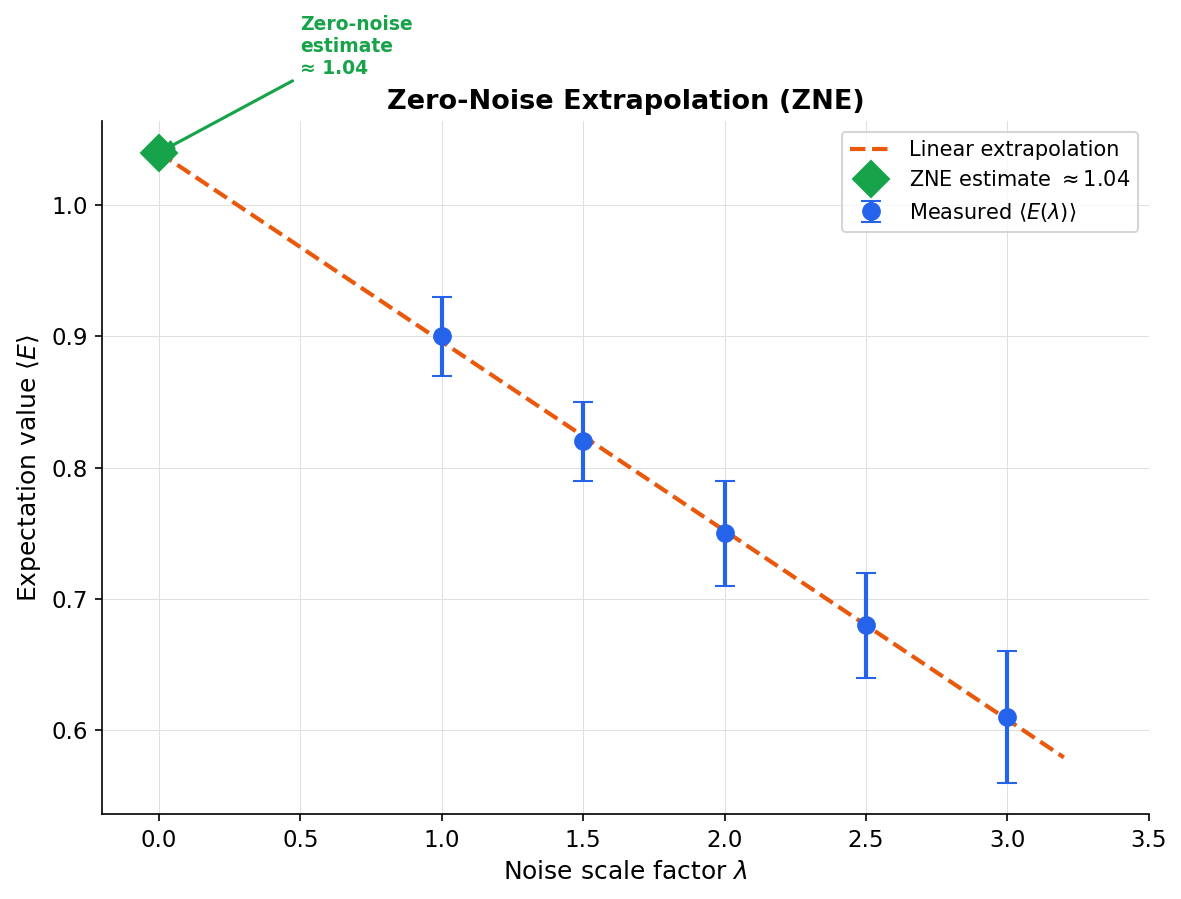
- Zero-Noise Extrapolation (ZNE) works by intentionally scaling up physical noise, measuring the output, and extrapolating back to the zero-noise limit.
- Noise scaling in ZNE is achieved through pulse stretching or digital gate folding (e.g., replacing U with U U^† U).
- Probabilistic Error Cancellation (PEC) represents ideal gates as quasi-probability distributions of noisy gates, offering exact mitigation at the cost of exponential sampling overhead.
- Error mitigation is strictly limited to expectation values and cannot protect digital, state-based algorithms like Shor's algorithm.
- Mitigation is the primary technology enabling practical 'quantum utility' demonstrations on today's NISQ processors.
Why This Matters
While Quantum Error Correction (QEC) is the ultimate destination for scalable quantum computing, it requires a massive overhead of physical qubits that is currently beyond the reach of modern hardware. To bridge this gap during the NISQ (Noisy Intermediate-Scale Quantum) era, researchers developed a parallel suite of techniques known as Quantum Error Mitigation (QEM). Unlike error correction, which actively detects and repairs physical errors in real-time, error mitigation uses clever classical post-processing to estimate the error-free output of a noisy quantum computation.
Error mitigation does not require any additional physical qubits or active stabilizer measurements. Instead, it works by running a quantum circuit multiple times under different, carefully controlled noise conditions, and then using classical algorithms to mathematically subtract the noise from the final data. This approach allows us to extract highly accurate results from today's imperfect, non-error-corrected processors.
In this topic, we will explore the core mathematical techniques of error mitigation. We will analyze Zero-Noise Extrapolation (ZNE), the most widely used mitigation protocol, and introduce Probabilistic Error Cancellation (PEC). You will learn how to distinguish between error correction and error mitigation, and understand how mitigation acts as a vital stepping stone toward practical quantum utility today.
Core Intuition
To understand error mitigation, imagine taking a photograph of a beautiful landscape through a dirty window. The dirt on the glass represents physical quantum noise, making the final image blurry and distorted.
One way to fix this is to replace the window with a highly advanced, self-cleaning smart glass that actively detects and wipes away dust particles in real-time. This is analogous to Quantum Error Correction: it is highly effective but incredibly expensive and difficult to build.
An alternative approach is to take several photos of the landscape under different lighting conditions, or with different camera settings that amplify the dirt in predictable ways. You then feed these noisy photos into a classical photo-editing software (like Photoshop) that analyzes the patterns of the dirt and mathematically subtracts them, leaving you with a clean, clear image of the landscape. You never actually cleaned the window, but you successfully 'mitigated' the blurriness to get the clean data you wanted. This is Quantum Error Mitigation.
Another analogy is noise-canceling headphones. They do not stop the background noise from existing in the room; instead, they measure the noise, generate an opposite sound wave, and combine them to cancel out the noise for your ears. Error mitigation uses classical algorithms to generate that 'opposite wave' and cancel out the mathematical impact of quantum noise from your final measurement results.
Visualization
Technical Explanation
The most common error mitigation technique is Zero-Noise Extrapolation (ZNE). Suppose we want to measure the expectation value of an observable $A$ for a quantum circuit, denoted as $E(\lambda)$, where $\lambda$ represents the physical noise level of the hardware. In a perfect, noiseless quantum computer, the noise level is $\lambda = 0$, and we want to find the ideal expectation value $E(0)$.
On real hardware, we can only measure $E(1)$ at the base noise level $\lambda = 1$. To estimate $E(0)$, ZNE intentionally scales up the noise of the hardware to higher levels, such as $\lambda = 2$ and $\lambda = 3$. This noise scaling can be achieved by stretching the duration of control pulses or by replacing single gates with equivalent sequences of multiple gates (e.g., replacing a gate $U$ with $U U^{\dagger} U$, which preserves the logic but triples the noise).
We measure the expectation values at these amplified noise levels, obtaining $E(1)$, $E(2)$, and $E(3)$. We then fit a classical polynomial curve through these noisy data points and extrapolate the curve backward to the intercept where $\lambda = 0$. For a linear extrapolation using two points, the estimated zero-noise value is:
$$E(0) \approx 2E(1) - E(2)$$
For a quadratic extrapolation using three points, the formula is:
$$E(0) \approx 3E(1) - 3E(2) + E(3)$$
Another advanced technique is Probabilistic Error Cancellation (PEC), which represents the ideal, noiseless gate as a quasi-probability distribution of noisy physical gates. By randomly sampling from this distribution and applying classical sign-weights to the outputs, PEC can reconstruct the exact noiseless expectation value, though it suffers from an exponential sampling overhead as the circuit depth increases.