Error Sources
Hardware errors include SPAM errors, control miscalibration, crosstalk between qubits, and leakage to non-qubit states
Source: mortalapps.com- Hardware errors extend beyond decoherence to include SPAM, coherent control errors, crosstalk, and leakage.
- SPAM errors limit the fidelity of the initial state preparation and the final classical readout.
- Coherent control errors are systematic pulse imperfections that accumulate quadratically over long gate sequences.
- Crosstalk is the unwanted interaction between control lines or neighboring qubits, causing parasitic rotations.
- Leakage is the physical transition of a qubit out of its computational subspace into higher energy levels.
- Randomized Benchmarking is the industry-standard method used to measure average gate fidelity independent of SPAM errors.
Why This Matters
While decoherence is a major source of quantum information loss, it is far from the only error source in physical quantum hardware. Real quantum processors suffer from a wide variety of systematic and random errors that degrade the fidelity of computations. To build and program these machines effectively, we must categorize and understand these physical error sources, including control errors, measurement errors, crosstalk, and state leakage.
Core Intuition
To understand the different error sources in a quantum computer, imagine trying to play a complex piece of music on an old, slightly out-of-tune piano in a noisy room.
First, there are State Preparation and Measurement (SPAM) errors: this is like starting with your hands on the wrong keys before you even play a note, or having a listener mishear the final chord because of background noise. Second, there are Gate errors (control errors): this is like your fingers hitting a key slightly too hard or too soft, causing the note to sound flat or sharp. Third, there is Crosstalk: this is like pressing one key and having the neighboring string vibrate slightly because they are physically too close. Finally, there is Leakage: this is like hitting a key so hard that the string snaps or jumps out of its slot entirely, entering a state where it can no longer produce the correct musical notes. Each of these errors degrades the performance of our quantum program in distinct ways.
Visualization
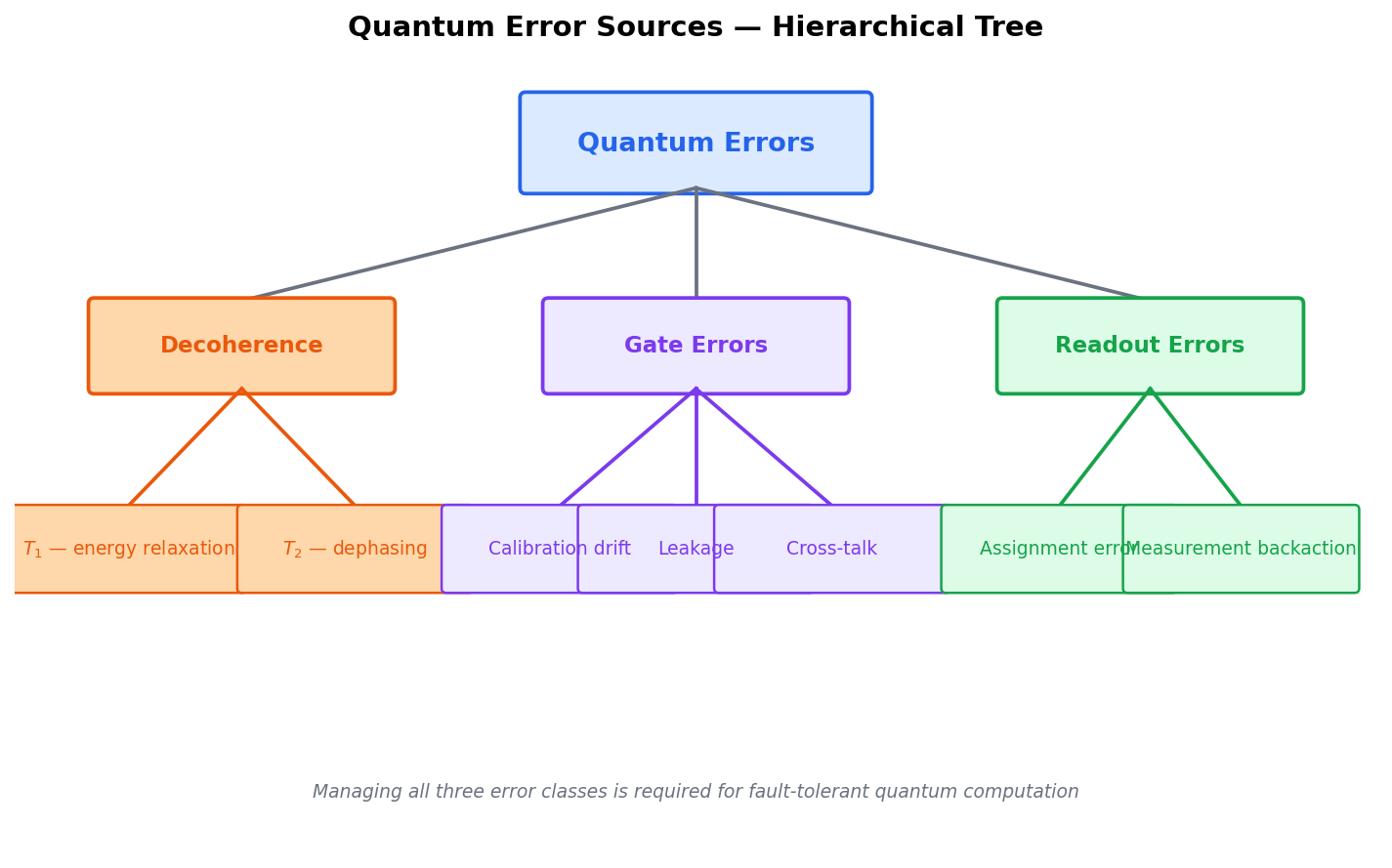
Technical Explanation
We categorize physical hardware errors into four primary classes:
1. SPAM (State Preparation and Measurement) Errors: State preparation error $\epsilon_{\text{prep}}$ is the probability that the initialized state is not exactly $|0\rangle$. Measurement error $\epsilon_{\text{meas}}$ is the probability of reading out $|1\rangle$ when the state was $|0\rangle$ (false positive, $P(1|0)$) or reading $|0\rangle$ when the state was $|1\rangle$ (false negative, $P(0|1)$).
2. Coherent Control Errors: These are systematic errors in the control pulses. For example, an over-rotation error occurs when a pulse designed to perform a $\pi$-rotation (an $X$ gate) actually performs a $(\pi + \delta)$-rotation. The unitary operator becomes $U = e^{-i(\pi + \delta)\sigma_x / 2}$, leading to a state fidelity loss proportional to $\delta^2$.
3. Crosstalk: This occurs when a control signal intended for Qubit $A$ inadvertently affects Qubit $B$. Mathematically, if we apply a drive $H_A = \Omega_A \sigma_x^{(A)}$, the effective Hamiltonian includes a parasitic term $H_{\text{cross}} = \epsilon \Omega_A \sigma_x^{(B)}$ on the neighboring qubit, causing unwanted rotations.
4. Leakage: Qubits are typically constructed from physical systems with many energy levels (e.g., transmons have levels $|0\rangle, |1\rangle, |2\rangle, \dots$). Leakage is the transition of population out of the computational subspace $\{|0\rangle, |1\rangle\}$ into higher-excited states like $|2\rangle$. Because control pulses are tuned to the $|0\rangle \to |1\rangle$ transition, once a qubit leaks to $|2\rangle$, it no longer responds correctly to gates, acting as a 'dead' qubit for the rest of the computation.