Why Errors Matter
Quantum errors are continuous amplitude and phase rotations, far more complex than classical binary bit flips
Source: mortalapps.com- Physical quantum systems are highly sensitive to environmental noise, leading to decoherence and computational errors.
- Quantum errors are more complex than classical errors, consisting of both bit flips (X) and phase flips (Z), as well as continuous rotations.
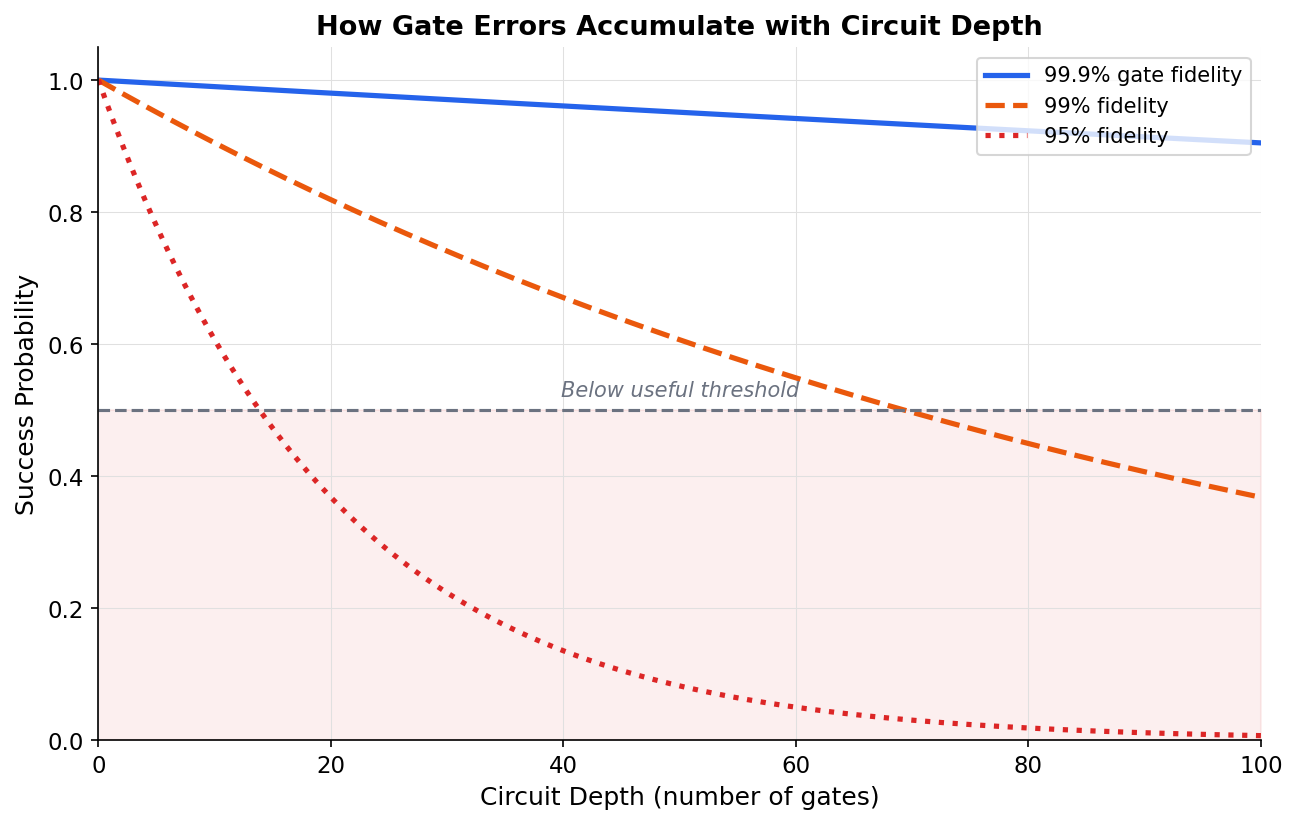
- The success probability of a quantum circuit decays exponentially as the total gate count increases.
- Even with a high physical gate fidelity of 99.9%, a circuit with 1,000 gates has only a 36.8% chance of returning an uncorrupted result.
- The No-Cloning Theorem prevents the direct application of classical repetition codes to quantum states.
- Current NISQ-era quantum computers are strictly limited in circuit depth due to the compounding nature of physical gate errors.
- Transitioning to fault-tolerant quantum computing is the only viable path to executing deep, useful quantum algorithms.
Why This Matters
In the previous sections, we explored the remarkable theoretical capabilities of quantum algorithms and the physical architectures designed to run them. However, a stark reality separates the elegant mathematical formulations of quantum gates from the physical hardware operating in laboratories today. This reality is defined by quantum noise, environmental decoherence, and imperfect control systems that introduce errors into quantum computations. Understanding why these errors occur and how they compound is the first critical step toward building practical, large-scale quantum computers.
Every physical system is subject to noise, but quantum systems are uniquely sensitive due to the fragile nature of superposition and entanglement. Even the slightest interaction with the surrounding environment, such as thermal fluctuations, electromagnetic interference, or material defects, can destroy the delicate quantum states holding our computational data. This phenomenon, known as decoherence, acts as a constant, destructive force that limits the duration and depth of any quantum calculation we attempt to run.
This topic will establish the quantitative foundation of quantum error rates and demonstrate how minor physical imperfections compound exponentially over time. By analyzing the mathematical relationship between gate fidelity, circuit depth, and success probability, you will understand why current Noisy Intermediate-Scale Quantum (NISQ) devices cannot execute deep quantum circuits. This realization shifts our focus from merely building more physical qubits to developing robust methods for protecting quantum information.
Core Intuition
To understand why quantum errors are so catastrophic, imagine playing a game of 'Chinese Whispers' (or Telephone) where a message is passed down a long line of people. If each person has a $99\%$ chance of hearing and repeating the message perfectly, a short chain of three or four people will likely preserve the original message. However, if the chain grows to one thousand people, the probability of the final message being correct drops to almost zero because the small $1\%$ error rate compounds at every single step. In a quantum computer, each gate operation is like a person passing the message, and a deep circuit represents a very long chain where errors inevitably accumulate.
Another helpful analogy is a leaky bucket used to transport water over a long distance. Each small hole in the bucket represents a source of physical noise, such as thermal dephasing or amplitude damping. If you only need to carry the water a few feet, the leak is negligible, and you will arrive with a nearly full bucket. But if you must walk several miles, analogous to running a complex quantum algorithm with thousands of sequential gates, the bucket will be completely empty long before you reach your destination, leaving you with nothing but useless noise.
In classical computing, we rarely worry about this because classical transistors are incredibly robust, boasting error rates lower than $10^{-18}$ per gate operation. Classical bits are represented by billions of electrons, making them highly resistant to minor thermal fluctuations. Quantum bits, however, are microscopic single-particle systems where a single stray photon or thermal phonon can completely flip the state, making them billions of times more fragile than their classical counterparts.
Visualization
Technical Explanation
Quantitatively, the survival of a quantum computation depends on the fidelity of its individual operations. Let $F_g$ represent the average fidelity of a single-qubit or two-qubit gate, where the error rate per gate is defined as $\epsilon = 1 - F_g$. If we assume for simplicity that errors occur independently and with equal probability across all gates, the probability of executing a quantum circuit containing $N$ gates without a single error is given by the exponential relation:
$$P_{\text{success}} = (1 - \epsilon)^N = F_g^N$$
Consider a modest quantum circuit with $N = 1,000$ gates. If we use state-of-the-art physical qubits with a gate fidelity of $F_g = 99.9\%$ (or $\epsilon = 10^{-3}$), the probability of obtaining a correct, error-free result at the end of the computation is:
$$P_{\text{success}} = (0.999)^{1000} \approx 36.8\%$$
If we scale the circuit to $N = 10,000$ gates, which is still far below what is required for useful algorithms like Shor's or Grover's, the success probability plummets to:
$$P_{\text{success}} = (0.999)^{10000} \approx 0.0045\%$$
This exponential decay demonstrates that physical gate errors quickly render any complex quantum computation entirely useless, as the output becomes indistinguishable from random noise. Furthermore, quantum noise is not limited to simple bit flips ($|0\rangle \leftrightarrow |1\rangle$, represented by the Pauli $X$ operator); it also includes phase flips ($|0\rangle + |1\rangle \leftrightarrow |0\rangle - |1\rangle$, represented by the Pauli $Z$ operator), and continuous rotation errors that cannot be easily corrected by classical voting schemes.