Matrix Basics
Every quantum gate is a matrix, and matrix structure is the foundation for expressing all quantum operations
Source: mortalapps.com- A matrix is a rectangular array of numbers arranged in rows and columns, representing transformations or operations.
- The size of a matrix is defined by its number of rows and columns (e.g., $2 \times 2$).
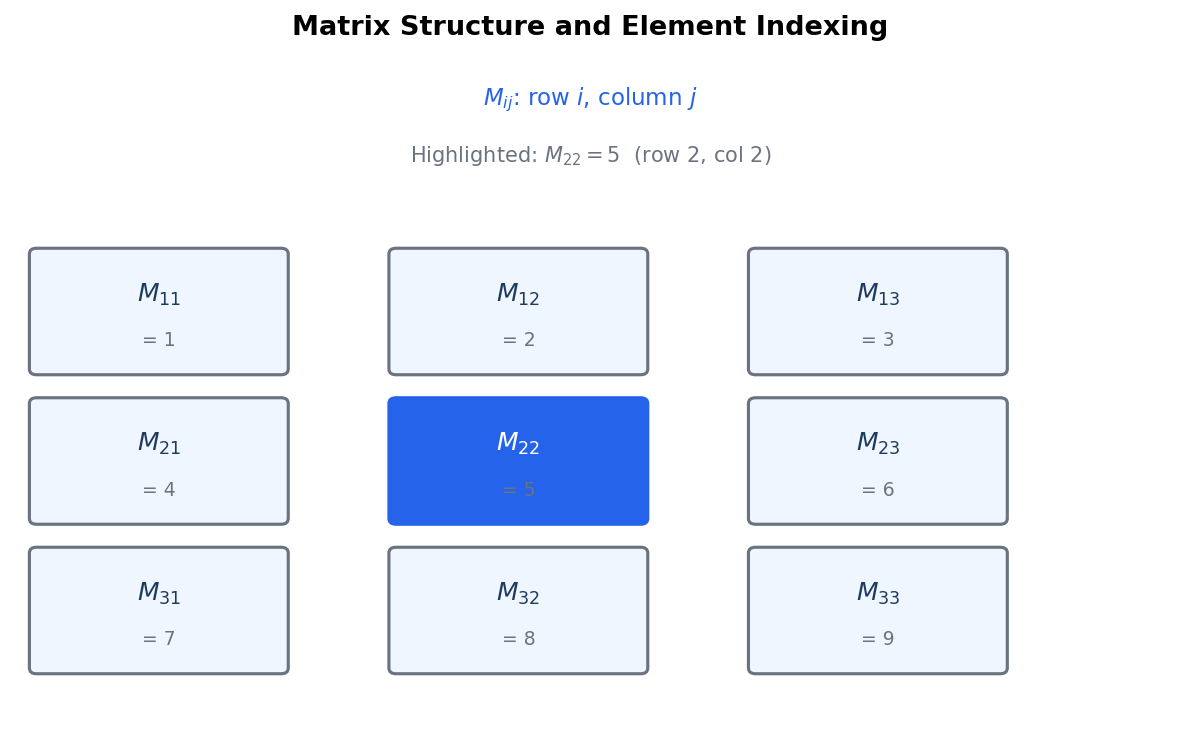
- Individual elements in a matrix are identified by their row and column indices, $A_{ij}$.
- Matrices can be added or subtracted element-wise if they have the same dimensions.
- Scalar multiplication involves multiplying every element of a matrix by a single number.
- The identity matrix ($I$) is a special matrix that leaves other matrices or vectors unchanged upon multiplication.
Why This Matters
In quantum computing, we don't just observe static qubit states; we manipulate them using quantum gates. These gates are the fundamental operations that transform a qubit from one state to another. To mathematically describe these transformations, we use matrices. Matrices are powerful tools that can represent actions, changes, or mappings in a structured way.
Understanding matrices is essential because every quantum gate, from a simple NOT gate to more complex operations, is represented by a specific matrix. When a gate acts on a qubit, it's equivalent to multiplying a matrix by the qubit's state vector.
By the end of this topic, you will understand what a matrix is, how its elements are organized, and how basic matrix operations work, setting the stage for understanding how quantum gates transform qubit states.
Core Intuition
Imagine a spreadsheet or a grid of numbers. That's essentially what a matrix is: a rectangular array of numbers arranged in rows and columns. But a matrix is more than just a table; it's a mathematical entity that can represent a transformation or an operation.
Think of a matrix as a 'machine' that takes an input (like a vector) and produces an output (a new, transformed vector). For example, a matrix could represent a command to 'rotate everything by 90 degrees' or 'stretch everything by a factor of two.' It's a compact way to encode a set of rules for how things should change.
Another analogy is a lens. When you look through a lens, it transforms the image you see – it might magnify it, flip it, or distort it. A matrix acts like such a lens on mathematical objects, systematically transforming them according to its internal structure. This idea of a matrix as a transformer is central to its role in quantum computing.
Visualization
Technical Explanation
A matrix is a rectangular array of numbers, symbols, or expressions, arranged in rows and columns. The 'size' or 'dimension' of a matrix is given by the number of rows by the number of columns (e.g., a $2 \times 2$ matrix has 2 rows and 2 columns). For a single qubit, quantum gates are typically represented by $2 \times 2$ matrices.
Each entry in a matrix is called an 'element,' and it's identified by its row and column index. For a matrix $A$, the element in the $i$-th row and $j$-th column is denoted $A_{ij}$. For example, a $2 \times 2$ matrix $A$ looks like: $$A = \begin{pmatrix} A_{11} & A_{12} \\ A_{21} & A_{22} \end{pmatrix}$$
Just like with numbers and vectors, we can perform basic operations on matrices:
- Matrix Addition/Subtraction: To add or subtract two matrices, they must have the same dimensions. You simply add or subtract their corresponding elements.
- Scalar Multiplication: To multiply a matrix by a scalar (a single number), you multiply every element in the matrix by that scalar.
Two special matrices are important:
- Zero Matrix ($0$): A matrix where all elements are zero. It acts like the number zero in addition.
- Identity Matrix ($I$): A square matrix (same number of rows and columns) with ones on the main diagonal (from top-left to bottom-right) and zeros everywhere else. When multiplied by another matrix or vector, it leaves it unchanged. For a $2 \times 2$ matrix, it is: