Real-World Quantum Industry
The quantum industry spans hardware makers, SDK developers, and application builders across public and private sectors
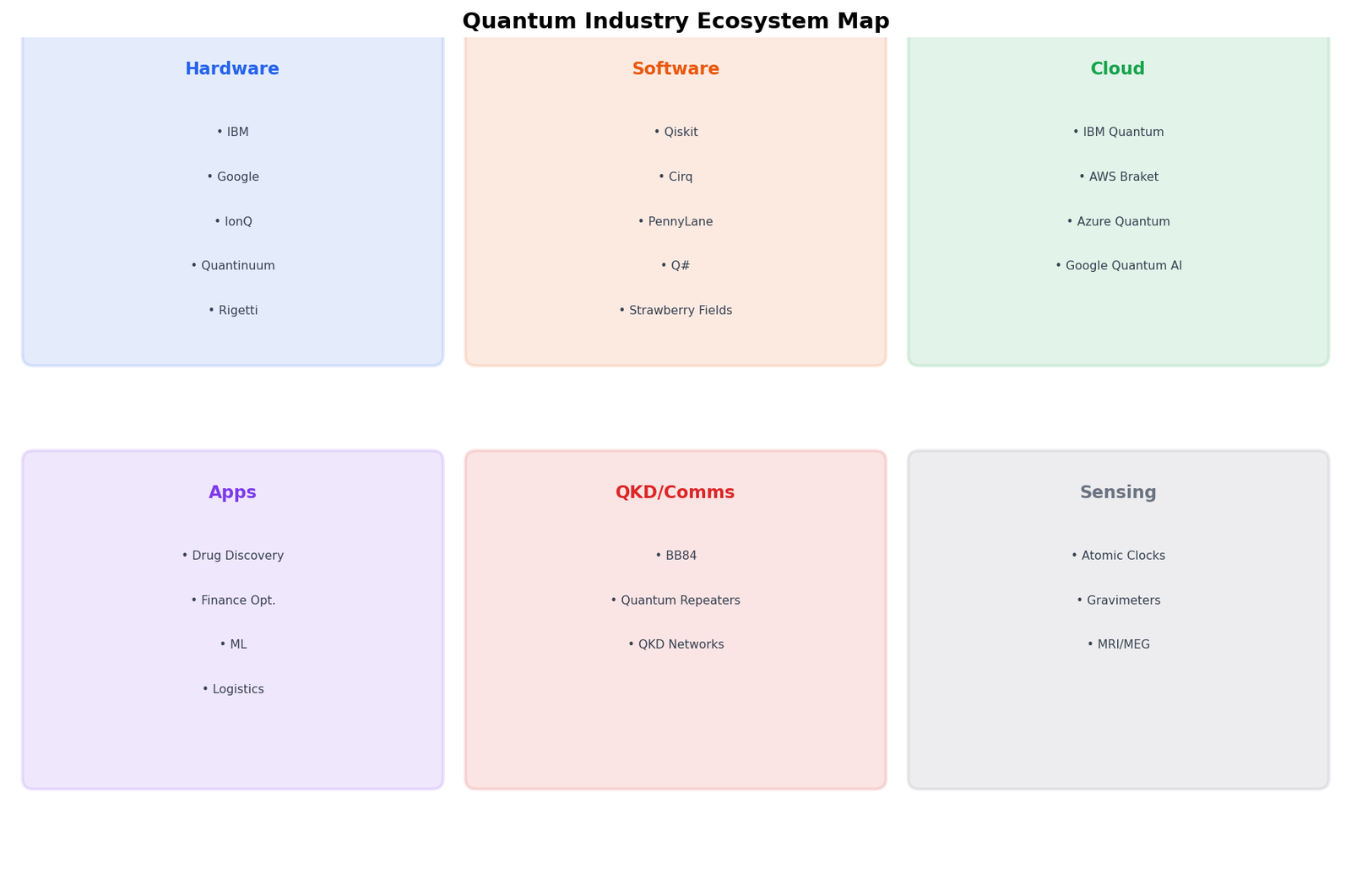
Source: mortalapps.com- The quantum industry is a rapidly growing ecosystem involving diverse players.
- Key players include hardware developers (IBM, Google, IonQ), software developers (Qiskit, Cirq), and application developers.
- Major tech giants, innovative startups, academic institutions, and governments are all investing heavily.
- Companies like Merck, JP Morgan Chase, and BMW are exploring quantum applications in their industries.
- Cloud platforms (IBM Quantum, Azure Quantum) are making quantum computers accessible.
- The industry is highly collaborative, with a global focus on advancing quantum technology.
- Quantum computing is moving from theoretical research to tangible real-world impact.
Why This Matters
We've journeyed from the limits of classical computing to the mind-bending concepts of superposition and entanglement, culminating in the idea of quantum advantage. You now understand the 'why' and 'what' of quantum computing's existence. But who is actually building these machines, developing the algorithms, and exploring their applications?
This topic will introduce you to the vibrant and rapidly expanding real-world quantum industry. We'll explore the key players – from tech giants to innovative startups, academic powerhouses, and government initiatives – that are driving the quantum revolution. You'll see that quantum computing is no longer just a theoretical concept; it's a tangible field with significant investment and real-world impact.
By the end of this topic, you'll have a clear overview of the quantum ecosystem, recognizing the diverse roles and collaborations that are accelerating the development and adoption of this transformative technology.
Core Intuition
Imagine a new type of car that can fly. It's a revolutionary idea! But to make it a reality, you don't just need one brilliant inventor. You need companies to design the engines, factories to build the parts, software engineers to create the navigation systems, pilots to fly them, and even new regulations for air traffic control.
Quantum computing is similar. It's not just about building a quantum processor in a lab. It requires a whole ecosystem: hardware manufacturers to build the qubits, software developers to write quantum algorithms, cloud providers to offer access to quantum computers, researchers to discover new applications, and industries to adopt and integrate this technology. It's a massive collaborative effort, much like the early days of classical computing or the internet.
Think of it as a complex orchestra. Each section – strings, brass, percussion – plays a vital role, and they all need to work together to create a symphony. The quantum industry is that orchestra, with different players contributing their unique expertise to bring quantum computing to life.
Visualization
Technical Explanation
The quantum computing industry is a rapidly evolving ecosystem comprising various players, each contributing to different aspects of the technology's development and deployment.
1. Hardware Developers: These companies focus on building the actual quantum processors, which involve creating and controlling qubits. Key players include:
- IBM: A pioneer in superconducting qubits, offering cloud access to its quantum systems (IBM Quantum).
- Google Quantum AI: Known for its Sycamore processor and achieving quantum advantage, also using superconducting qubits.
- IonQ: A leader in trapped ion quantum computers, providing cloud-based access.
- Quantinuum (a merger of Honeywell Quantum Solutions and Cambridge Quantum): Another major player in trapped ion technology and quantum software.
- Rigetti Computing: Develops superconducting quantum computers and a full-stack quantum computing platform.
- Intel: Researching silicon spin qubits and superconducting qubits for scalability.
2. Software and Algorithm Developers: These companies and groups focus on creating the tools, programming languages, and algorithms that run on quantum hardware. Examples include:
- Qiskit (IBM): An open-source quantum computing framework.
- Cirq (Google): Another open-source framework for quantum programming.
- Microsoft Azure Quantum: Provides a cloud platform with access to various quantum hardware and software tools.
- Xanadu (PennyLane): An open-source quantum software framework for quantum machine learning and variational algorithms.
3. Application Developers and End-Users: These are the industries and organizations exploring how to apply quantum computing to their specific problems. This includes:
- Pharmaceuticals: Merck, Boehringer Ingelheim.
- Finance: JP Morgan Chase, Goldman Sachs.
- Materials Science: BMW, Airbus.
- Logistics: Volkswagen.
- Energy: ExxonMobil.
4. Academic and Government Research: Universities and national labs play a crucial role in fundamental research, talent development, and setting standards. Examples include:
- QuTech (Netherlands): A leading research center for quantum technology.
- Institute for Quantum Computing (Canada): A major academic hub.
- National Quantum Initiative (USA): A government program funding quantum R&D.
- European Quantum Flagship: A large-scale EU initiative.
This diverse ecosystem fosters innovation, drives technological advancements, and works towards making quantum computing a practical reality for solving some of the world's most challenging problems.