Trapped Ion Systems
Trapped ion qubits are identical natural atoms in vacuum, offering long coherence times and all-to-all connectivity
Source: mortalapps.com- Trapped ion qubits are individual, identical natural atoms suspended in a vacuum by electric fields.
- Qubits are encoded in the stable hyperfine ground states of the ions, offering exceptionally long coherence times.
- Single-qubit gates are performed using targeted laser pulses, while two-qubit gates use shared motional modes (phonons) as a bus.
- The Mølmer-Sørensen gate is the standard entangling gate, utilizing spin-dependent forces to entangle the ions.
- Trapped ions offer all-to-all connectivity within a single chain, eliminating the need for compiler SWAP gates.
- The primary trade-offs of trapped ions are slow gate speeds (10-100 us) and the complexity of scaling up the laser control systems.
Why This Matters
Trapped ion quantum computing is one of the oldest and most successful hardware architectures. Instead of fabricating artificial qubits on a chip, this approach uses individual, naturally occurring atoms (typically Ytterbium or Calcium) that have been stripped of one electron to become positively charged ions. These ions are suspended in a vacuum chamber by oscillating electric fields and manipulated with highly precise laser beams. Because every ion of a given isotope is absolutely identical, trapped ion systems avoid the fabrication defects that plague solid-state architectures.
Core Intuition
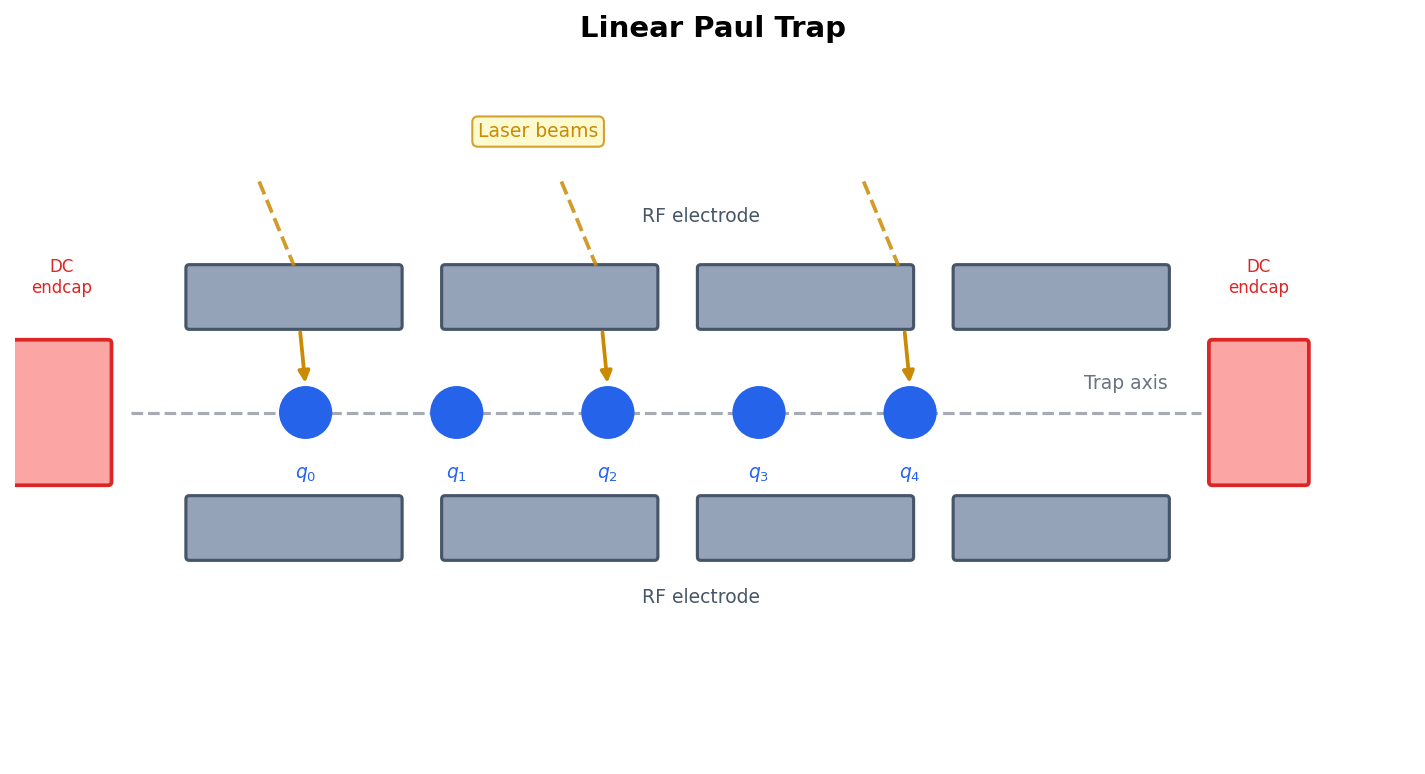
To understand a trapped ion quantum computer, imagine a row of marbles sitting in an invisible, vibrating bowl. The bowl is created by electric fields (a Paul trap) that keep the marbles suspended in a straight line in the middle of a vacuum chamber. Because the marbles are all positively charged, they repel each other, keeping a precise, equal distance between them.
Each marble represents a single ion, and its qubit state is stored in the internal spin of its valence electron (pointing up for $|1\rangle$ or down for $|0\rangle$). To perform a single-qubit gate, we shine a laser beam on a single marble, flipping its spin. To perform a two-qubit gate, we must make two marbles talk to each other. Since they cannot touch, we use their shared physical motion. If we gently push the first marble with a laser, it vibrates, and its electrostatic repulsion pushes the second marble, causing it to vibrate as well. This shared vibration (called a phonon mode) acts as a physical bus that allows us to entangle the qubits.
Visualization
Technical Explanation
In trapped ion systems, ions are confined using a Paul trap (or radio-frequency quadrupole trap), which uses a combination of static (DC) and oscillating (RF) electric fields to create a dynamic three-dimensional potential well. The qubits are typically encoded in the hyperfine ground states of the ions (e.g., $^{171}\text{Yb}^+$), which have a transition frequency in the microwave regime (e.g., $12.6\text{ GHz}$ for Ytterbium).
The Hamiltonian of a single trapped ion coupled to a laser field can be written in the rotating frame as: $$H = \frac{\hbar \Omega}{2} \left( \sigma_+ e^{i(\eta(a + a^dagger) - \delta t)} + \sigma_- e^{-i(\eta(a + a^dagger) - \delta t)} \right)$$ where $\Omega$ is the Rabi frequency (proportional to laser intensity), $\sigma_\pm$ are the qubit raising and lowering operators, $a^\dagger$ and $a$ are the creation and annihilation operators for the ion's motional mode (phonons), $\delta$ is the laser detuning from the atomic transition, and $\eta$ is the Lamb-Dicke parameter, which measures the coupling strength between the ion's internal spin and its external motion: $$\eta = k \sqrt{\frac{\hbar}{2 M \nu}}$$ where $k$ is the laser wavenumber, $M$ is the ion mass, and $\nu$ is the trap vibrational frequency.
Two-qubit gates are typically performed using the Mølmer-Sørensen (MS) gate. By applying a bichromatic laser field detuned near the motional sidebands, the MS gate drives transitions that entangle the spin states of two ions via the shared motional bus, executing a symmetric entangling gate (equivalent to a CNOT up to single-qubit rotations) without requiring individual addressing of the motional states.
Key hardware parameters for trapped ions:
- T1 (Energy Relaxation): Practically infinite (days)
- T2 (Dephasing): $1 - 100\text{ seconds}$
- Gate Fidelity: Single-qubit $> 99.99\%$, Two-qubit $> 99.9\%$
- Connectivity: All-to-all within a single trap module
- Operating Temperature: Room temperature vacuum chamber (ions laser-cooled to $\sim 10\ \mu\text{K}$)
- Gate Speed: $10 - 100\ \mu\text{s}$