Quantum Weirdness
Superposition, entanglement, and the observer effect produce behavior that defies every classical intuition we have
Source: mortalapps.com- Quantum weirdness refers to phenomena like superposition, entanglement, and the observer effect that defy classical intuition.
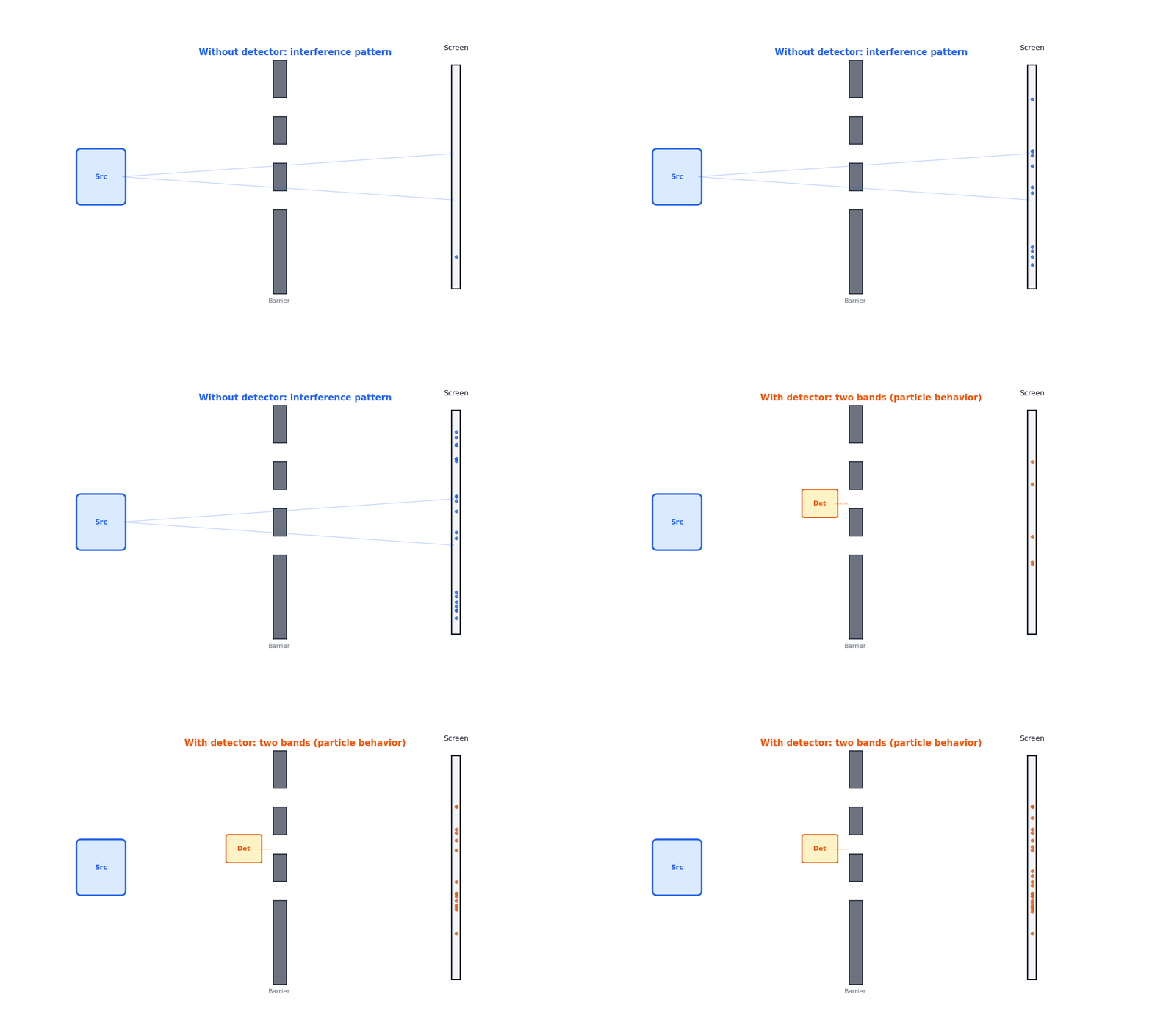
- The double-slit experiment shows particles behaving like waves (superposition) when unobserved, and like particles when observed.
- The observer effect means that gaining information about a quantum system forces it to collapse from superposition to a definite state.
- In the quantum world, reality is not fixed until it is measured or observed.
- This 'weirdness' is not a flaw, but a fundamental property of nature that quantum computers exploit.
- Harnessing quantum weirdness allows quantum computers to process information in fundamentally new and powerful ways.
Why This Matters
You've now encountered superposition and entanglement – two concepts that probably feel deeply counter-intuitive. Particles existing in multiple states at once? Instantaneous connections across vast distances? It's natural to feel a bit bewildered. This feeling is often referred to as 'quantum weirdness,' and it's a hallmark of the quantum world.
This topic is dedicated to embracing that weirdness. We'll explore more examples of how quantum mechanics defies our everyday intuition, particularly through the famous double-slit experiment and the concept of the 'observer effect.' The goal isn't to make it less weird, but to help you appreciate *why* it's weird and *why* that weirdness is a powerful computational resource.
By the end of this topic, you'll understand that the 'weirdness' isn't a bug; it's a feature. It's the very foundation upon which quantum computers build their unique capabilities, allowing them to solve problems that classical machines cannot.
Core Intuition
Imagine you're throwing tennis balls at a wall with two slits. The balls either go through the left slit or the right slit, creating two distinct piles behind the wall. This is how classical objects behave: they pick one path.
Now, imagine you're throwing *quantum* tennis balls (like electrons). If you throw them one by one, you'd expect them to go through either the left or right slit. But surprisingly, they behave like waves, creating an interference pattern – bright and dark bands – on the wall behind, as if each ball went through *both* slits at once and interfered with itself! It's like a single person walking through two doors at the same time and then meeting themselves on the other side.
Even stranger, if you try to *watch* which slit the quantum tennis ball goes through, it suddenly stops behaving like a wave and acts like a classical ball, picking just one slit. The act of observation changes its behavior. It's as if the universe is playing hide-and-seek, and the rules change when you look. This is the essence of quantum weirdness: particles can be in multiple places or states, and observing them forces them to 'choose' one.
Visualization
Technical Explanation
Quantum weirdness refers to the collection of phenomena in quantum mechanics that defy classical intuition. These include superposition, entanglement, and the observer effect, which collectively highlight that the quantum world operates under rules vastly different from our macroscopic experience.
One of the most famous demonstrations of this weirdness is the double-slit experiment. When tiny particles like electrons or photons are fired one by one at a barrier with two slits, they don't behave like tiny bullets. Instead, they create an interference pattern on a screen behind the barrier, just like waves would. This suggests that each particle somehow passes through *both* slits simultaneously and interferes with itself, a direct manifestation of superposition.
However, the weirdness deepens with the observer effect. If we place a detector at the slits to determine which path each particle takes, the interference pattern disappears. The particles suddenly behave like classical bullets, choosing only one slit. The act of measurement or observation forces the quantum system to 'collapse' from its superposition of possibilities into a single, definite state. This isn't about the detector physically blocking the path; it's about gaining information about the system.
This means that in the quantum realm, reality isn't fixed until it's observed. Before observation, particles exist in a fuzzy cloud of probabilities. This is a profound departure from classical physics, where objects have definite properties whether we look at them or not.
Entanglement, as we discussed, adds another layer of weirdness by linking these probabilistic states across distances. The combined effect of superposition, entanglement, and the observer effect means that quantum systems can explore and process information in a fundamentally non-classical way. They don't just compute; they *are* the computation, leveraging the inherent probabilistic and interconnected nature of reality at its most fundamental level. This 'weirdness' is precisely the resource that quantum computers exploit to solve problems intractable for classical machines.