Basis States, |0⟩ and |1⟩
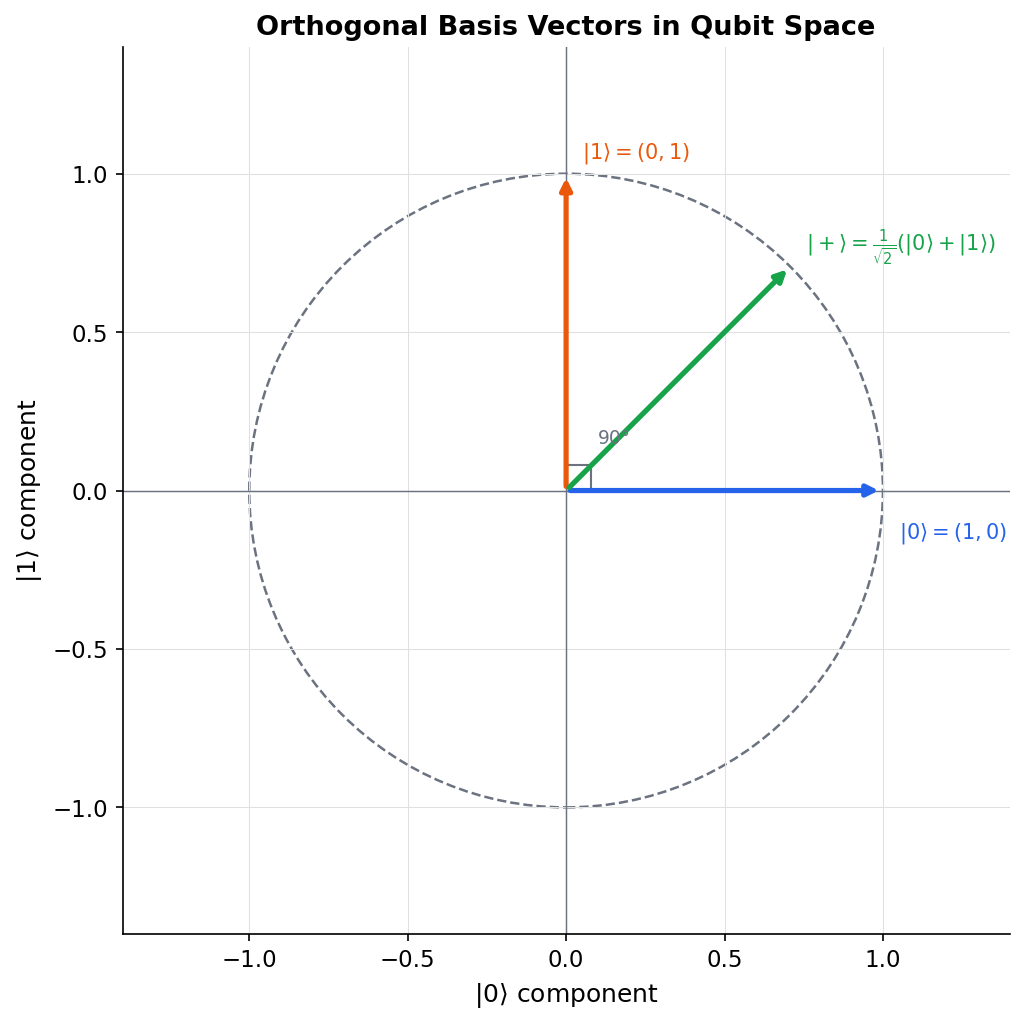
The computational basis states |0> and |1> are orthonormal coordinate axes that every qubit superposition is built from
Source: mortalapps.com- The computational basis states |0⟩ and |1⟩ are the standard coordinate axes of a qubit's state space.
- Mathematically, |0⟩ is represented by the column vector [1, 0]^T, and |1⟩ is represented by [0, 1]^T.
- These states are orthonormal, meaning they are normalized to unit length and are orthogonal to each other.
- The inner product ⟨0|1⟩ is exactly 0, proving their mathematical orthogonality.
- Because they are linearly independent, they span the entire two-dimensional complex vector space C².
- Any single-qubit state can be written as a unique linear combination of these two basis states.
Why This Matters
In any vector space, we need a frame of reference to define coordinates and perform calculations. For a qubit, this frame of reference is provided by the computational basis states, denoted as $|0\rangle$ and $|1\rangle$. These two states represent the standard, definite classical outcomes of our quantum system. They are the foundation upon which all quantum superpositions are built, acting as the fundamental 'North' and 'South' poles of our quantum universe.
This topic focuses on the mathematical and physical properties of these basis states. We will explore why they are chosen, how they are represented as column vectors, and what it means for them to be orthogonal. Understanding these states in their purest form is essential for grasping how quantum gates manipulate information and how measurements collapse complex states back into classical certainty.
By the end of this topic, you will be able to write the matrix representations of $|0\rangle$ and $|1\rangle$, perform basic vector operations with them, and explain the physical meaning of orthogonality in quantum mechanics. This will solidify your ability to navigate the coordinate systems of quantum state spaces.
Core Intuition
Think of a standard map. To describe any location on Earth, we use a coordinate system based on two primary directions: North-South and East-West. These directions are perpendicular (orthogonal) to each other. If you travel directly North, you are making zero progress East. They are completely independent. In the state space of a qubit, $|0\rangle$ and $|1\rangle$ are the equivalent of these independent, perpendicular directions.
Another analogy is the primary colors of light. If we use a red-green-blue system, Red and Green are independent channels. A pure red light contains absolutely no green light. In quantum terms, the state of being 'pure red' is completely orthogonal to the state of being 'pure green'. The computational basis states $|0\rangle$ and $|1\rangle$ are the pure, unmixed primary colors of our qubit.
When we measure a qubit, we are forcing it to project itself onto one of these two perpendicular axes. Because they are perpendicular, a qubit that is purely in the $|0\rangle$ state has absolutely zero overlap with the $|1\rangle$ state. This complete independence is what allows us to read out a clear, unambiguous classical 0 or 1 at the end of a quantum computation.
Visualization
Technical Explanation
The computational basis states $|0\rangle$ and $|1\rangle$ are defined as the standard basis vectors of the two-dimensional complex vector space $\mathbb{C}^2$. Their column vector representations are:
$$|0\rangle = \begin{pmatrix} 1 \\ 0 \end{pmatrix}, \quad |1\rangle = \begin{pmatrix} 0 \\ 1 \end{pmatrix}$$
These vectors are orthonormal. This means they satisfy two conditions. First, they are normalized, meaning their inner product with themselves is 1:
$$\langle 0|0\rangle = \begin{pmatrix} 1 & 0 \end{pmatrix} \begin{pmatrix} 1 \\ 0 \end{pmatrix} = 1$$ $$\langle 1|1\rangle = \begin{pmatrix} 0 & 1 \end{pmatrix} \begin{pmatrix} 0 \\ 1 \end{pmatrix} = 1$$
Second, they are orthogonal, meaning their inner product with each other is 0:
$$\langle 0|1\rangle = \begin{pmatrix} 1 & 0 \end{pmatrix} \begin{pmatrix} 0 \\ 1 \end{pmatrix} = 0$$ $$\langle 1|0\rangle = \begin{pmatrix} 0 & 1 \end{pmatrix} \begin{pmatrix} 1 \\ 0 \end{pmatrix} = 0$$
Because these two vectors are linearly independent, they form a basis for $\mathbb{C}^2$. This means that *any* vector $|\psi\rangle$ in this space can be written as a unique linear combination of $|0\rangle$ and $|1\rangle$:
$$|\psi\rangle = \begin{pmatrix} \alpha \\ \beta \end{pmatrix} = \alpha \begin{pmatrix} 1 \\ 0 \end{pmatrix} + \beta \begin{pmatrix} 0 \\ 1 \end{pmatrix} = \alpha|0\rangle + \beta|1\rangle$$
This mathematical structure ensures that the computational basis is a complete and robust coordinate system for describing any single-qubit state.