Cryogenic Systems
Dilution refrigerators cool superconducting chips to 10-15 mK using helium-3 and helium-4 to suppress thermal noise
Source: mortalapps.com- Solid-state qubits must be cooled to 10-15 mK to suppress thermal noise and prevent spontaneous state decay.
- Dilution refrigerators use a mixture of Helium-3 and Helium-4 to achieve millikelvin temperatures.
- Cooling power is generated by forcing Helium-3 to cross the phase boundary from the concentrated to the dilute phase.
- The cooling power of a dilution refrigerator scales quadratically with temperature ($\dot{Q} \propto T^2$), leaving a tiny budget at 10 mK.
- Coaxial cables must be thermally anchored at every stage to intercept heat traveling from room temperature.
- Attenuators are used to cool the thermal blackbody radiation (photons) traveling down the control lines.
Why This Matters
For solid-state quantum processors (such as superconducting and silicon spin qubits), heat is the ultimate enemy. Thermal fluctuations represent random, uncontrolled energy that spontaneously excites and de-excites qubits, destroying quantum information. To prevent this, these processors must be cooled to temperatures colder than deep space, typically around 10 to 15 millikelvin (0.015 Kelvin above absolute zero). This extreme environment is created and maintained by an extraordinary piece of engineering: the dilution refrigerator.
Core Intuition
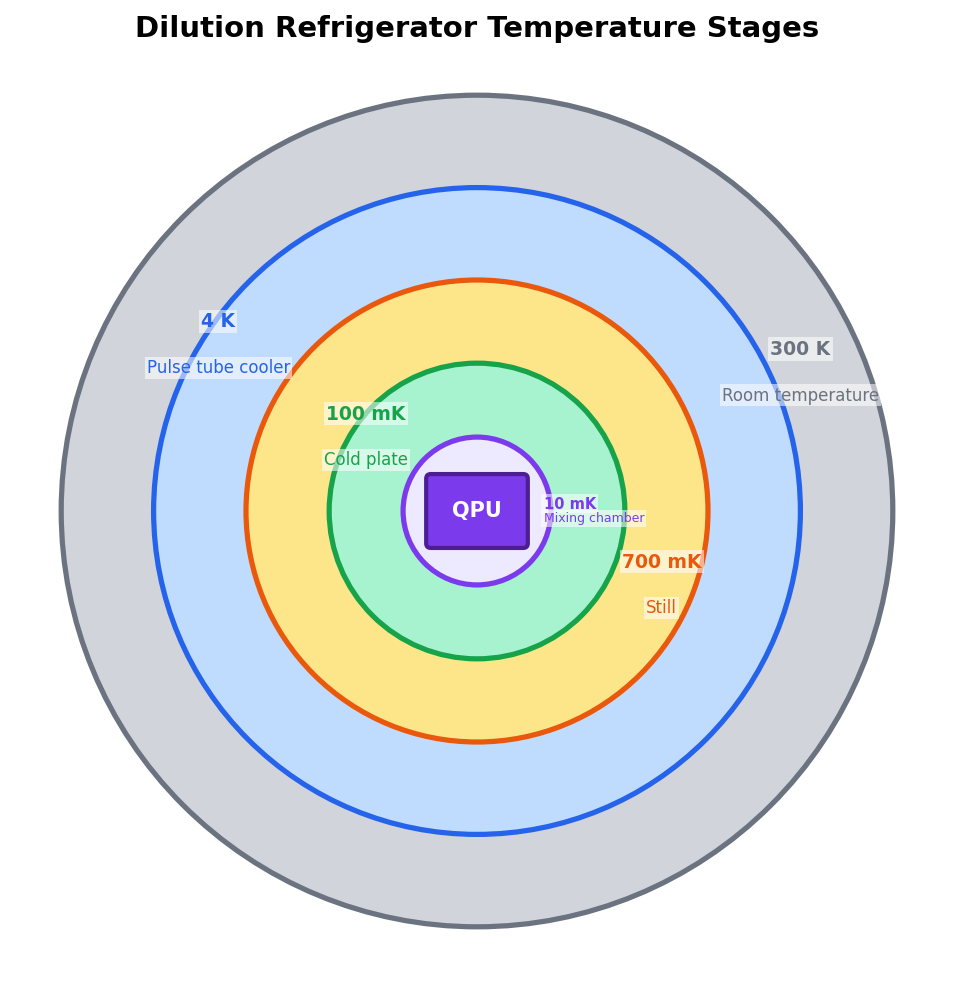
To understand how a dilution refrigerator works, imagine a multi-stage thermal elevator descending into a deep, freezing canyon. Each floor of the elevator is a gold-plated copper plate, and as you go down, the temperature drops exponentially. The top floor is at room temperature (300 K), the next is at 50 K, then 4 K, then 1 K, then 100 mK, and finally the basement at 10 mK.
To cool the basement to these extreme temperatures, we cannot use standard refrigeration techniques (like evaporating freon). Instead, we use a unique quantum fluid: a mixture of two isotopes of Helium, Helium-3 and Helium-4. When cooled below 0.8 Kelvin, this mixture spontaneously separates into two phases, like oil and water. By forcing Helium-3 atoms to 'evaporate' across the boundary from the concentrated phase into the dilute phase, we absorb heat from the surroundings. This process, called 'dilution cooling', is physically similar to how evaporating sweat cools your skin, but it operates at the quantum level near absolute zero.
Visualization
Technical Explanation
The physics of a dilution refrigerator relies on the unique thermodynamic properties of the $^3\text{He}/^4\text{He}$ mixture. Below the tri-critical point of $T \approx 0.87\text{ K}$, the mixture undergoes phase separation into a $^3\text{He}$-rich phase (the 'concentrated phase', which is pure liquid $^3\text{He}$) and a $^3\text{He}$-poor phase (the 'dilute phase', which is mostly superfluid $^4\text{He}$ with about $6.6\%$ dissolved $^3\text{He}$).
The cooling power $\dot{Q}$ of the mixing chamber (the coldest stage) is governed by the enthalpy difference of $^3\text{He}$ between the concentrated and dilute phases: $$\dot{Q} = \dot{n}_3 \left[ H_d(T) - H_c(T) \right]$$ where $\dot{n}_3$ is the molar circulation rate of $^3\text{He}$, $H_d(T)$ is the enthalpy of $^3\text{He}$ in the dilute phase, and $H_c(T)$ is the enthalpy in the concentrated phase. At low temperatures ($T < 100\text{ mK}$), the enthalpies scale quadratically with temperature: $$H_d(T) \approx 84 T^2\ \text{J/mol}\cdot\text{K}^2$$ $$H_c(T) \approx 22 T^2\ \text{J/mol}\cdot\text{K}^2$$ Substituting these values gives the fundamental cooling power equation: $$\dot{Q} \approx 62 \dot{n}_3 T^2\ \text{W}$$
This quadratic dependence ($\dot{Q} \propto T^2$) means that as the temperature $T$ approaches absolute zero, the cooling power drops dramatically. At $10\text{ mK}$, a typical commercial dilution refrigerator has a cooling power of only $10 - 20\ \mu\text{W}$. This is an incredibly tiny heat budget, even a single microwatt of stray heat from control cables or thermal radiation can cause the refrigerator to warm up, destroying the quantum state of the processor.