Threshold Theorem
If physical error rates stay below a critical value, the Threshold Theorem guarantees arbitrary-depth computation
Source: mortalapps.com- The Threshold Theorem proves that arbitrary-depth quantum computations are possible if physical error rates are below a critical threshold.
- The fault-tolerance threshold (\epsilon_{th}) is a mathematical tipping point, analogous to a physical phase transition.
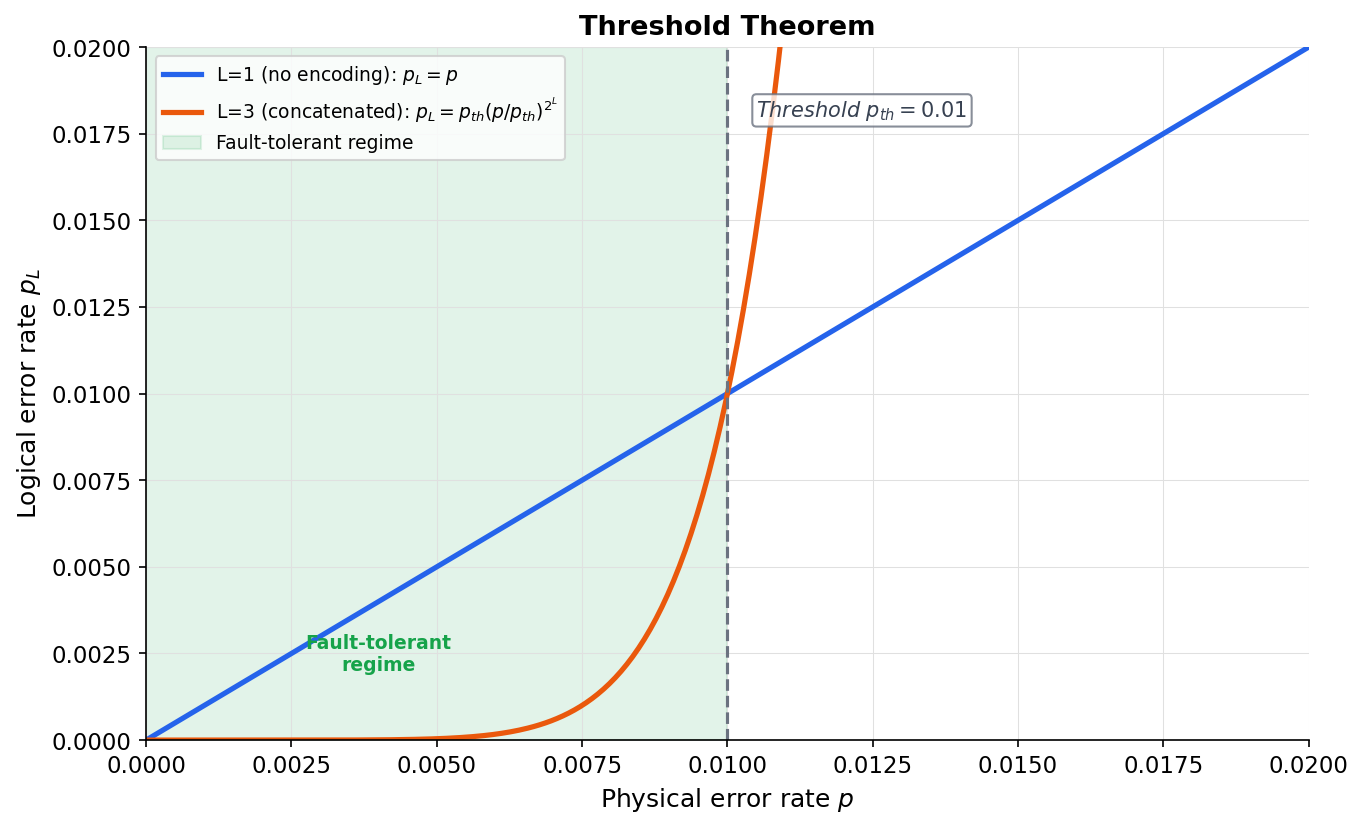
- If physical error rates are above the threshold, scaling up the code distance increases the logical error rate, leading to failure.
- If physical error rates are below the threshold, scaling up the code distance exponentially suppresses the logical error rate.
- For the standard 2D surface code, the threshold is approximately 1% under idealized noise models.
- Operating just barely below the threshold requires an impractically large physical qubit overhead.
- To build practical quantum computers, hardware developers aim to operate at least 5 to 10 times below the threshold value.
Why This Matters
The Threshold Theorem is the mathematical foundation of the entire quantum computing industry. Before this theorem was proven in the late 1990s, many prominent physicists believed that quantum computing was a practical impossibility. They argued that as a quantum computer scaled to include more qubits and gates, the accumulation of physical noise would inevitably grow faster than any capacity to correct it, eventually drowning the computation in chaos.
The Threshold Theorem shattered this pessimistic view. It mathematically proves that if the physical error rate of individual quantum gates is below a certain critical value, the fault-tolerance threshold, then we can make the logical error rate arbitrarily small by simply adding more physical qubits to our error-correcting code. In other words, once we cross this threshold, scaling up the hardware makes the computer *more* reliable, not less.
In this topic, we will explore the mathematics of the Threshold Theorem. We will analyze the threshold crossing curves, understand how the logical error rate scales with code distance, and examine the real-world threshold values for different architectures. This topic will reveal the exact target metrics that hardware developers must hit to unlock infinite quantum scaling.
Core Intuition
To understand the Threshold Theorem, imagine a classic phase transition in physics, such as water freezing into ice. At $1^{\circ}\text{C}$, water is a chaotic liquid. But as you lower the temperature below the critical threshold of $0^{\circ}\text{C}$, a sudden, dramatic transition occurs: the water molecules lock into a highly ordered, solid crystalline structure. The threshold is a tipping point where the global behavior of the system completely changes.
Another helpful analogy is a parachute. If you jump out of an airplane with a parachute that is too small (above the threshold of safe descent), adding more fabric to a poorly designed, tangled parachute will only make you fall faster and more dangerously. However, if your parachute design is solid and its drag coefficient is below the critical threshold for safe descent, then adding more fabric (increasing the size of the parachute) will exponentially slow your descent, guaranteeing a safe landing.
In quantum computing, the physical gate error rate is like that temperature or descent rate. If your physical error rate is *above* the threshold, adding more physical qubits to your code just introduces more noise, causing the system to fail faster. But if your physical error rate is *below* the threshold, adding more physical qubits acts like adding fabric to a good parachute: it exponentially suppresses the logical error rate, allowing you to run infinitely deep circuits safely.
Visualization
Technical Explanation
Mathematically, let $\epsilon_p$ represent the physical error rate per gate, and let $\epsilon_{th}$ represent the fault-tolerance threshold of the specific quantum error-correcting code. The Threshold Theorem states that if:
$$\epsilon_p < \epsilon_{th}$$
then there exists a family of quantum codes such that the logical error rate $\epsilon_L$ can be suppressed to any arbitrary target value $\delta > 0$. For a code with distance $d$, the logical error rate scales as:
$$\epsilon_L \approx C \left( \frac{\epsilon_p}{\epsilon_{th}} \right)^{\frac{d+1}{2}}$$
where $C$ is a constant of order $1$. Let us analyze the behavior of this equation:
1. Above Threshold ($\epsilon_p > \epsilon_{th}$): The ratio $\epsilon_p / \epsilon_{th}$ is greater than $1$. As we increase the code distance $d$ (adding more physical qubits), the term $(\epsilon_p / \epsilon_{th})^{(d+1)/2}$ grows larger. Scaling up the code *increases* the logical error rate, leading to rapid computational failure.
2. Below Threshold ($\epsilon_p < \epsilon_{th}$): The ratio $\epsilon_p / \epsilon_{th}$ is less than $1$. As we increase the code distance $d$, the term $(\epsilon_p / \epsilon_{th})^{(d+1)/2}$ decays exponentially toward zero. By choosing a sufficiently large $d$, we can make $\epsilon_L$ arbitrarily small, enabling computations of any desired depth.
For the 2D surface code, the threshold $\epsilon_{th}$ is approximately $1\%$ under idealized noise models, and around $0.5\%$ to $0.7\%$ when accounting for realistic measurement errors and phenomenological noise. This means that physical gate fidelities must be strictly greater than $99.0\%$ (ideally $>99.5\%$) for the surface code to function.