Control Electronics
Over 99% of a quantum computer is classical electronics, with FPGAs providing deterministic sub-nanosecond pulse timing
Source: mortalapps.com- Over 99% of a physical quantum computer consists of classical control electronics.
- FPGAs are the brain of the control stack, providing deterministic, sub-nanosecond timing control.
- DACs and AWGs convert digital gate descriptions into analog voltage pulses.
- IQ modulation is used to control both the amplitude and phase of microwave pulses, defining the rotation axis on the Bloch sphere.
- Cryogenic amplifiers (JPAs and HEMTs) are critical to amplify weak readout signals without adding thermal noise.
- Active error correction requires a closed-loop feedback latency that is significantly shorter than the qubit coherence time.
Why This Matters
A quantum computer is not purely quantum; in fact, over 99% of the physical hardware in a quantum data center consists of classical electronics. Physical qubits are passive elements that do nothing on their own. To perform a computation, we must actively drive them with highly precise classical electromagnetic pulses, and to read their states, we must capture and digitize weak analog signals. This topic explores the complex classical control stack that bridges the gap between high-level software code and the physical pulses that manipulate qubits.
Core Intuition
To understand the control stack, imagine a high-tech recording studio. The qubits are like the delicate strings of an acoustic piano inside a soundproof room. The classical control electronics are the automated mechanical fingers, microphones, and mixing boards outside the room.
When you write a line of code, it is like writing a musical score. The control stack must translate that score into precise electrical voltages (the mechanical fingers) that strike the strings at the exact microsecond required. To hear the result, the microphones must capture the tiny vibrations, amplify them, and convert them back into digital audio files. If the mechanical fingers are slightly off-time, or if the microphone has static, the music is ruined. In quantum computing, the 'fingers' are Arbitrary Waveform Generators (AWGs) and the 'microphones' are high-speed Analog-to-Digital Converters (ADCs).
Visualization
Technical Explanation
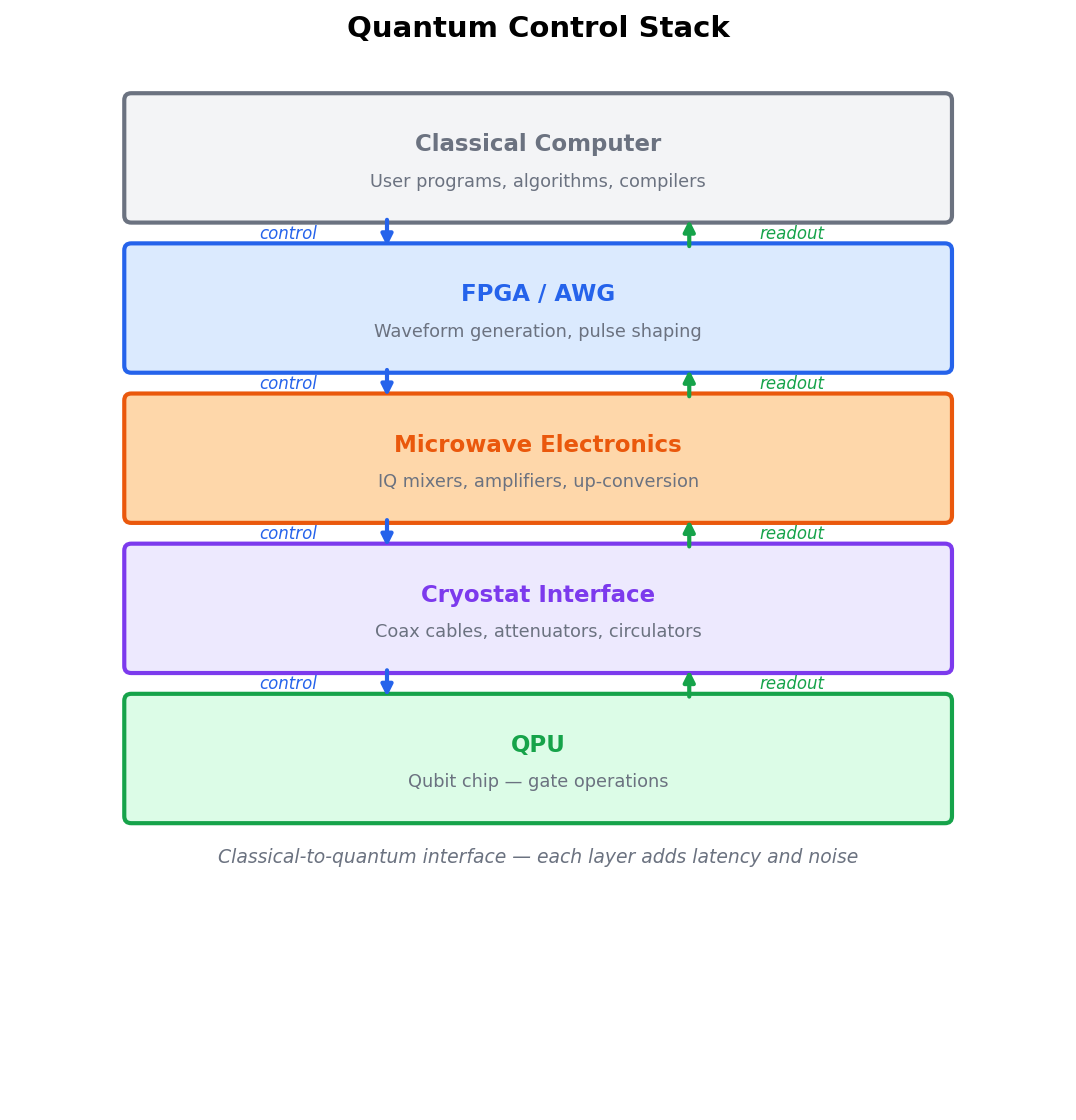
The classical control stack is organized into several distinct layers:
1. Software Layer: The user writes a circuit in a language like Qiskit or Cirq. This is compiled into a digital instruction set (such as OpenQASM). 2. Digital Processing Layer: A classical processor (often an FPGA or ASIC) interprets the instructions and schedules the exact timing of pulse execution. FPGAs are highly favored because they offer sub-nanosecond timing determinism. 3. Analog Generation Layer: Digital-to-Analog Converters (DACs) and Arbitrary Waveform Generators (AWGs) convert the digital pulse descriptions into analog voltage waveforms. For superconducting qubits, these pulses are modulated using IQ Mixers to shift the baseband pulse (typically $\sim 100\text{ MHz}$) up to the microwave carrier frequency ($\sim 5\text{ GHz}$): $$V(t) = I(t) \cos(\omega_c t) - Q(t) \sin(\omega_c t)$$ where $I(t)$ and $Q(t)$ are the in-phase and quadrature control envelopes, and $\omega_c$ is the carrier frequency. 4. Signal Conditioning Layer: The pulses travel down coaxial cables through attenuators (to suppress thermal noise) and bandpass filters (to remove out-of-band noise) before reaching the QPU. 5. Readout and Digitization Layer: The weak reflected signal from the readout resonator is amplified by cryogenic amplifiers (such as High Electron Mobility Transistors, or HEMTs, and Josephson Parametric Amplifiers, or JPAs) and sent back to room temperature, where an Analog-to-Digital Converter (ADC) digitizes the signal. The FPGA then performs digital demodulation and thresholding to determine if the qubit was in state $|0\rangle$ or $|1\rangle$.
This entire loop must operate within a strict latency budget (typically $< 1\ \mu\text{s}$) to enable active feedback loops, which are critical for quantum error correction.