Probability Amplitudes
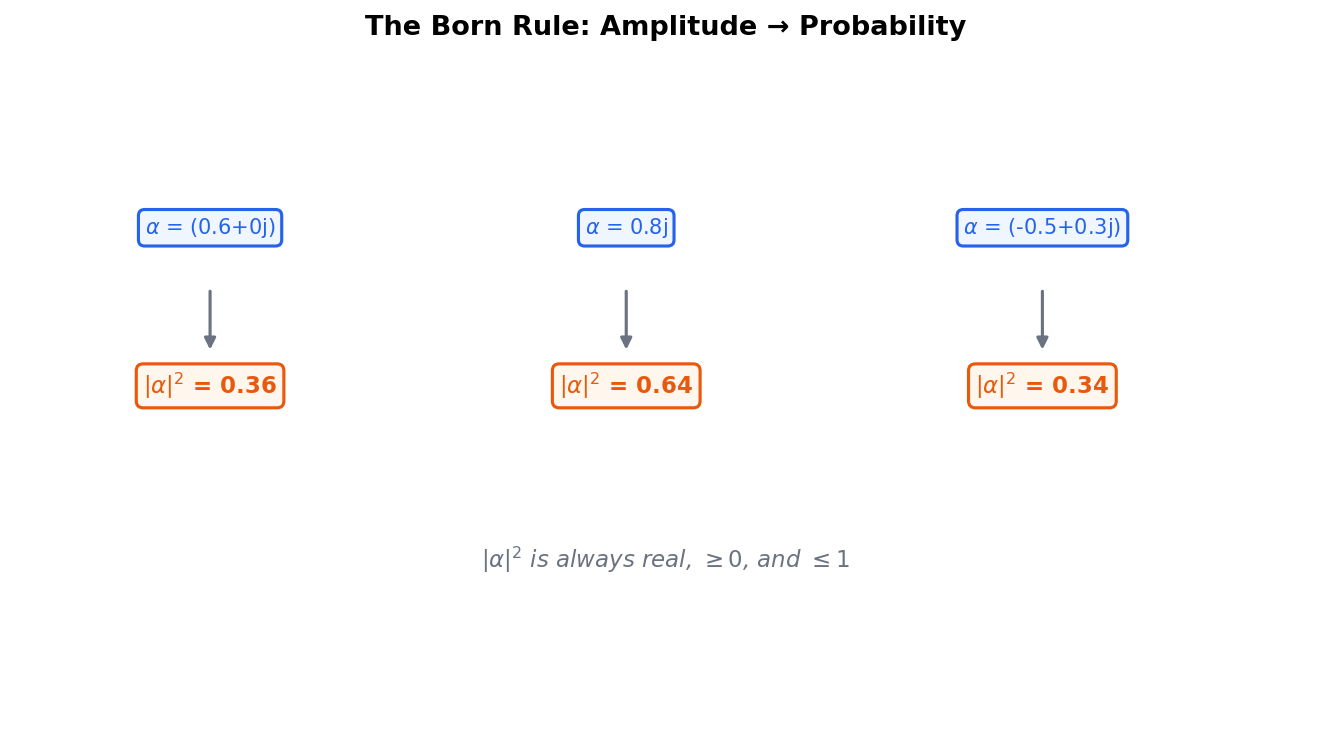
The Born Rule converts complex amplitudes to real probabilities by taking the squared modulus of each coefficient
Source: mortalapps.com- Probability amplitudes are complex numbers that represent the state of a quantum system.
- The Born Rule states that the probability of a measurement outcome is the squared modulus of its amplitude.
- Mathematically, P(0) = |α|² and P(1) = |β|².
- Because amplitudes are complex, they can interfere constructively or destructively.
- Squaring the amplitude discards the phase information, making phase directly unobservable in a single measurement.
- The normalization condition ensures that the sum of all Born Rule probabilities is exactly 1.
Why This Matters
In classical physics, probabilities are simple, real numbers between 0 and 1. If you flip a coin, there is a 0.5 probability of heads. In quantum mechanics, however, nature does not use probabilities directly. Instead, it uses a more fundamental concept: probability amplitudes. These amplitudes are complex numbers, and they are the secret behind all quantum behavior.
In this topic, we will explore the nature of probability amplitudes. We will study the Born Rule, the fundamental law of physics that connects these abstract complex amplitudes to real-world, observable probabilities. We will analyze why amplitudes must be complex, how they differ from classical probabilities, and how their wave-like nature allows for quantum interference.
By the end of this topic, you will be able to calculate measurement probabilities from any complex state vector, explain the physical significance of the Born Rule, and describe how negative and complex amplitudes enable quantum systems to perform computations that classical systems cannot match.
Core Intuition
Imagine you are looking at a shadow cast by a 3D object on a wall. The shadow is a 2D projection of a richer, 3D reality. If you only look at the shadow, you lose information about the depth of the object. In quantum mechanics, classical probabilities are like the shadow, and probability amplitudes are the 3D object itself.
Another helpful analogy is water waves. If you throw two stones into a pond, the ripples will meet. Where two wave crests meet, they add together to form a larger wave (constructive interference). Where a crest meets a trough, they cancel each other out, leaving the water perfectly flat (destructive interference). The height of the wave at any point is like the probability amplitude, it can be positive (crest) or negative (trough). The actual intensity of the wave (the energy it carries) is proportional to the square of the height. This intensity is always positive, just like real-world probability.
In classical probability, you can never add two positive chances together and get zero. If there is a 50% chance of a ball going through Door A and a 50% chance of it going through Door B, the total chance of it passing through is 100%. But in quantum mechanics, because amplitudes can be negative or complex, we can add two non-zero amplitudes together and get exactly zero. This is quantum cancellation, and it is only possible because nature tracks amplitudes, not probabilities.
Visualization
Technical Explanation
Let a qubit be in the state $|\psi\rangle = \alpha|0\rangle + \beta|1\rangle$. The coefficients $\alpha$ and $\beta$ are the probability amplitudes for the basis states $|0\rangle$ and $|1\rangle$, respectively.
The connection between these amplitudes and physical observations is governed by the Born Rule, formulated by physicist Max Born in 1926. The Born Rule states that the probability $P(x)$ of measuring a quantum system in a specific basis state $|x\rangle$ is equal to the squared modulus of the inner product between the state vector and that basis state:
$$P(x) = |\langle x|\psi\rangle|^2$$
For our computational basis states, this yields:
$$P(0) = |\langle 0|\psi\rangle|^2 = |\alpha|^2 = \alpha\alpha^*$$ $$P(1) = |\langle 1|\psi\rangle|^2 = |\beta|^2 = \beta\beta^*$$
Because $\alpha$ and $\beta$ are complex numbers, we can write them as $\alpha = a + bi$ and $\beta = c + di$. The squared modulus is:
$$|\alpha|^2 = a^2 + b^2$$ $$|\beta|^2 = c^2 + d^2$$
Notice that all phase information (the angle of the complex number on the complex plane) is lost when we take the squared modulus. This is why phase is invisible during a direct measurement of a single qubit, yet it remains crucial because it dictates how the amplitudes will combine and interfere when we apply quantum gates *before* measurement.