Quantum Dots
Silicon spin qubits trap individual electrons in quantum dots on standard chips, leveraging existing semiconductor fabs
Source: mortalapps.com- Silicon spin qubits trap individual electrons in electrostatic potential wells called quantum dots.
- The qubit is encoded in the spin state of the trapped electron, acting as a microscopic magnetic dipole.
- Zeeman splitting in an external magnetic field defines the qubit transition frequency.
- Single-qubit gates use microwave-driven spin resonance, while two-qubit gates use the Heisenberg exchange interaction.
- Isotopic purification of silicon (removing Silicon-29) is critical to eliminate magnetic noise and achieve long coherence times.
- Quantum dots offer extreme physical density and compatibility with existing semiconductor manufacturing infrastructure.
Why This Matters
Silicon quantum dots, often referred to as semiconductor spin qubits, are a highly promising solid-state quantum hardware technology. Instead of building artificial circuits (like transmons) or trapping atoms in a vacuum, this approach traps individual electrons inside microscopic semiconductor structures fabricated on silicon chips. By manipulating the spin of these trapped electrons, we can perform quantum computations. The massive appeal of this technology is that it can leverage the existing, multi-trillion-dollar silicon manufacturing infrastructure used to make classical computer chips.
Core Intuition
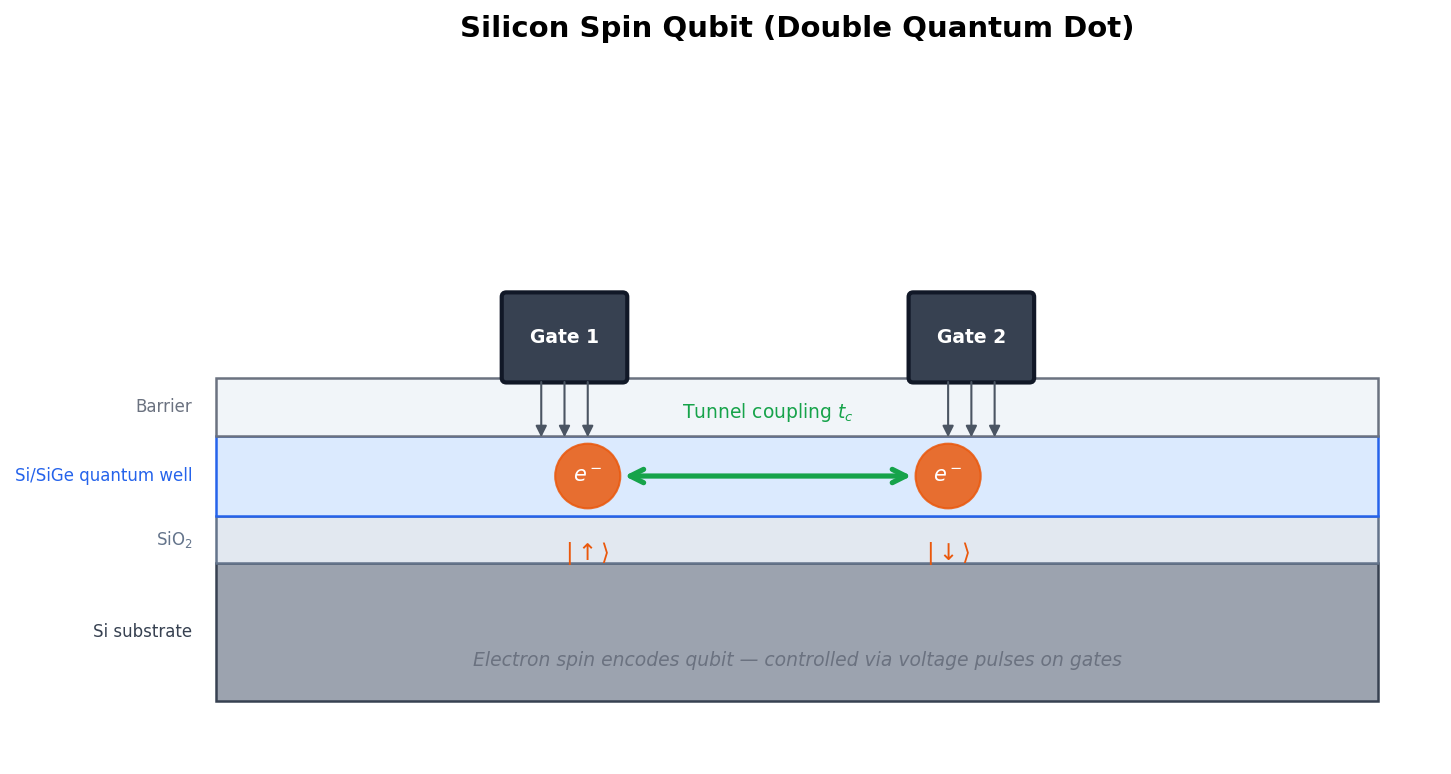
To understand a silicon quantum dot, imagine a microscopic puddle of water on a flat surface, where the puddle is so small that it can only hold a single drop. In our semiconductor chip, we use tiny metal electrodes (gates) on top of a silicon wafer to create an electrostatic 'puddle' (a potential well) that traps exactly one single electron. This trap is called a quantum dot.
Once we have trapped the electron, we use its spin as our qubit. The electron's spin acts like a tiny, microscopic compass needle. If the needle points up, it represents $|0\rangle$; if it points down, it represents $|1\rangle$. To perform a single-qubit gate, we apply a tiny microwave signal to rotate the compass needle. To perform a two-qubit gate, we lower the electrostatic barrier between two neighboring puddles, allowing the two electrons to feel each other's presence and exchange their spin states. This allows us to build a quantum computer inside the exact same material used to make your smartphone's processor.
Visualization
Technical Explanation
Silicon quantum dots are fabricated using semiconductor heterostructures, typically silicon-germanium (Si/SiGe) or silicon-on-insulator (SOI). By applying voltages to metallic gate electrodes on the surface, we deplete the two-dimensional electron gas (2DEG) below, leaving isolated potential wells that trap individual electrons.
The qubit is typically encoded in the spin state of a single electron. In the presence of an external magnetic field $B_0$, the spin degeneracy is broken by Zeeman splitting: $$\Delta E = g \mu_B B_0 = \hbar \omega_q$$ where $g$ is the electron g-factor in silicon, $\mu_B$ is the Bohr magneton, and $\omega_q$ is the qubit transition frequency (typically in the microwave regime, $10 - 40\text{ GHz}$).
Single-qubit gates are performed using Electron Spin Resonance (ESR) or Electric Dipole Spin Resonance (EDSR). By applying an oscillating magnetic or electric field at frequency $\omega_q$, we drive Rabi oscillations between the spin-up and spin-down states.
Two-qubit gates utilize the Heisenberg exchange interaction. When the electrostatic barrier between two adjacent dots is lowered, the wavefunctions of the two electrons overlap, governed by the Hamiltonian: $$H_{\text{exchange}}(t) = J(t) \mathbf{S}_1 \cdot \mathbf{S}_2$$ where $J(t)$ is the time-dependent exchange coupling strength, and $\mathbf{S}_i$ are the spin operators. Pulsing $J(t)$ for a precise duration implements a SWAP-like gate (such as $\sqrt{\text{SWAP}}$ or CZ), which is universal when combined with single-qubit rotations.
Key hardware parameters for silicon spin qubits:
- T1 (Energy Relaxation): Seconds (at low temperatures)
- T2 (Dephasing): Milliseconds (in isotopically purified $^{28}\text{Si}$)
- Gate Fidelity: Single-qubit $> 99.9\%$, Two-qubit $> 99\%$
- Connectivity: Nearest-neighbor (2D grid)
- Operating Temperature: $100\text{ mK} - 1\text{ K}$ (higher than superconducting qubits)
- Gate Speed: $10 - 100\text{ ns}$