Intro to Cirq
Cirq is Google's open-source framework with explicit control over qubit placement and gate scheduling for NISQ research
Source: mortalapps.com- Cirq is an open-source Python framework developed by Google, optimized for NISQ-era research and Google's hardware.
- Cirq's design philosophy emphasizes low-level control over qubit mapping, gate scheduling, and physical constraints.
- Qubits in Cirq are represented as independent objects, such as
LineQubitor 2DGridQubit. - A Cirq
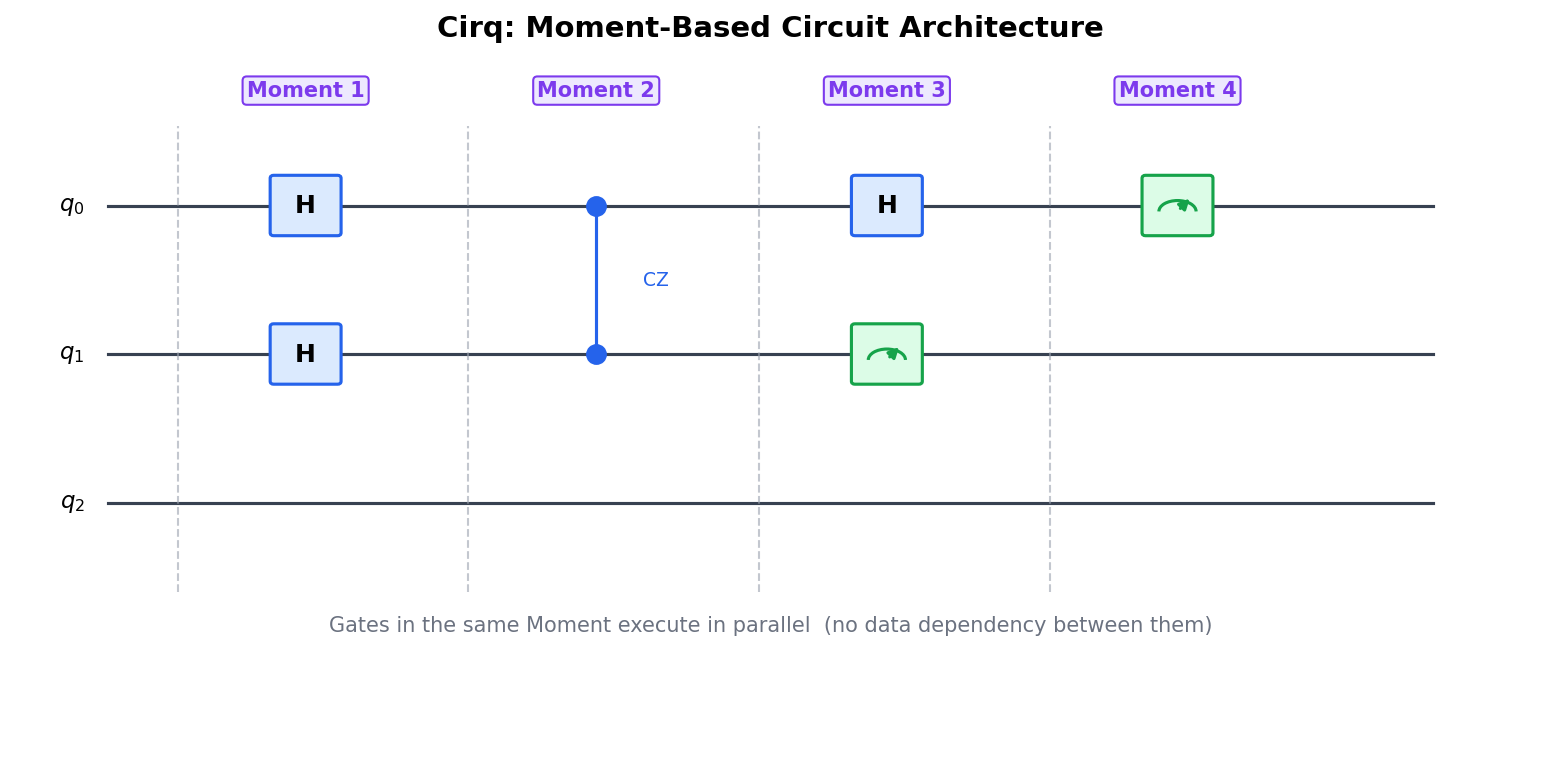
Circuitis organized as a sequence ofMomentobjects, which represent parallel time slices of execution. - Cirq does not use registers; gates are applied directly to qubit objects to create operations.
- By default, Cirq's measurement histogram returns decimal representations of binary outcomes (e.g., 3 for '11').
Why This Matters
While Qiskit is the dominant framework for programming IBM's quantum systems, the quantum computing ecosystem is diverse and multi-faceted. Different hardware manufacturers and research groups have developed alternative software development kits (SDKs) tailored to their specific physical architectures and design philosophies. The most prominent of these alternatives is Cirq, an open-source quantum programming framework developed by Google.
Cirq is designed specifically for developing and running quantum algorithms on Noisy Intermediate-Scale Quantum (NISQ) processors, with a particular focus on Google's superconducting quantum hardware (such as the Sycamore chip). Cirq's design philosophy emphasizes low-level control over qubit mapping, gate scheduling, and hardware-specific constraints, making it a favorite among researchers who want to push the boundaries of physical hardware performance.
In this topic, you will explore the architecture and syntax of Cirq. You will learn how Cirq's design philosophy differs from Qiskit, understand its unique representation of qubits and circuits, and write code to build and simulate a Bell state using Cirq. This will broaden your programming toolkit and prepare you to work across different hardware platforms.
Core Intuition
Think of learning Cirq after mastering Qiskit like learning to drive a manual transmission sports car after driving an automatic sedan. Both vehicles have the same underlying physics, use the same roads, and have the same goal: getting you from point A to point B. However, the controls and the driving experience are fundamentally different.
Qiskit is like the automatic sedan: it abstracts away many low-level details, provides high-level primitives, and manages execution pipelines automatically, making it comfortable and highly efficient for general-purpose driving. Cirq is like the manual sports car: it forces you to manually select your gears (qubit coordinates), manage your engine timing (gate scheduling), and handle physical constraints directly. It requires more effort, but it gives you precise, low-level control over the hardware, which is exactly what you need when racing on a track (conducting frontier physics research).
For example, while Qiskit indexes qubits as simple integers (0, 1, 2), Cirq represents qubits as physical coordinates on a 2D grid (GridQubits), reflecting their actual physical layout on Google's chip. This low-level representation ensures that you are always aware of the physical reality of the hardware you are programming.
Visualization
Technical Explanation
Cirq's architecture is built around several core classes that differ from Qiskit's design: 1. Qubits: In Cirq, qubits are not just indices in a register. They are represented by specific classes like cirq.NamedQubit (for abstract qubits), cirq.LineQubit (for qubits arranged in a 1D line), and cirq.GridQubit (for qubits arranged in a 2D grid, matching physical chip layouts). 2. Operations: An operation is a gate applied to specific qubits (e.g., cirq.H(q0)). In Cirq, gates are factory objects, and applying them to qubits returns an Operation object. 3. Moments: A Moment is a slice of time in a circuit where all operations occur in parallel. A Cirq Circuit is represented as a sequence of Moment objects, enforcing strict temporal alignment.
Here is a complete, runnable Cirq program that constructs a Bell state, prints the circuit diagram, and simulates its execution:
import cirq

# Step 1: Define qubits
# We use LineQubit to represent qubits in a 1D sequence
q0 = cirq.LineQubit(0)
q1 = cirq.LineQubit(1)

# Step 2: Build the circuit
# We pass a list of operations. Cirq automatically groups them into Moments.
circuit = cirq.Circuit([
    cirq.H(q0),             # Hadamard on q0
    cirq.CNOT(q0, q1),      # CNOT with control q0 and target q1
    cirq.measure(q0, q1, key='result') # Measure both qubits
])

# Step 3: Print the circuit diagram
print("--- Cirq Circuit Diagram ---")
print(circuit)

# Step 4: Instantiate the simulator
simulator = cirq.Simulator()

# Step 5: Run the simulation
# We run the circuit for 1000 repetitions (shots)
result = simulator.run(circuit, repetitions=1000)

# Step 6: Analyze results
# Retrieve the histogram of outcomes
histogram = result.histogram(key='result')
print("\nSimulation Results (1000 repetitions):")
print(histogram)
In this code, cirq.Circuit takes a list of operations. Cirq's default compiler automatically groups these operations into parallel time slices (Moments). The Simulator class is used to run local simulations, and result.histogram aggregates the measurement outcomes into a dictionary where the keys are decimal representations of the binary outcomes (e.g., 0 for '00' and 3 for '11').
Key Takeaways
LineQubit or 2D GridQubit.Circuit is organized as a sequence of Moment objects, which represent parallel time slices of execution.