Quantum Internet
The quantum internet transmits qubits and entanglement globally, enabling secure QKD and distributed quantum computing
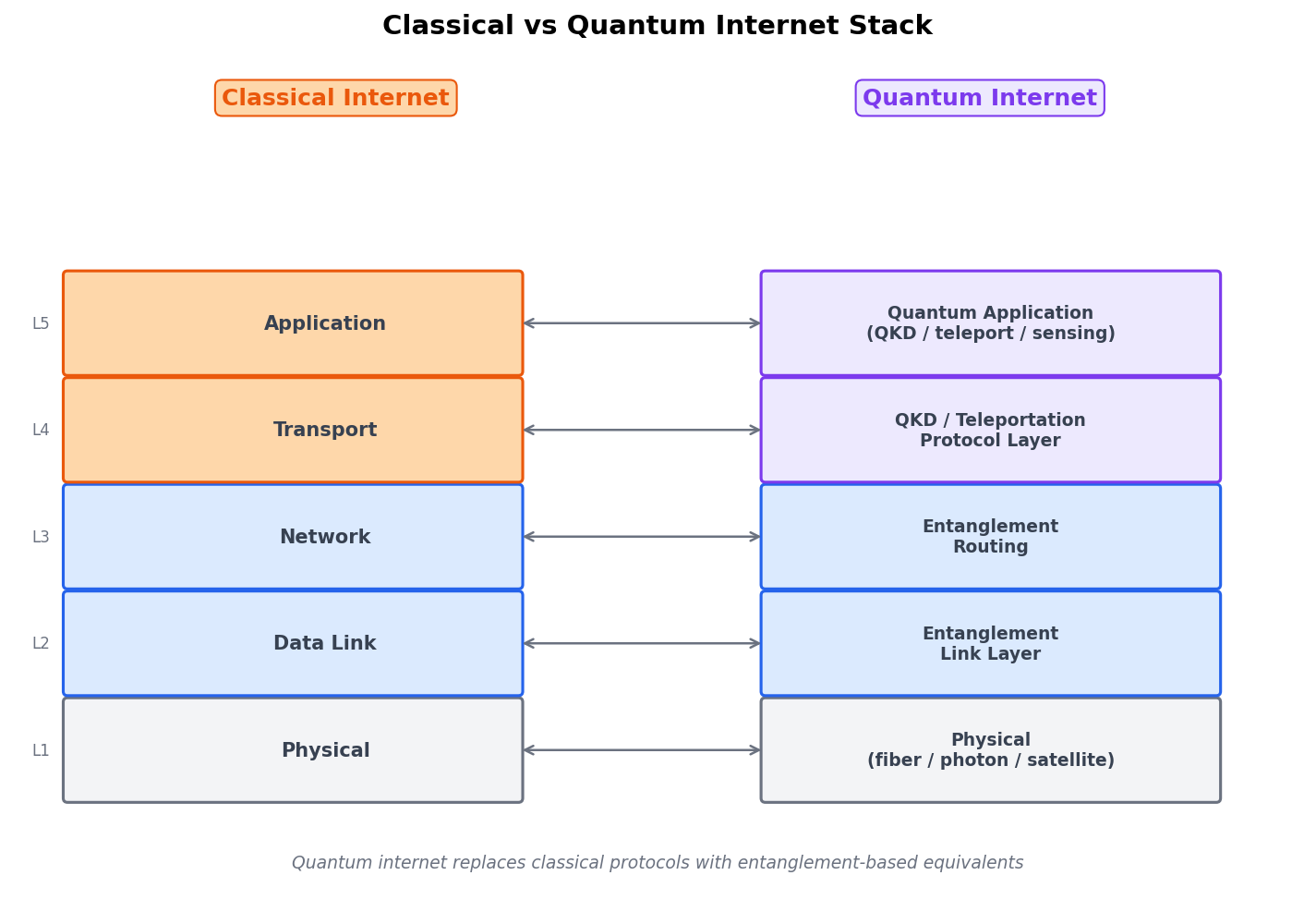
Source: mortalapps.com- The Quantum Internet transmits qubits and entanglement, running parallel to the classical internet.
- Fiber attenuation limits direct quantum communication to ~100 km, requiring quantum repeaters for scaling.
- Quantum repeaters use entanglement swapping to connect distant nodes without violating the No-Cloning Theorem.
- Entanglement swapping requires high-fidelity quantum memory to store qubit states during the protocol.
- Quantum teleportation is the primary mechanism for moving quantum states across the network.
- Global initiatives are currently building metropolitan-scale testbeds to lay the groundwork for a global quantum network.
Why This Matters
The Quantum Internet is not a replacement for our current classical internet, but a revolutionary co-existing network. Its purpose is to transmit quantum information, specifically qubits and entanglement, between physically separated quantum devices. By connecting quantum computers, sensors, and cryptographic systems globally, the quantum internet will enable secure communication, distributed quantum computing, and ultra-precise sensor networks.
Core Intuition
To understand the quantum internet, imagine trying to send a delicate, glowing glass ornament through the mail. If you drop it or handle it roughly, it shatters. In classical networks, we can copy data as many times as we want to prevent loss. But because of the No-Cloning Theorem, we cannot copy a qubit. If a photon carrying a qubit is absorbed by a fiber-optic cable, that qubit is lost forever. We cannot use standard classical amplifiers to boost the signal.
Instead of physically sending the qubit the entire distance, the quantum internet uses entanglement as a highway. Imagine having two magic, connected dice. You keep one, and your friend miles away keeps the other. By performing a measurement on your die and a classical message, you can make your friend's die instantly adopt the exact state of the qubit you wanted to send. This is quantum teleportation, and it is the core mechanism of the quantum internet.
Visualization
Technical Explanation
The fundamental challenge of the quantum internet is fiber attenuation. Photons in standard telecom fibers are absorbed exponentially over distance, limiting direct quantum communication to around 100 kilometers. To overcome this, we use quantum repeaters.
Quantum repeaters do not amplify signals. Instead, they use entanglement swapping to build long-distance entanglement from shorter, high-fidelity segments. Imagine Alice, Bob, and a repeater station Charlie in the middle. Alice and Charlie share an entangled pair $| \Phi^+ \rangle_{AC}$, while Charlie and Bob share another pair $| \Phi^+ \rangle_{CB}$:
$$| \Phi^+ \rangle = \frac{|00\rangle + |11\rangle}{\sqrt{2}}$$
Charlie performs a Bell State Measurement (BSM) on his two photons (one from each pair). This measurement projects Charlie's photons into an entangled state, which instantly projects Alice's and Bob's distant photons into an entangled state $| \Phi^+ \rangle_{AB}$, despite them never having physically interacted. This process is repeated across multiple nodes to span arbitrary distances.
To make this work, quantum repeaters require quantum memory, the ability to store a qubit's state in a physical medium (like trapped ions or solid-state spins) without measuring it, waiting for neighboring nodes to successfully establish their entanglement before performing the swapping measurement.