Hybrid Quantum Algorithms
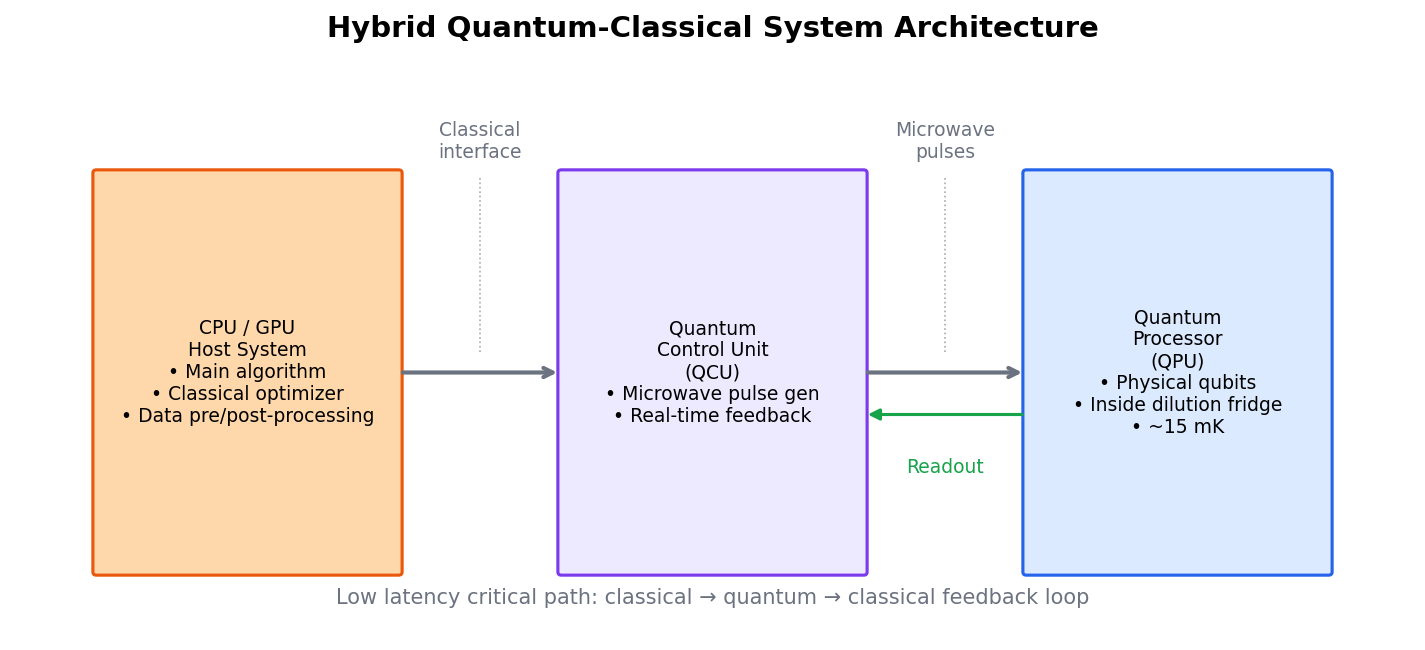
Hybrid algorithms use the quantum processor for expectation value evaluation while a classical computer optimizes
Source: mortalapps.com- Hybrid algorithms treat the quantum computer as a specialized co-processor.
- The classical computer handles optimization, while the quantum computer evaluates complex states.
- QAOA is a hybrid algorithm designed for combinatorial optimization.
- QAOA uses alternating layers of cost and mixing Hamiltonians.
- Hybrid architectures minimize the required quantum gate depth, making them ideal for near-term hardware.
Why This Matters
Hybrid Quantum-Classical Algorithms represent the dominant paradigm for practical quantum computing today. Rather than viewing the quantum computer as a standalone processor, hybrid architectures treat it as a specialized co-processor, similar to how GPUs are used alongside CPUs to accelerate specific mathematical tasks.
Core Intuition
Think of a quantum computer as a high-performance wind tunnel. You don't build the entire airplane inside the wind tunnel. Instead, you build a model classically, place it in the tunnel (quantum evaluation), measure how the air flows around it, and then use a classical workshop to modify the model before testing it again. In hybrid algorithms, the classical computer orchestrates the entire process, using the quantum computer only to evaluate complex, high-dimensional states that are too difficult to simulate classically.
Visualization
Technical Explanation
In a hybrid quantum-classical architecture, the computation is split into two main phases:
1. Quantum Phase (State Evaluation): The quantum processor executes a parameterized circuit $U(\theta)$ and performs measurements to estimate expectation values or sample from a probability distribution. 2. Classical Phase (Optimization & Control): The classical processor processes the measurement data, evaluates a cost function, and runs an optimization algorithm to update the parameters $\theta$.
The Quantum Approximate Optimization Algorithm (QAOA): QAOA is a hybrid algorithm designed to solve combinatorial optimization problems (like Max-Cut). It uses an ansatz consisting of alternating layers of a 'problem Hamiltonian' $H_C$ and a 'mixing Hamiltonian' $H_B$:
$$|\gamma, \beta\rangle = e^{-i \beta_p H_B} e^{-i \gamma_p H_C} \dots e^{-i \beta_1 H_B} e^{-i \gamma_1 H_C} |+\rangle^{\otimes n}$$
where $\gamma$ and $\beta$ are classical parameters optimized to maximize the expectation value of the cost function $\langle H_C\rangle$.