Linear Transformations
Quantum gates are unitary linear transformations that preserve the structure of state space and guarantee reversibility
Source: mortalapps.com- A linear transformation is a function that preserves vector addition and scalar multiplication.
- All quantum gates are linear transformations, specifically unitary transformations.
- Linear transformations can be represented by matrices and act on vectors through matrix multiplication.
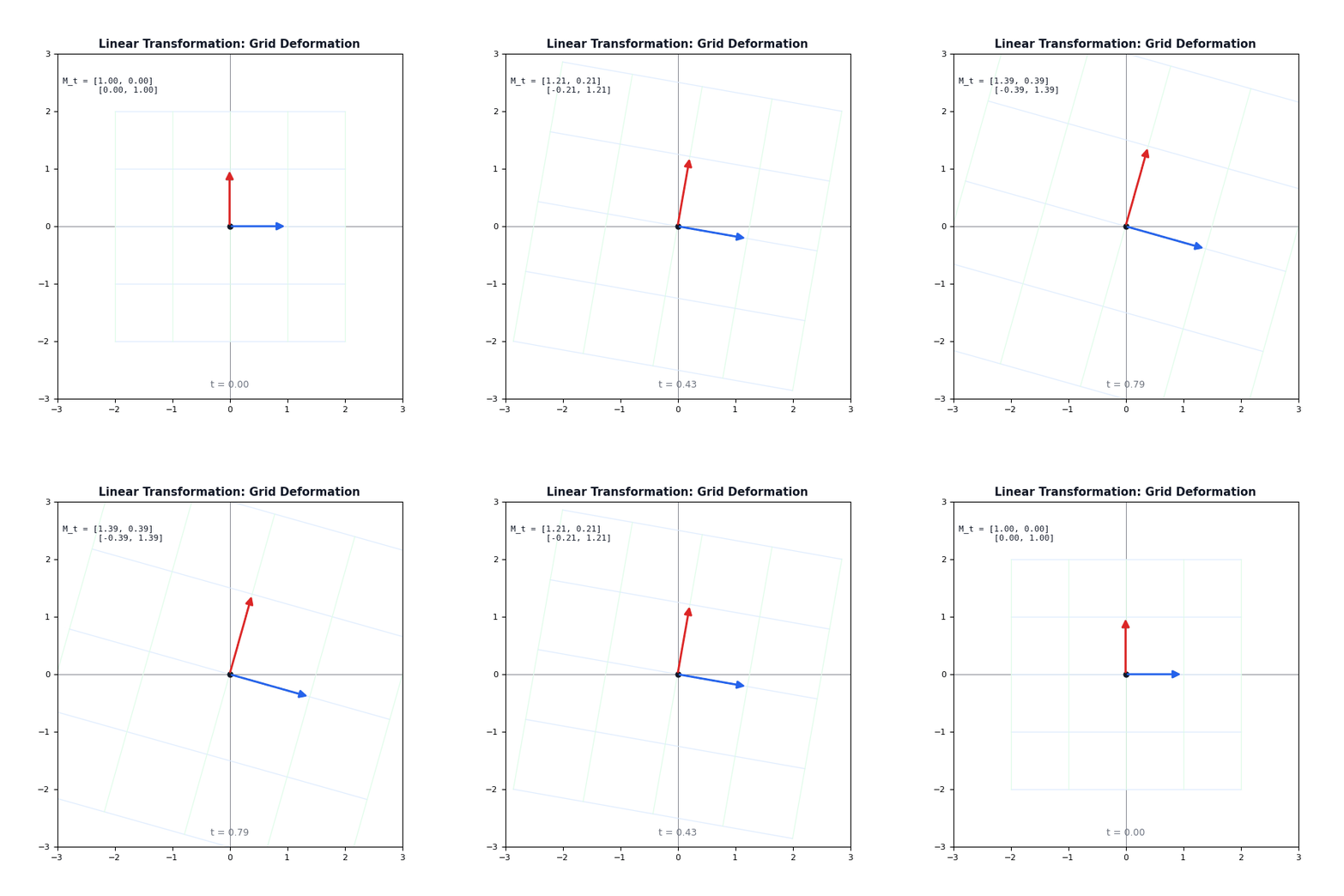
- Geometrically, linear transformations keep the origin fixed and transform straight lines into straight lines.
- Common linear transformations include rotation, scaling, reflection, and shear.
- The linearity of quantum gates is crucial for the superposition principle and the systematic analysis of quantum circuits.
Why This Matters
Quantum gates are not just arbitrary operations; they are specific types of 'linear transformations' that preserve the underlying mathematical structure of quantum states. Understanding what a linear transformation is reveals why quantum operations behave predictably, allowing us to compose gates and analyze their effects systematically.
This concept is fundamental to understanding the rules that govern how quantum information is processed. It explains why matrices are such a perfect fit for representing quantum gates and why the superposition principle holds true throughout a quantum computation.
By the end of this topic, you will grasp the definition and properties of linear transformations, understand their geometric effects, and see why they are the mathematical language for all quantum gates.
Core Intuition
Imagine you have a rubber sheet with a grid drawn on it. A linear transformation is like stretching, rotating, or reflecting that sheet. What's important is that straight lines on the grid remain straight lines, and parallel lines remain parallel. Also, the origin (the point (0,0)) always stays fixed.
Think of a function that scales and adds. If you double the input, you double the output. If you add two inputs, you add their outputs. For example, a function that multiplies everything by 2 is linear. A function that adds 5 to everything is *not* linear because it shifts the origin and doesn't scale proportionally.
In essence, linear transformations are 'well-behaved' transformations. They don't introduce kinks, curves, or arbitrary shifts. This predictability is exactly what we need for quantum computation, where we rely on precise, reversible operations to manipulate quantum information.
Visualization
Technical Explanation
A linear transformation (or linear map) is a function that maps vectors from one vector space to another (or to itself) while preserving two key properties:
1. Additivity: The transformation of a sum of vectors is the sum of their individual transformations. $$T(\vec{u} + \vec{v}) = T(\vec{u}) + T(\vec{v})$$ 2. Homogeneity (Scalar Multiplication): The transformation of a scalar multiple of a vector is the scalar multiple of the transformed vector. $$T(c\vec{u}) = cT(\vec{u})$$
These two properties can be combined into a single condition: $T(c_1\vec{u} + c_2\vec{v}) = c_1T(\vec{u}) + c_2T(\vec{v})$.
Matrices and Linear Transformations: Every linear transformation can be represented by a matrix, and every matrix multiplication corresponds to a linear transformation. This is why matrices are the perfect tool for quantum gates. When a matrix $M$ acts on a vector $\vec{v}$, the operation $M\vec{v}$ is a linear transformation.
Geometric Effects of Linear Transformations: Common linear transformations include:
- Rotation: Changing the orientation of a vector or space.
- Scaling: Stretching or shrinking vectors.
- Reflection: Flipping vectors across an axis or plane.
- Shear: Distorting a shape by shifting points in one direction proportional to their distance from an axis.
Crucially, linear transformations always map the origin to the origin ($T(\vec{0}) = \vec{0}$) and preserve straight lines (they remain straight, though their orientation or length might change). In quantum mechanics, all quantum gates are linear transformations (specifically, unitary transformations, which also preserve vector length, ensuring normalization). This linearity is what allows the superposition principle to hold throughout a quantum computation.