Research Roadmaps
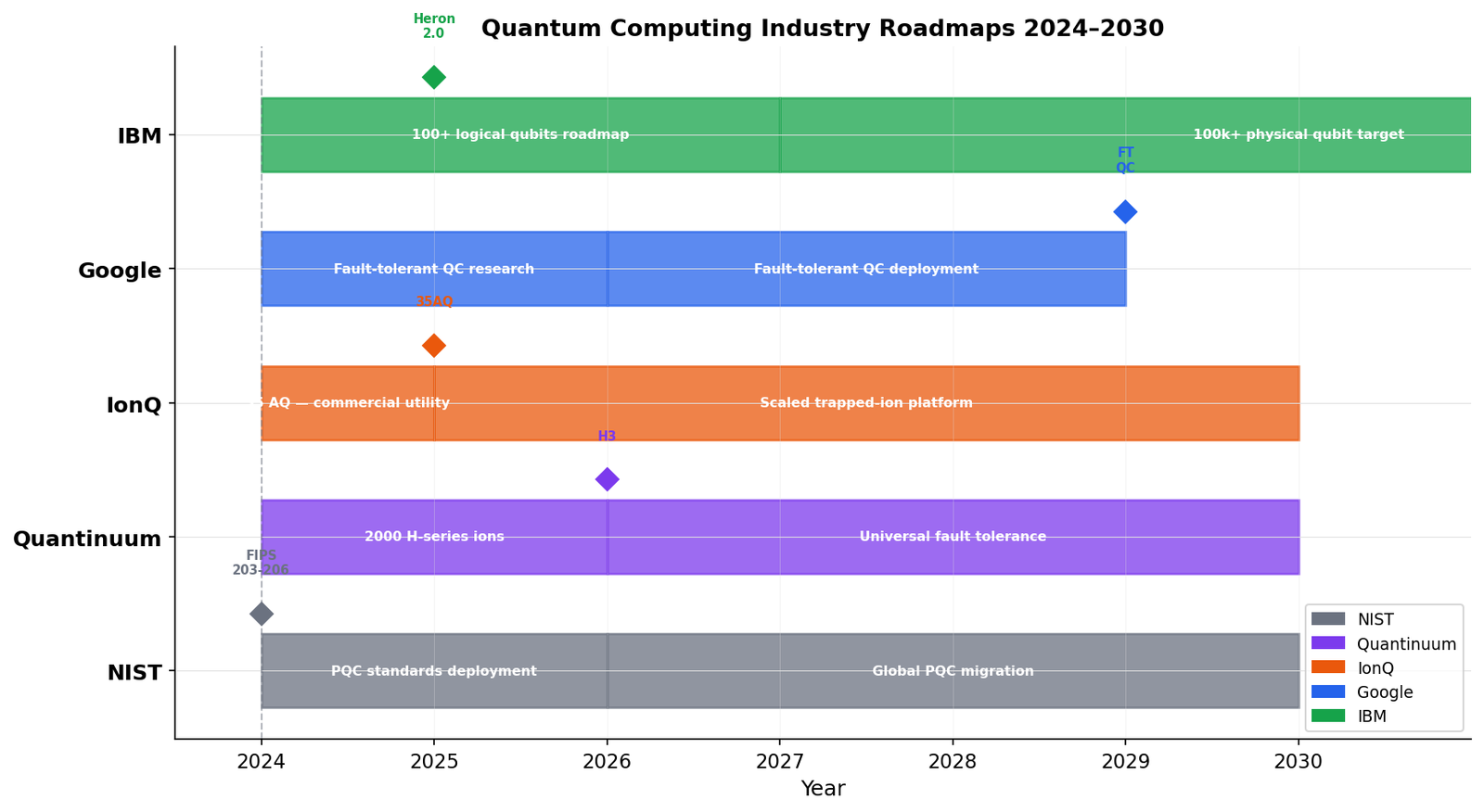
IBM targets 100,000 qubits by 2033 via modular linked processors, while others focus on error rate reduction milestones
Source: mortalapps.com- Research roadmaps outline hardware milestones, software releases, and timelines for achieving fault tolerance.
- IBM's roadmap focuses on modular, quantum-communication-linked processors, targeting 100,000 physical qubits by 2033.
- Google's roadmap is structured around six error-correction milestones, targeting 1,000 logical qubits by 2030+.
- IonQ uses the Algorithmic Qubits ($AQ$) metric to measure progress, targeting $AQ = 64$ by 2028.
- Microsoft's roadmap focuses on topological qubits, aiming to deliver built-in physical error protection.
- True fault-tolerant quantum computing is projected by most major roadmaps to arrive in the early 2030s.
Why This Matters
To navigate the quantum frontier, we must look at where the industry's leaders are steering their ships. Major quantum computing companies and research institutions publish detailed, multi-year Research Roadmaps. These documents outline their hardware milestones, software releases, and projected timelines for achieving fault tolerance. By analyzing these roadmaps, we can separate realistic engineering targets from marketing hype and understand when utility-scale quantum computing will arrive.
Core Intuition
To understand quantum roadmaps, think of the Apollo program in the 1960s. NASA didn't just announce they were going to the moon; they published a step-by-step roadmap. First, they had to test orbiters (Project Mercury), then docking maneuvers (Project Gemini), and finally the lunar lander (Project Apollo). Each mission built on the last. Quantum roadmaps are the Apollo missions of our era.
Another analogy is the semiconductor industry's Moore's Law roadmap. For decades, chip manufacturers like Intel published roadmaps detailing when they would shrink transistors from 90nm to 45nm, and then to 22nm. This allowed software developers and device manufacturers to prepare their products years in advance. Quantum roadmaps serve the same purpose, telling software developers exactly when they will have access to 100, 1,000, or 10,000 logical qubits.
Visualization
Technical Explanation
Analyzing quantum roadmaps requires understanding the specific metrics companies use to measure progress. IBM Quantum uses a roadmap focused on scaling physical qubits while improving gate fidelities, transitioning from its 'Heron' processor (133 high-fidelity qubits) to modular, quantum-communication-linked architectures like 'Kookaburra' and 'Flamingo'. IBM projects achieving a 100,000-physical-qubit system by 2033, which they estimate will yield 1,000 logical qubits using advanced error-correcting codes.
Google Quantum AI's roadmap is structured around six major milestones, culminating in a 1-million-physical-qubit system that can support 1,000 fault-tolerant logical qubits. Google's milestones are strictly tied to error correction performance, with Milestone 2 (proving that larger codes suppress logical errors) achieved in late 2024 with the Willow processor. Google's next targets include demonstrating a logical gate with fidelity exceeding 99.9% (Milestone 3) and scaling to a fully error-corrected logical qubit (Milestone 4).
IonQ measures progress using Algorithmic Qubits ($AQ$), a metric defined as the number of physical qubits that can be successfully used in a circuit of depth equal to the qubit count. The relation is given by:
$$AQ \approx \log_2(N_{\text{qubits}}) - \text{overhead}$$
IonQ projects reaching $AQ = 64$ by 2028, which they claim will enable quantum advantage for specific machine learning and chemistry tasks. Microsoft's roadmap focuses on topological qubits, aiming to build a 'Majorana-based' hardware platform that has built-in physical error protection, projecting a timeline that skips early noisy stages to deliver a fault-tolerant system directly.