Pure vs Mixed States
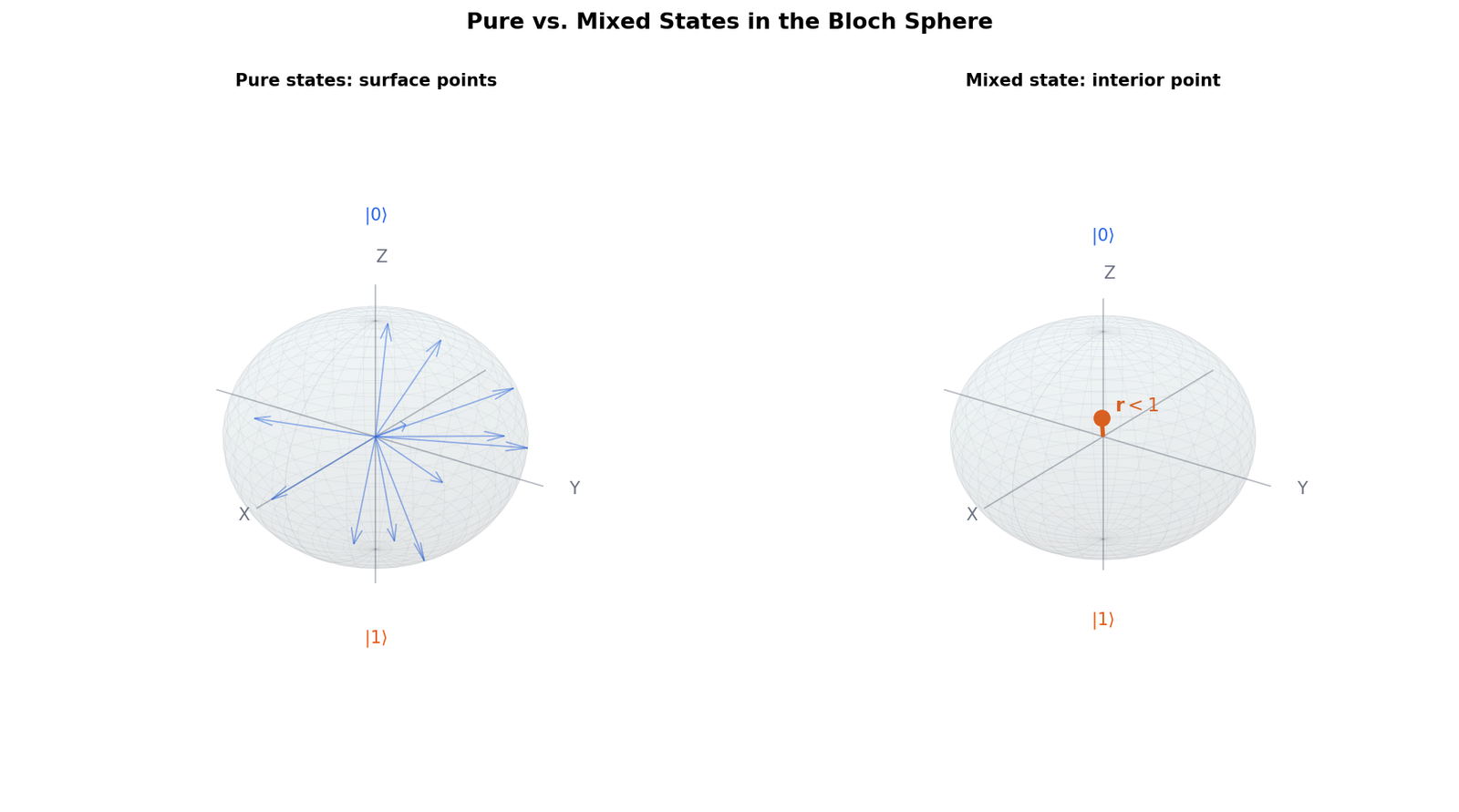
Pure states on the Bloch sphere surface represent full quantum knowledge, while mixed states inside reflect decoherence
Source: mortalapps.com- Pure states represent complete quantum certainty and live on the surface of the Bloch Sphere.
- Mixed states represent statistical mixtures of quantum states and live inside the Bloch Sphere.
- The density matrix ρ is the mathematical formalism used to describe both pure and mixed states.
- A density matrix must be Hermitian and have a trace of exactly 1.
- The condition Tr(ρ²) = 1 identifies a pure state, while Tr(ρ²) < 1 identifies a mixed state.
- Decoherence is the physical process where environmental noise degrades a pure state into a mixed state.
Why This Matters
Up to this point, we have assumed that we always know the exact state of our qubit with absolute certainty. Such states are called pure states, and they are represented by vectors on the surface of the Bloch Sphere. In the real world, however, qubits are never perfectly isolated. They interact with their noisy environments, causing us to lose precise knowledge of their state. To describe this realistic scenario, we must introduce a broader class of states: mixed states.
In this topic, we will explore the critical distinction between pure and mixed states. We will move beyond the state vector representation and introduce the density matrix formalism, the advanced mathematical language of open quantum systems. We will analyze how environmental noise (decoherence) degrades pure states into mixed states, and understand how this transition is represented geometrically.
By the end of this topic, you will be able to write down a density matrix, calculate whether a state is pure or mixed using the trace condition, and visualize mixed states as points residing inside the interior of the Bloch Sphere. This understanding is essential for analyzing real-world quantum hardware and error correction.
Core Intuition
Imagine you have a laser pointer that emits a pure, coherent beam of polarized light. Every single photon in the beam is in the exact same state. This is a pure state. You have complete, perfect information about the quantum state of the system.
Now, imagine you turn off the laser and light a standard candle. The candle emits a chaotic jumble of light. Some photons are polarized horizontally, some vertically, some diagonally, all mixed together at random. If you pick a single photon from the candle, you cannot describe it with a single state vector; you can only say there is a 50% chance it is horizontal and a 50% chance it is vertical. This is a mixed state. It represents a statistical ensemble, a mixture of different quantum states.
On our Bloch Sphere globe, pure states live on the surface. But as a qubit interacts with the noisy environment, it loses its quantum coherence. The state vector begins to shrink, spiraling inward away from the surface. A completely randomized qubit (a 50/50 mix of 0 and 1 with no phase coherence) sits exactly at the dead center of the sphere. The distance from the center to the state point represents the 'purity' of our quantum information.
Visualization
Technical Explanation
To describe mixed states, we must abandon the state vector $|\psi\rangle$ and use the density matrix (or density operator), denoted by the Greek letter $\rho$ (rho). For a pure state $|\psi\rangle$, the density matrix is simply the outer product of the state with itself:
$$\rho = |\psi\rangle\langle\psi|$$
For a statistical mixture where the system is in state $|\psi_i\rangle$ with probability $p_i$, the density matrix is:
$$\rho = \sum_i p_i |\psi_i\rangle\langle\psi_i|$$
where the probabilities $p_i$ are real, non-negative numbers that sum to 1 ($\sum_i p_i = 1$).
Any valid density matrix must satisfy two fundamental mathematical conditions: 1. It must be Hermitian: $\rho^\dagger = \rho$. 2. It must have a trace of 1 (the sum of the diagonal elements must equal 1): $\text{Tr}(\rho) = 1$.
To determine if a density matrix represents a pure or mixed state, we calculate the trace of its square, $\text{Tr}(\rho^2)$:
- For a pure state: $\text{Tr}(\rho^2) = 1$.
- For a mixed state: $\text{Tr}(\rho^2) < 1$ (with a minimum value of $0.5$ for a single qubit).
On the Bloch Sphere, the density matrix can be parameterized using the Bloch vector $\vec{r} = (x, y, z)$:
$$\rho = \frac{I + xX + yY + zZ}{2} = \frac{1}{2} \begin{pmatrix} 1+z & x-iy \\ x+iy & 1-z \end{pmatrix}$$
The magnitude of the Bloch vector, $r = \sqrt{x^2 + y^2 + z^2}$, determines the purity: if $r = 1$, the state is on the surface (pure); if $r < 1$, the state is in the interior (mixed).