The Next Decade of Quantum
The 2025 to 2035 decade is the inflection point where quantum shifts from research demos to industrial accelerators
Source: mortalapps.com- The next decade (2025–2035) represents the critical inflection point for quantum technology.
- Quantum computing will operate as a hybrid model, acting as specialized accelerators (QPUs) alongside classical supercomputers.
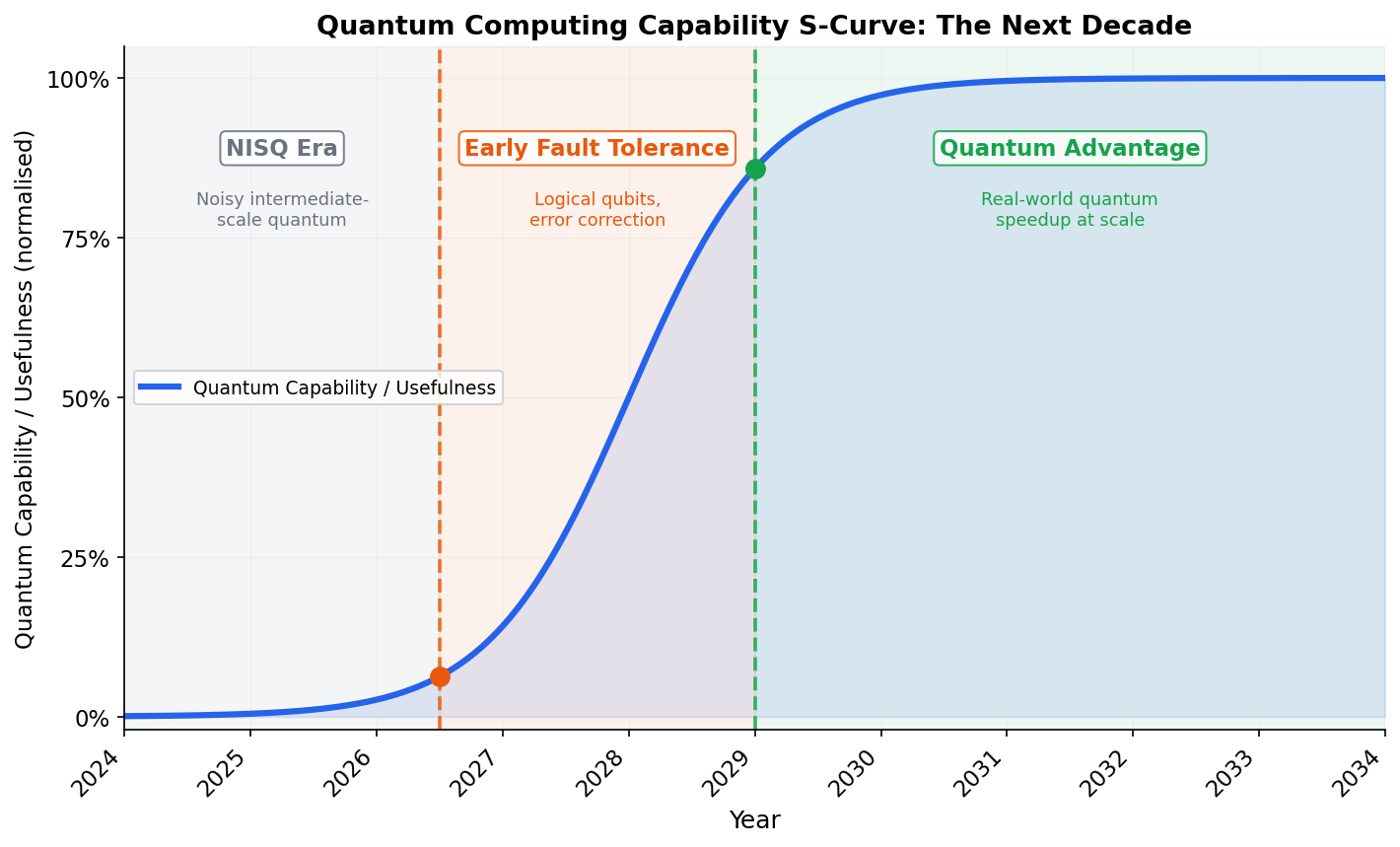
- By 2030, early fault-tolerant systems are projected to achieve practical quantum advantage in chemistry and materials science.
- The global migration to Post-Quantum Cryptography must be completed over the next decade to secure digital infrastructure.
- The convergence of Quantum, AI, and High-Performance Computing will create a unified computational fabric.
- Your mastery of this curriculum provides the rigorous foundation required to participate in and shape the quantum era.
Why This Matters
We have reached the final destination of our journey. Over fourteen topics in this section, and ten sections across this entire curriculum, you have built a complete, rigorous foundation in quantum computing. We close our study by looking forward to the next decade (2025–2035). This period will represent the critical inflection point where quantum computing transitions from a specialized research field into a global industrial force, converging with artificial intelligence and materials science to reshape modern technology.
Core Intuition
To understand the next decade of quantum, imagine standing on the shore watching a massive tide roll in. You can see the individual waves crashing (the hardware releases), but the true transformation is the rising water level that will eventually reshape the entire coastline. By 2035, quantum computing will not be an isolated technology; it will be the invisible engine powering our most advanced scientific discoveries.
Another analogy is the convergence of technologies that enabled the smartphone. In the early 2000s, we had mobile phones, GPS, digital cameras, and high-speed internet, but they were all separate devices. When these technologies converged into a single device, it transformed global culture, commerce, and communication. In the next decade, we will witness the convergence of Quantum Computing, High-Performance Classical Computing (HPC), and Artificial Intelligence, creating a unified computational fabric capable of solving humanity's most complex challenges.
Visualization
Technical Explanation
The next decade will be defined by the transition from 'quantum utility' (running classically intractable circuits on noisy hardware) to 'fault-tolerant quantum advantage' (running error-corrected algorithms that solve practical problems). This transition will be characterized by a hybrid computational model, where quantum processors act as specialized accelerators (QPUs) alongside classical CPUs and GPUs in supercomputing centers.
The value of this integration can be modeled as a function of quantum scale ($Q_{scale}$) and classical integration efficiency ($C_{integration}$):
$$V_{impact} = f(Q_{scale}, C_{integration})$$
By 2035, we project the arrival of systems with 1,000 to 10,000 logical qubits. These systems will enable the first practical simulations of complex chemical reactions, such as catalyst design for carbon capture and the discovery of new superconducting materials. Simultaneously, the global migration to Post-Quantum Cryptography will be largely complete, securing the digital world against quantum attacks. The next decade is not just about scaling hardware; it is about building the entire software, networking, and educational infrastructure required to support a quantum-enabled society.