Classical vs Quantum Algorithms
Quantum speedups arise from systematic phase manipulation and interference, not from brute-force parallel search
Source: mortalapps.com- Quantum speedups are not achieved by brute-force parallel search, but through the systematic manipulation of quantum phases.
- The oracle model allows us to analyze algorithm performance based on query complexity, independent of hardware implementation details.
- A quantum oracle uses linear, unitary operations to evaluate functions on superpositions of inputs.
- Phase kickback is a primary mechanism used to encode classical function outputs into quantum phases.
- Quantum algorithms can solve certain black-box problems with exponentially fewer queries than classical algorithms.
Why This Matters
In the previous sections, we explored the mechanics of quantum states, gates, and multi-qubit circuits. We saw how entanglement and superposition can be engineered using unitary operators. However, we have not yet addressed the fundamental question: how do we use these physical phenomena to solve computational problems faster than classical computers? This topic introduces the paradigm shift of quantum algorithm design, contrasting classical step-by-step logic with quantum wave-like interference.
Core Intuition
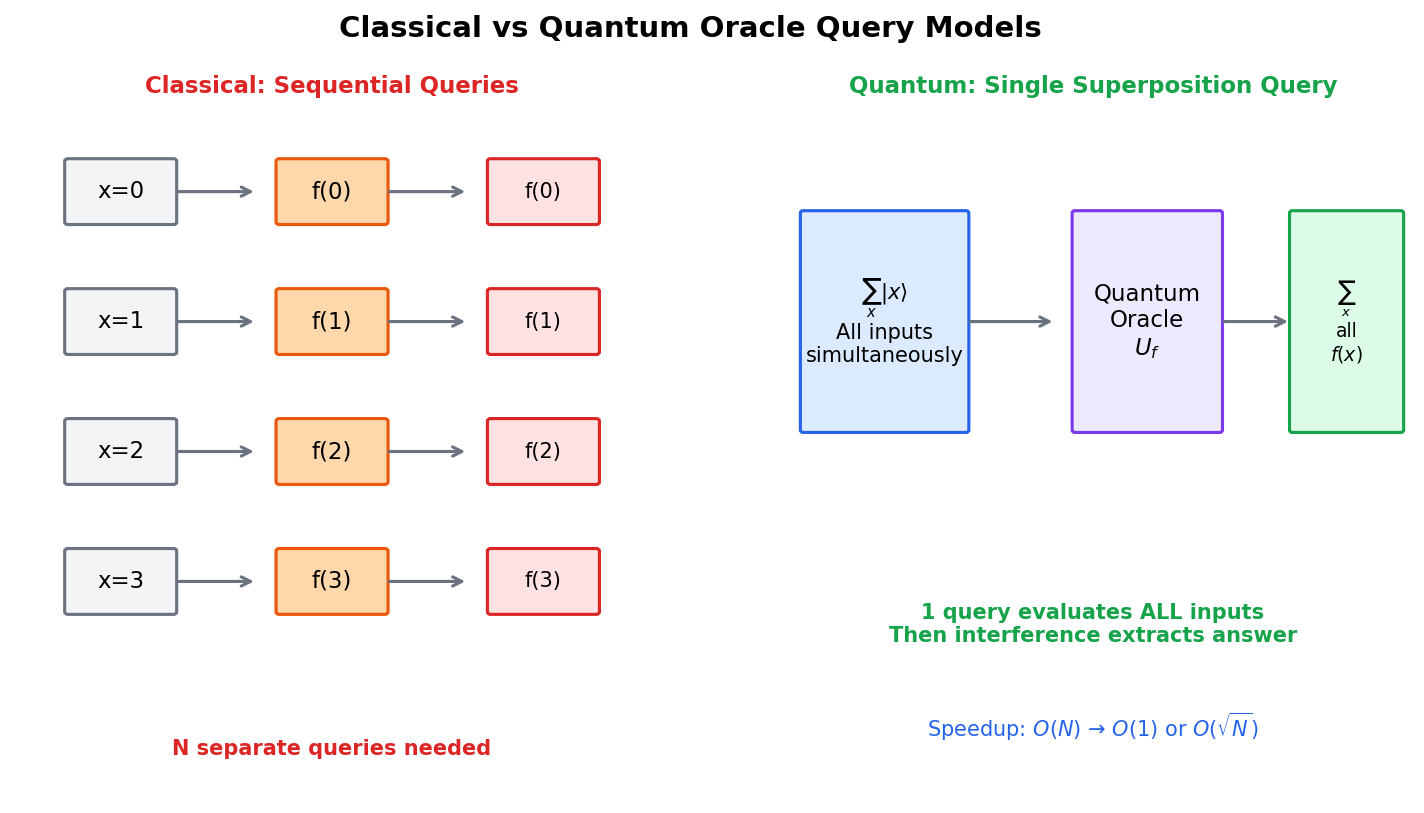
Imagine searching for a single marked page in a massive, unindexed library. A classical assistant must open each book one by one, a sequential, linear process. If there are $N$ books, it takes on average $N/2$ steps, and in the worst case, $N$ steps. A quantum assistant, however, does not look at one book at a time. Instead, it sets up a physical wave of probability across all books simultaneously. By engineering the system so that incorrect books cause destructive interference (canceling each other out) and the correct book causes constructive interference (amplifying its probability), the quantum assistant can locate the target in only $\sqrt{N}$ steps. Quantum algorithms do not simply 'try all paths at once' and magically pick the right one; they manipulate the phases of quantum states so that the wrong answers systematically destroy themselves, leaving only the correct answer to be measured.
Visualization
Technical Explanation
To compare classical and quantum algorithms rigorously, we use asymptotic notation ($O$, $\Omega$, $\Theta$) and the black-box (oracle) model. In query complexity, we measure the efficiency of an algorithm by the number of times it queries an unknown function (the oracle) represented as $f: \{0,1\}^n \to \{0,1\}^m$.
In a classical query model, the oracle is a black box that takes an input $x$ and returns $f(x)$. To evaluate a property of $f$, we must query it with distinct classical inputs. In the quantum query model, the oracle is represented as a unitary operator $U_f$ that acts on quantum states. The standard bit oracle is defined as:
$$U_f |x\rangle |y\rangle = |x\rangle |y \oplus f(x)\rangle$$
where $\oplus$ denotes bitwise addition modulo 2. Because $U_f$ is linear, we can feed it a coherent superposition of all possible inputs:
$$|\psi\rangle = \frac{1}{\sqrt{2^n}} \sum_{x=0}^{2^n-1} |x\rangle$$
Applying the oracle yields:
$$U_f (|\psi\rangle |0\rangle) = \frac{1}{\sqrt{2^n}} \sum_{x=0}^{2^n-1} |x\rangle |f(x)\rangle$$
This state contains information about $f(x)$ for all $x$ simultaneously. However, a direct measurement of this state collapses it to a single random pair $(x, f(x))$, yielding no more information than a single classical query. The core challenge of quantum algorithm design is to apply unitary transformations *after* the oracle query to cause constructive interference on the desired global property of $f$, allowing us to extract it with high probability in fewer queries than classically possible.