What is a Quantum Gate
A quantum gate is a unitary 2x2 matrix, realized physically as a laser pulse or microwave burst on a qubit
Source: mortalapps.com- A quantum gate is a physical operation that transforms the state of a qubit.
- Mathematically, single-qubit gates are represented by 2x2 complex matrices.
- All physical quantum gates must be unitary, meaning they satisfy U†U = I.
- Unitary gates preserve the normalization of the qubit's state vector.
- Geometrically, a single-qubit gate corresponds to a rotation on the Bloch sphere.
- Unlike many classical gates, quantum gates are always reversible.
Why This Matters
In classical computing, information is manipulated using logic gates like AND, OR, and NOT, which take input bits and transform them into output bits according to deterministic rules. In the quantum realm, we use quantum gates to manipulate the delicate superposition states of qubits. A quantum gate is not a physical door or switch, but rather a controlled physical interaction, such as a laser pulse or a microwave burst, that alters the state of a qubit in a precise, predictable manner. Understanding quantum gates is the key to transitioning from static quantum states to dynamic quantum computation.
Core Intuition
Imagine a spinning top. If you leave it alone, it spins in a stable orientation, which we can think of as its initial state. If you gently tap the top with your finger, you change its tilt and the direction of its spin. A quantum gate is like that gentle, precise tap. It takes a qubit in a certain state and rotates it to a new orientation. Another helpful analogy is a optical lens: when a beam of light passes through a lens, the lens doesn't destroy the light; it bends and refocused it, changing its path and polarization. Similarly, a quantum gate acts as a mathematical lens that transforms the input state vector into a new output state vector without collapsing its quantum nature.
Visualization
Technical Explanation
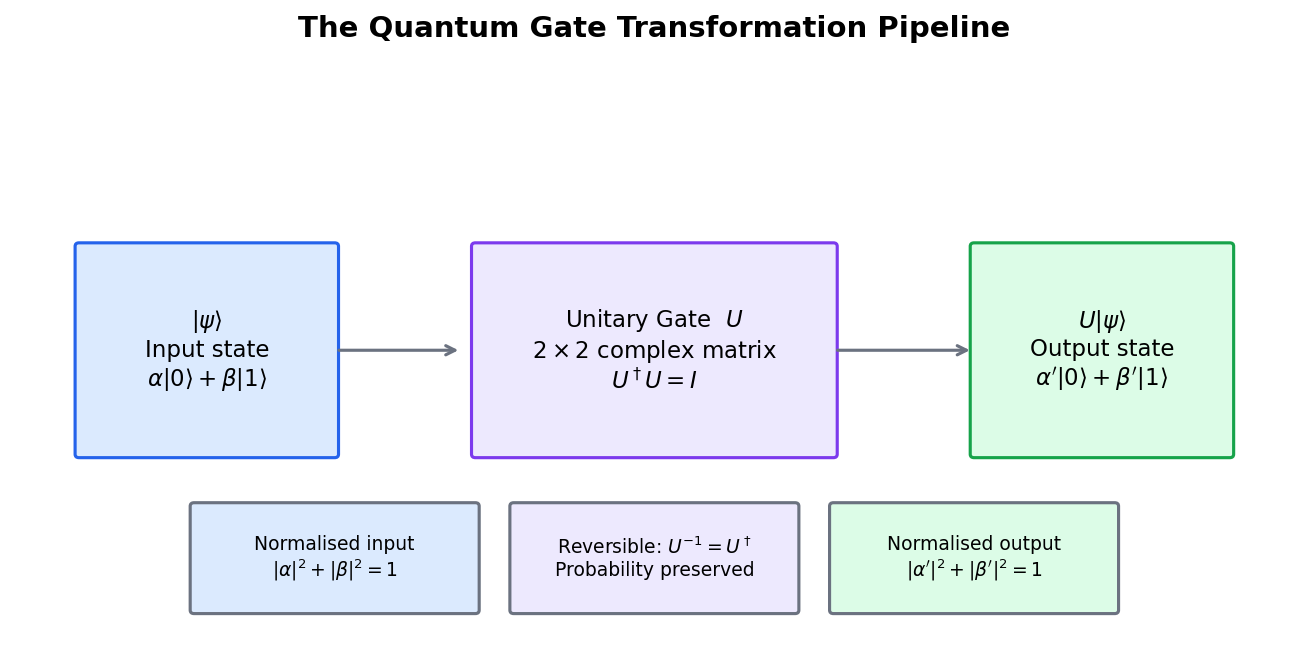
Mathematically, a quantum gate acting on a single qubit is represented by a $2 \times 2$ complex matrix, denoted as $U$. For a gate to be physically realizable, it must preserve the total probability of the qubit state, which means the state vector must remain normalized (its length must remain exactly 1). This requirement dictates that all quantum gates must be represented by unitary matrices. A matrix $U$ is unitary if its conjugate transpose, denoted as $U^\dagger$ (U-dagger), is also its inverse, satisfying the relation $U^\dagger U = U U^\dagger = I$, where $I$ is the identity matrix. When we apply a gate $U$ to a qubit state $|\psi\rangle = \alpha|0\rangle + \beta|1\rangle$, we perform matrix-vector multiplication: $|\psi'\rangle = U|\psi\rangle$. Because $U$ is unitary, the new state $|\psi'\rangle = \alpha'|0\rangle + \beta'|1\rangle$ is guaranteed to satisfy $|\alpha'|^2 + |\beta'|^2 = 1$. Geometrically, any single-qubit unitary operation corresponds to a rigid rotation of the state vector on the surface of the 3D Bloch sphere, preserving the angle between states and the distance to the origin.