National Quantum Initiatives
Governments worldwide are investing billions to secure strategic leadership in quantum hardware, software, and workforce
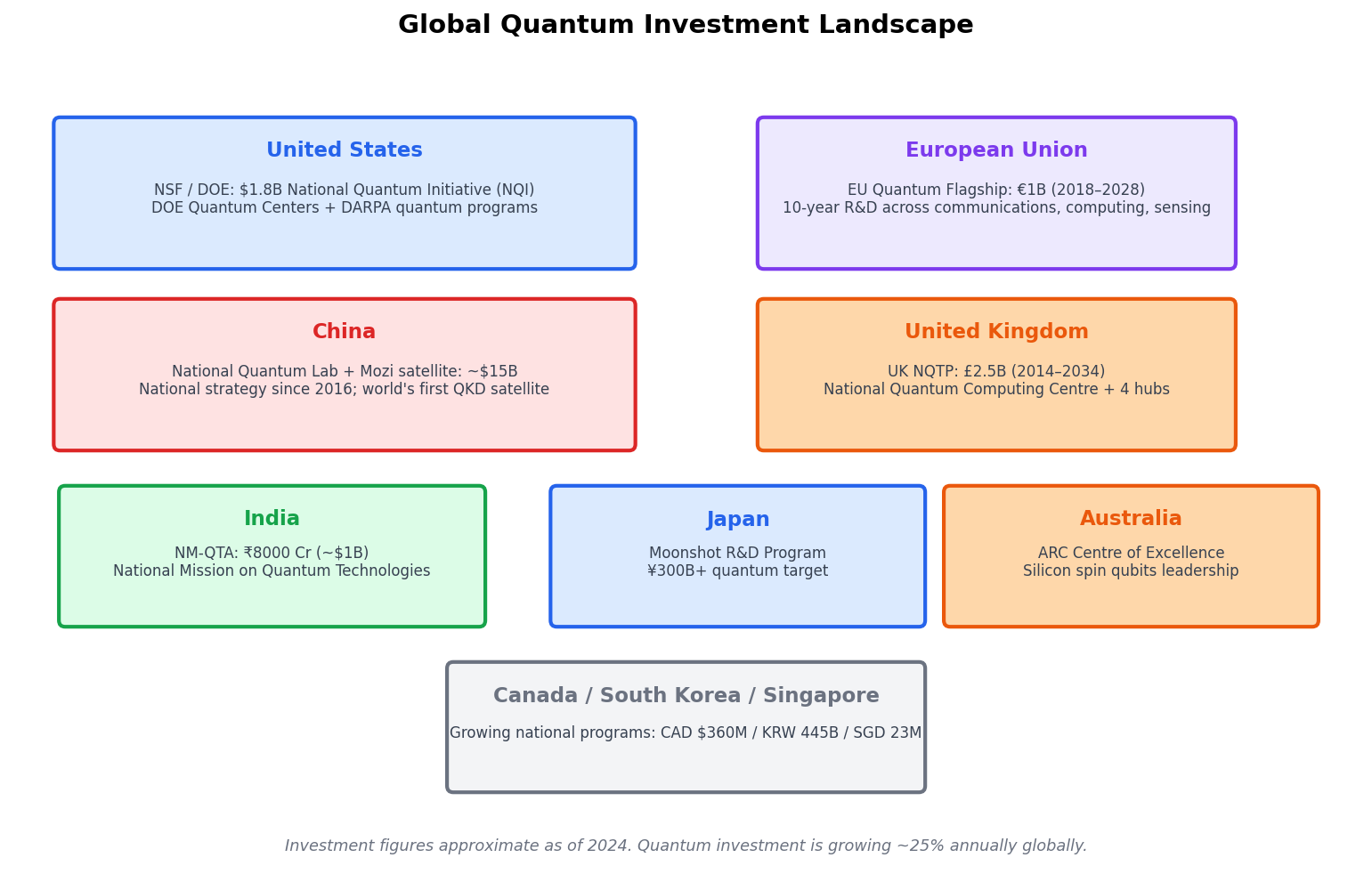
Source: mortalapps.com- National Quantum Initiatives are strategic government programs designed to secure leadership in quantum technology.
- The US National Quantum Initiative Act (2018) established dedicated research centers led by the NSF and DOE.
- China leads global public investment with an estimated $15+ billion, focusing heavily on centralized research facilities.
- National strategies must balance open scientific collaboration with national security and export controls.
- Workforce development is a critical pillar, as the industry faces a severe shortage of qualified quantum engineers.
- Government funding acts as the primary driver for risky, long-term research that private capital cannot support.
Why This Matters
Quantum computing is no longer confined to academic laboratories; it has become a matter of national security and economic competitiveness. Governments around the world have recognized that leadership in quantum technology will define the geopolitical landscape of the 21st century. As a result, nations have launched massive, multi-billion-dollar National Quantum Initiatives to fund research, build infrastructure, and train the future quantum workforce.
Core Intuition
To understand national quantum initiatives, think of the Space Race of the 1960s. When the US and the Soviet Union competed to reach the moon, it wasn't just about planting a flag; it was about developing the advanced materials, computing systems, and engineering talent that would power the next several decades of technological dominance. Quantum computing is the new Space Race.
Another analogy is the building of the transcontinental railroads in the 19th century. No single private company could afford the massive risk and capital required to lay thousands of miles of track across unexplored territory. Governments stepped in with land grants and subsidies because they knew the resulting network would unlock unprecedented economic growth. Similarly, governments today are funding the foundational quantum research that is too risky or expensive for private venture capital to support alone.
Visualization
Technical Explanation
National quantum initiatives are structured policy frameworks designed to accelerate the transition of quantum technologies from physics labs to commercial markets. These programs typically focus on four key pillars: foundational research funding, infrastructure development (such as national user facilities), workforce development, and international standards and export controls.
In the United States, the National Quantum Initiative Act was signed into law in December 2018, allocating over $1.2 billion to establish dedicated quantum research centers led by the National Science Foundation (NSF) and the Department of Energy (DOE). These centers bring together national laboratories, universities, and private companies to collaborate on hardware scaling and algorithmic development.
Geopolitically, these initiatives must balance open scientific collaboration with national security. Because quantum computers threaten classical encryption, and quantum sensors can detect stealth military assets, governments are increasingly implementing export controls on quantum hardware and restricting foreign investments in domestic quantum startups. This has led to a fragmented global landscape where nations compete to secure intellectual property while trying to attract top global talent.