Reversible Computing
Every quantum gate is unitary and therefore reversible, meaning no information is lost and heat dissipation is avoided
Source: mortalapps.com- All closed quantum evolutions (and thus all quantum gates) are completely reversible.
- Reversibility is mathematically guaranteed by the unitary condition: U†U = I.
- Every quantum gate U has a unique inverse gate U† that perfectly undoes its action.
- To reverse a sequence of gates, you must apply their inverses in the reverse order.
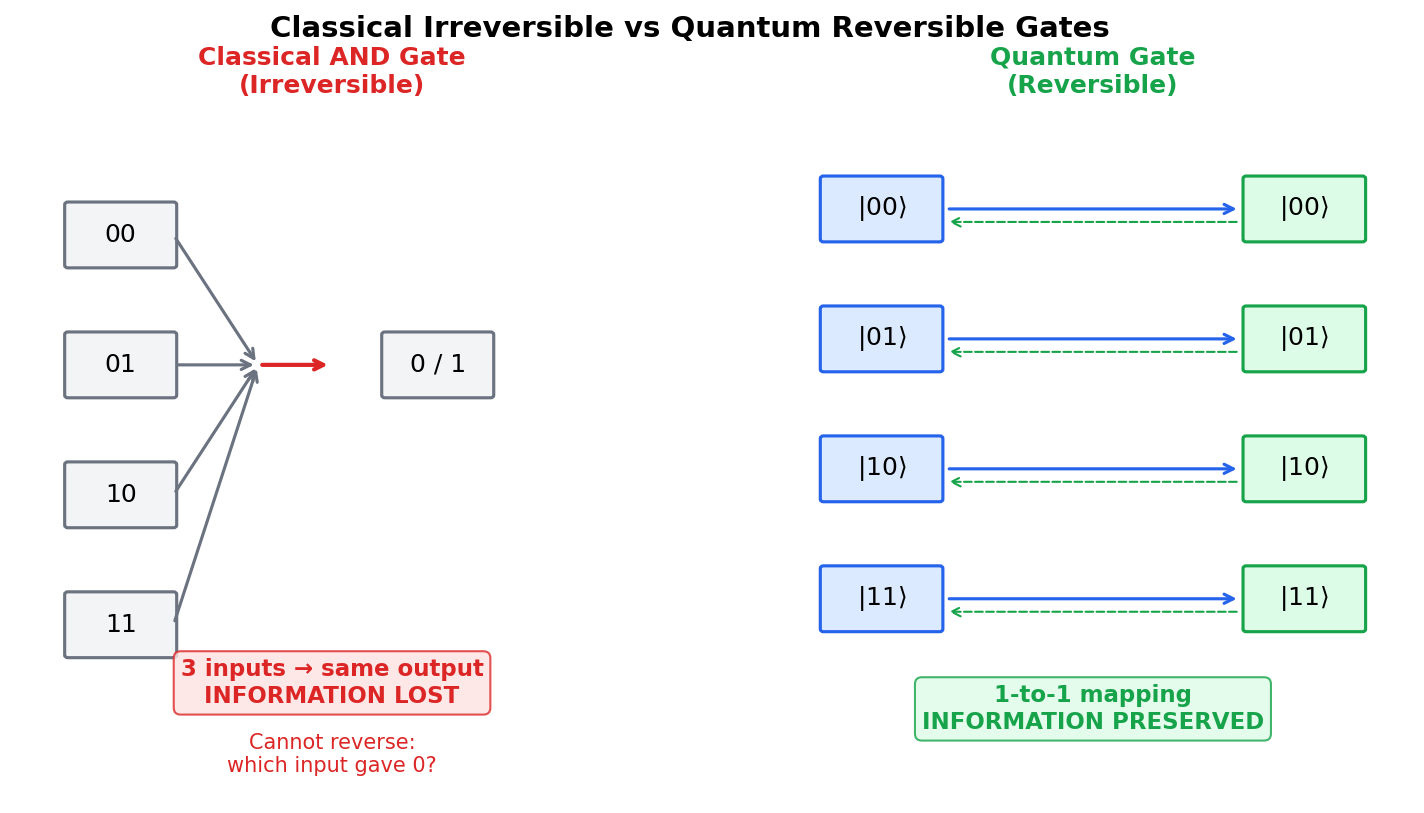
- Unlike classical logic gates (like AND), quantum gates never discard information.
- Measurement is the only operation in quantum computing that is irreversible.
Why This Matters
In classical computing, most operations are irreversible. When you perform an AND operation on two bits and get a 0, you cannot reconstruct the original inputs (they could have been 00, 01, or 10). This loss of information has a physical cost: according to Landauer's Principle, erasing information inevitably dissipates heat. In contrast, quantum computing is entirely reversible. Because all quantum gates are represented by unitary matrices, every single quantum operation can be run backward to perfectly reconstruct the input from the output. This fundamental property has profound implications for both the physics and the algorithms of quantum systems.
Core Intuition
Imagine watching a video of a glass falling off a table and shattering on the floor. If you play the video backward, you see the shards gather together and fly back onto the table, an event that is physically impossible in our everyday macroscopic world because of thermodynamics. In the quantum world, however, physics is perfectly symmetric. Every quantum gate is like a video that can be played backward with absolute physical fidelity. If you apply a gate to a qubit, you can always apply its 'inverse' gate to perfectly undo the operation, like unscrambling an egg. There is no 'delete' key in quantum computing; information is always conserved.
Visualization
Technical Explanation
The mathematical foundation of reversibility is the unitary condition: $U^\dagger U = I$. This equation states that for any quantum gate $U$, there exists an inverse operation $U^\dagger$ (the conjugate transpose) that perfectly undoes it. If we apply a gate $U$ to a state $|\psi\rangle$ to get $|\phi\rangle = U|\psi\rangle$, we can recover the original state by applying $U^\dagger$: $U^\dagger|\phi\rangle = U^\dagger(U|\psi\rangle) = (U^\dagger U)|\psi\rangle = I|\psi\rangle = |\psi\rangle$. In classical computing, a gate like AND is irreversible because it maps 4 input states (00, 01, 10, 11) to 2 output states (0, 1), losing 1 bit of information. In quantum computing, a gate must map $N$ states to $N$ states bijectively, preserving the dimensionality of the state space. This conservation of information is a direct consequence of the Schrödinger equation, which governs all closed quantum systems.