Common Misconceptions About Qubits
A qubit has one well-defined superposition state, and speedup comes from wave interference, not parallel universes
Source: mortalapps.com- A qubit is in a single, well-defined quantum state, not 'both 0 and 1' simultaneously.
- Quantum speedup is driven by wave interference, not brute-force parallel universe search.
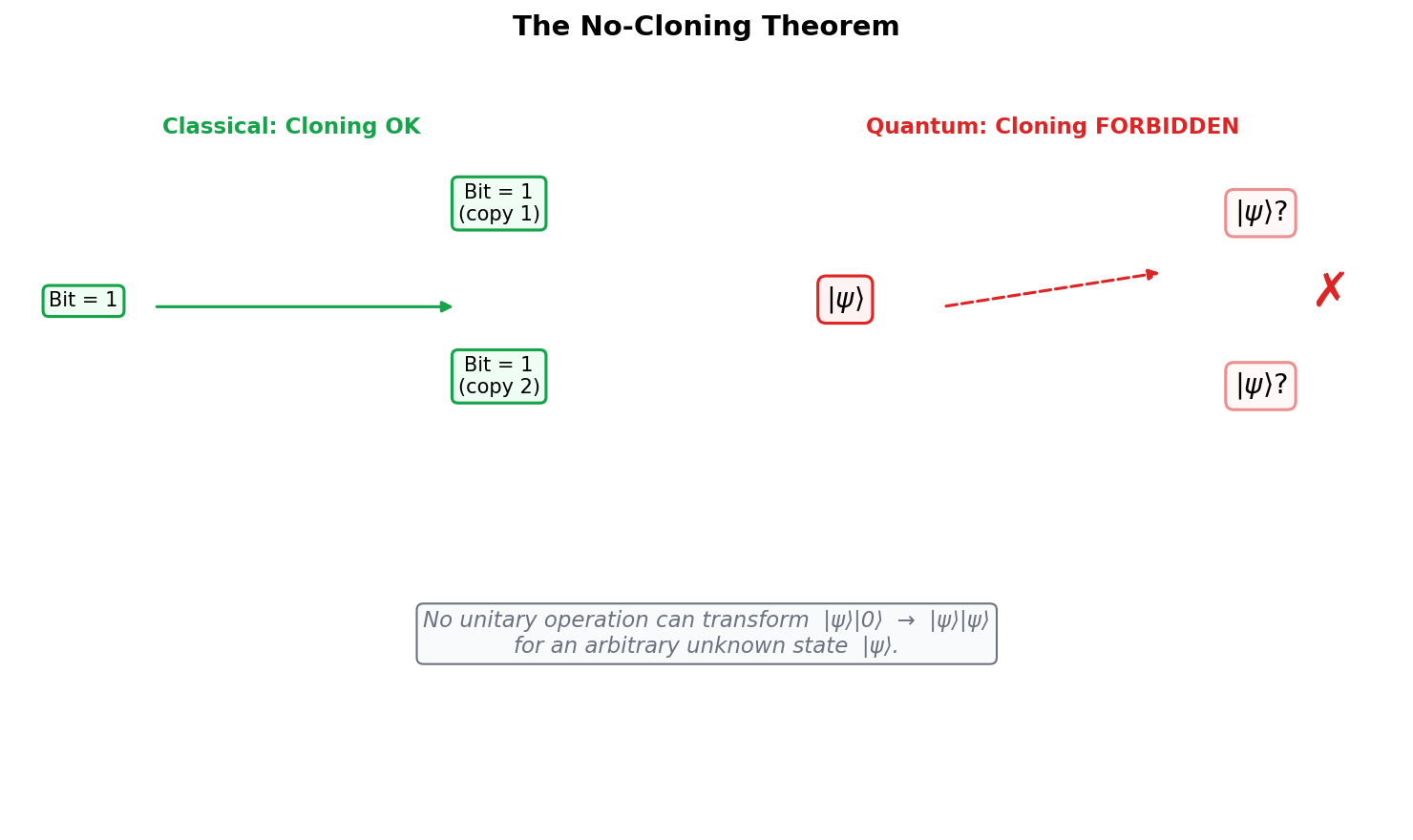
- The No-Cloning Theorem proves it is physically impossible to copy an unknown quantum state.
- Holevo's Theorem limits the extractable classical information from a single qubit to exactly 1 bit.
- The No-Communication Theorem ensures quantum entanglement cannot transmit information faster than light.
- Rigorous linear algebra, not popular science analogies, is the true language of quantum computing.
Why This Matters
As we conclude our deep dive into the qubit, it is vital to address the elephant in the room. Quantum computing is surrounded by an unprecedented amount of hype, popular science oversimplifications, and outright myths. Many of these misconceptions stem from trying to force quantum phenomena into classical mental models. While these analogies can help beginners, they quickly become major obstacles to true technical understanding.
In this topic, we will systematically deconstruct the most common misconceptions about qubits. We will analyze why popular phrases like 'both 0 and 1 at the same time' are mathematically misleading. We will explore the physical boundaries of quantum information, clarifying what a qubit can and cannot do, and establish a rigorous, accurate intuition that will serve you well as we transition to quantum gates.
By the end of this topic, you will be able to spot and correct common quantum myths, explain the physical limits of quantum information (such as the No-Cloning Theorem), and discuss quantum mechanics using the precise, professional language of quantum information scientists.
Core Intuition
Imagine you are watching a magic show. The magician appears to saw a person in half. If you believe they literally cut a person in half and put them back together, you are falling for an illusion. To understand the trick, you have to look behind the scenes at the physical mechanisms. Many popular explanations of quantum computing are like that magic trick, they describe the illusion, not the physical reality.
For example, the idea that a qubit is 'both 0 and 1 at the same time' is a classic illusion. It suggests the qubit is in some chaotic, dual state. In reality, a qubit is in a single, perfectly well-defined, coherent state (a vector pointing to a specific spot on the Bloch Sphere). The '0 and 1' only appear when we force the qubit to collapse through measurement. The superposition is a single state of potential, not a dual state of existence.
Another common illusion is that quantum computers are fast because they 'try every possible answer at once' in parallel universes. If this were true, quantum programming would be easy: you would just run a search and instantly get the answer. In reality, quantum computers are fast because they use wave interference to cancel out wrong answers and amplify correct ones. It is a process of coordination, not brute-force duplication.
Visualization
Technical Explanation
Let us mathematically analyze some of these misconceptions.
First, consider the myth of 'infinite information.' Since a qubit state $|\psi\rangle = \cos(\theta/2)|0\rangle + e^{i\phi}\sin(\theta/2)|1\rangle$ is defined by two continuous angles $\theta$ and $\phi$, it seems a single qubit can store an infinite amount of classical data (e.g., we could encode the entire text of the Encyclopedia Britannica into the digits of $\theta$). However, Holevo's Theorem (proved by Alexander Holevo in 1973) states that the maximum amount of classical information that can be extracted from a single qubit is exactly 1 bit. Measurement collapses the continuous state, destroying the extra information.
Second, consider the 'quantum copier' myth. In classical computing, we can copy data easily ($x = y$). In quantum mechanics, this is forbidden by the No-Cloning Theorem (proved by Wootters, Zurek, and Dieks in 1982). Suppose we have a unitary operator $U$ that can copy an arbitrary state $|\psi\rangle$ onto a target state $|e\rangle$:
$$U|\psi\rangle|e\rangle = |\psi\rangle|\psi\rangle$$ $$U|\phi\rangle|e\rangle = |\phi\rangle|\phi\rangle$$
Taking the inner product of these two equations:
$$\langle\psi|\phi\rangle\langle e|e\rangle = \langle\psi|\phi\rangle\langle\psi|\phi\rangle \implies \langle\psi|\phi\rangle = (\langle\psi|\phi\rangle)^2$$
This equation is only true if $\langle\psi|\phi\rangle = 0$ or $\langle\psi|\phi\rangle = 1$. This means we can only copy states that are identical or completely orthogonal. It is mathematically impossible to build a universal quantum copier that can clone an unknown quantum state.