Ethical Implications
Quantum computing could break current encryption and reshape global power, demanding proactive ethical governance now
Source: mortalapps.com- Quantum computing carries a profound ethical responsibility due to its potential societal impact.
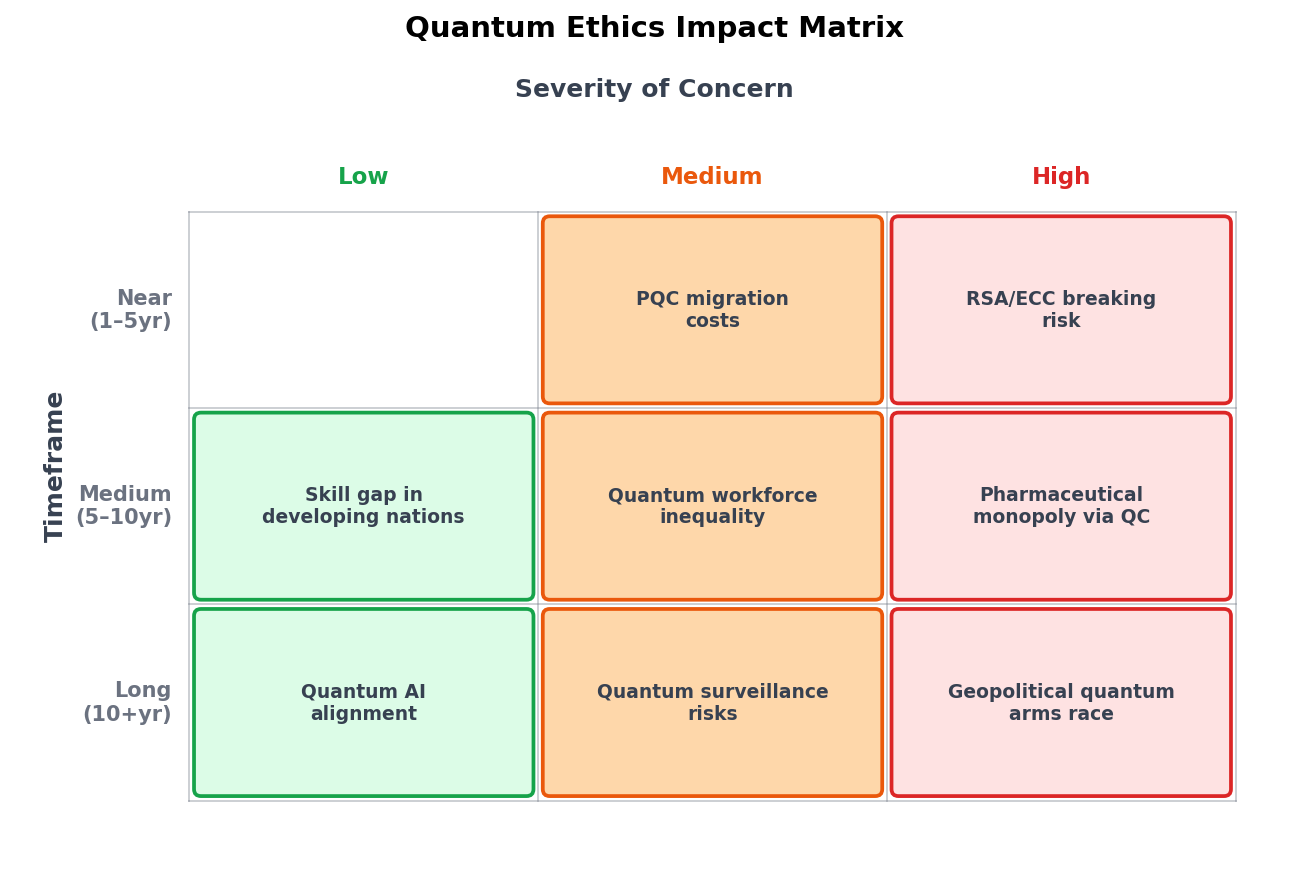
- The threat of Shor's algorithm breaking encryption represents a major risk to global privacy and security.
- The 'dual-use dilemma' means quantum simulation can design both life-saving medicines and lethal chemical weapons.
- The 'quantum divide' could concentrate the benefits of quantum technology in a few wealthy nations, worsening global inequality.
- Responsible governance requires collaboration between scientists, policy makers, and corporate leaders.
- Ethical frameworks must be integrated into quantum research and development today, before the technology matures.
Why This Matters
The development of quantum computing is not just a scientific challenge; it is a profound ethical responsibility. Like the pioneers of nuclear physics or artificial intelligence, quantum scientists are building a technology that has the potential to reshape society. From breaking the cryptographic systems that protect global privacy to creating powerful new materials and weapons, the ethical implications of quantum computing must be addressed today, before the technology matures.
Core Intuition
To understand the ethical stakes of quantum computing, imagine discovering a master key that can open any lock in the world. If this key falls into the hands of a single nation or corporation, they could access anyone's private bank accounts, medical records, and personal communications. The threat of Shor's algorithm breaking modern encryption is that master key. We have an ethical obligation to build the 'new locks' (Post-Quantum Cryptography) before the master key is completed.
Another analogy is the discovery of synthetic fertilizers in the early 20th century. The Haber-Bosch process allowed humanity to grow enough food to feed billions of people, saving entire populations from starvation. However, the exact same chemical principles were immediately used to manufacture explosives for World War I, leading to unprecedented destruction. Quantum chemistry simulations could help us design clean energy systems, but they could also be used to design highly lethal chemical weapons. How we govern this dual-use technology is a critical ethical challenge.
Visualization
Technical Explanation
The ethical landscape of quantum computing can be analyzed through three primary frameworks: security and privacy, equitable access, and dual-use governance. The security threat is mathematically defined by the timeline of cryptographic collapse. If the time to build a cryptanalytically useful quantum computer ($T_{collapse}$) is less than the time required to migrate global infrastructure to post-quantum standards ($T_{migration}$), we face a period of extreme vulnerability:
$$T_{migration} > T_{collapse} \implies \text{Cryptographic Crisis}$$
During this crisis, financial systems, national power grids, and personal data would be exposed to decryption, representing a massive failure of digital safety. The ethical responsibility to accelerate PQC migration is therefore a matter of protecting fundamental human rights to privacy and security.
Equitable access is another major concern. Because quantum computers are incredibly expensive to build and operate, they will likely be hosted in the cloud by a handful of tech giants in wealthy nations. This could create a 'quantum divide,' where developing nations are excluded from the economic and scientific benefits of quantum chemistry and optimization, exacerbating global inequality. Finally, the dual-use nature of quantum simulation, which can design both life-saving drugs and novel chemical weapons, requires the development of international governance frameworks similar to those used for nuclear and biological technologies.