Revisiting Classical Bits
A classical bit is mathematically formalized as a two-state orthonormal basis, laying the groundwork for the qubit
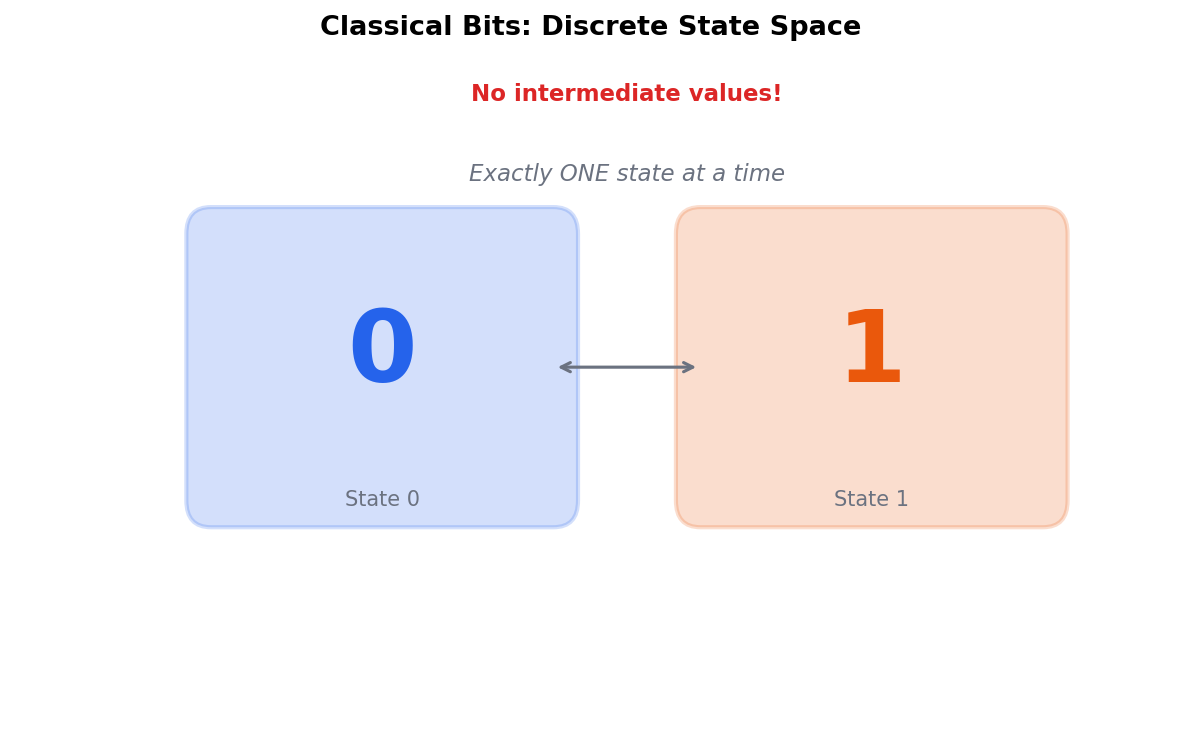
Source: mortalapps.com- A classical bit is the fundamental unit of classical information, existing in one of two mutually exclusive states.
- The states of a classical bit can be mathematically represented as orthonormal basis vectors in a two-dimensional vector space.
- The state |0⟩ is represented by the column vector [1, 0]^T, and the state |1⟩ is represented by [0, 1]^T.
- Orthonormality means that the inner product of a state with itself is 1, and the inner product of distinct states is 0.
- The state space of a classical bit consists of exactly two discrete points, with no physical or mathematical intermediate states allowed.
- Modern classical computers rely on physical transistors to implement these binary states through voltage levels.
Why This Matters
To truly appreciate the radical departure that quantum computing represents, we must first re-examine the foundation of modern digital technology: the classical bit. In our daily lives, we are surrounded by devices that process, store, and transmit vast oceans of information. Yet, at the lowest physical level, all of this complexity is distilled into a simple, binary choice between two mutually exclusive states. Understanding how we mathematically formalize this simple choice is the essential first step toward understanding how quantum systems expand this paradigm into infinite dimensions.
This topic deconstructs the classical bit not merely as a familiar programming concept, but as a physical system governed by classical state spaces. By viewing the classical bit through the mathematical lens of vector spaces, which we established in the previous section, we can begin to see the structural limitations of classical information. We will define the state of a classical bit using vector notation, laying a direct mathematical bridge to the quantum world.
By the end of this topic, you will be able to represent classical states as discrete vectors, understand the concept of a state space, and identify the precise mathematical boundaries that classical physics imposes on information processing. This rigorous re-framing will ensure that when we introduce the qubit, you will perceive it not as a magical entity, but as a natural, geometric generalization of the classical bit.
Core Intuition
Imagine a standard household light switch. It can be in one of two positions: up, which we label as 'on' (or 1), or down, which we label as 'off' (or 0). There is no stable middle ground; if you try to balance the switch halfway, gravity or the internal spring mechanism will inevitably force it into one of the two definite positions. This binary exclusivity is the core intuition of classical information. A classical bit is a physical system constrained to exist in one of two distinct, non-overlapping states.
Another helpful analogy is a railway switch that directs a train onto one of two parallel tracks. The train must travel down Track A or Track B; it cannot split itself to travel down both simultaneously. The physical state of the track switch is completely deterministic and mutually exclusive. If we inspect the switch, we find a single, definite piece of information that dictates the entire future path of the train.
In classical computing, we exploit this physical exclusivity by using microscopic transistors that either allow electrical current to flow (representing 1) or block it (representing 0). The entire digital universe, from high-definition video streaming to complex financial modeling, is built by chaining billions of these simple, binary switches together. The fundamental limitation, however, is that at any single point in time, each switch is strictly in one state or the other.
Visualization
Technical Explanation
Mathematically, we can represent the two states of a classical bit as vectors in a two-dimensional real vector space $\mathbb{R}^2$. Let us define the state '0' and the state '1' using Dirac notation as our computational basis vectors. We write the state 0 as the column vector $|0\rangle$ and the state 1 as the column vector $|1\rangle$:
$$|0\rangle = \begin{pmatrix} 1 \\ 0 \end{pmatrix}, \quad |1\rangle = \begin{pmatrix} 0 \\ 1 \end{pmatrix}$$
These two vectors are orthonormal, meaning they are both normalized to unit length and are orthogonal to each other. We can verify this using the inner product, which we write as a bra-ket. The inner product of $|0\rangle$ with itself is:
$$\langle 0|0\rangle = \begin{pmatrix} 1 & 0 \end{pmatrix} \begin{pmatrix} 1 \\ 0 \end{pmatrix} = 1(1) + 0(0) = 1$$
Similarly, the inner product of $|0\rangle$ and $|1\rangle$ is:
$$\langle 0|1\rangle = \begin{pmatrix} 1 & 0 \end{pmatrix} \begin{pmatrix} 0 \\ 1 \end{pmatrix} = 1(0) + 0(1) = 0$$
In classical information theory, a bit must exist strictly in state $|0\rangle$ or state $|1\rangle$. If we represent the general state of a bit as a vector $|x\rangle = c_0|0\rangle + c_1|1\rangle$, classical physics restricts the coefficients $c_0$ and $c_1$ such that one coefficient must be exactly 1 and the other must be exactly 0. There are no intermediate states, no fractional values, and no complex numbers. The state space of a classical bit consists of exactly two discrete points in $\mathbb{R}^2$.