The Limits of Classical Computing
Moore's Law is slowing as transistors hit atomic scales, forcing us to look beyond classical bits for a path forward
Source: mortalapps.com- Classical computers process information using bits, which are always in a definite state of either 0 or 1.
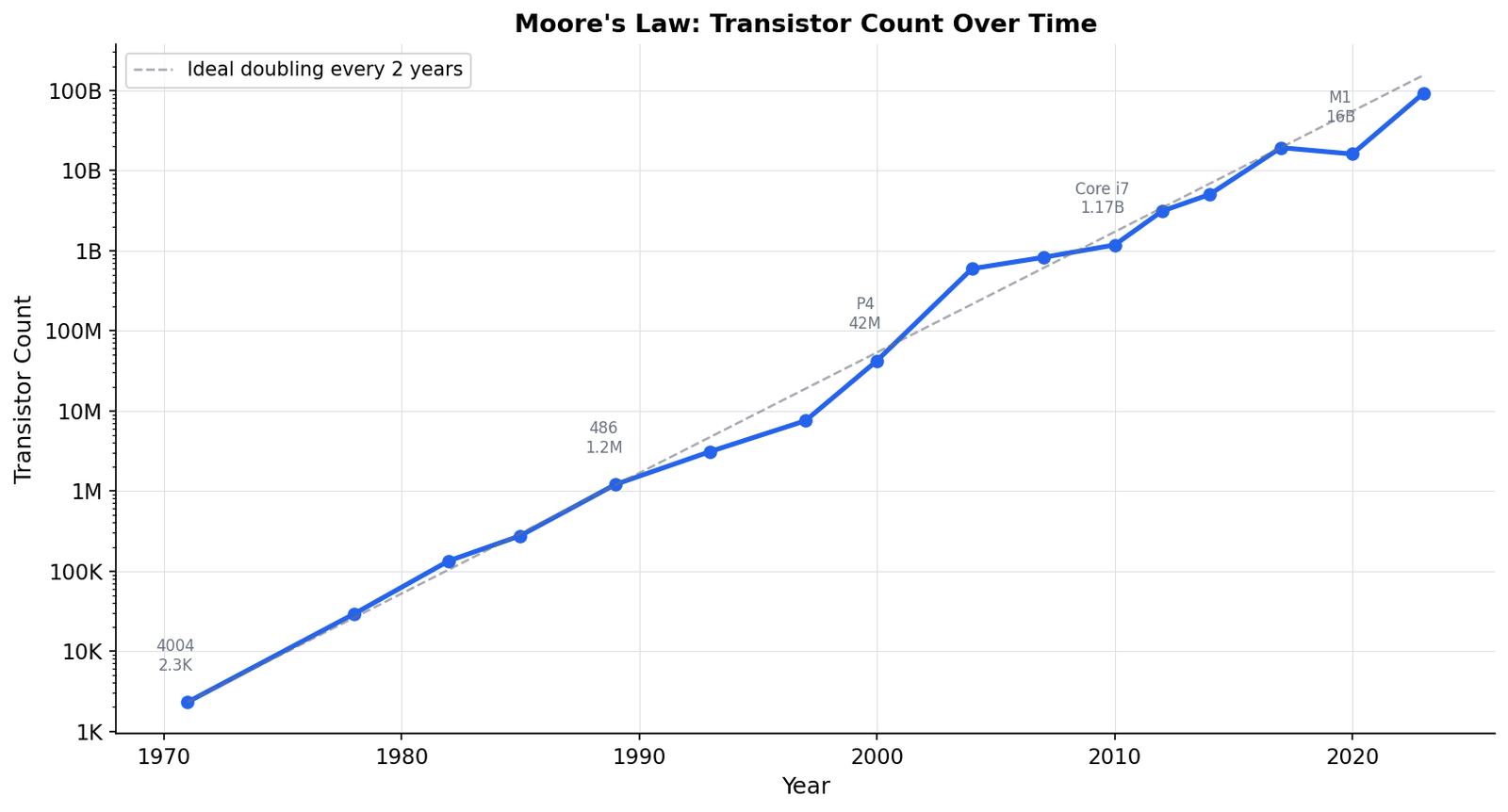
- Moore's Law, the historical trend of increasing transistor density, is slowing down due to physical limitations.
- Beyond physical limits, classical computers struggle with problems where the number of possibilities grows exponentially.
- Examples of such problems include simulating complex molecules, designing new materials, and solving large-scale optimization tasks.
- Classical computers often have to rely on approximations for these hard problems, which can lead to less accurate or suboptimal solutions.
- The need for quantum computing arises from these fundamental limitations, not from classical computers being 'bad' at everyday tasks.
Why This Matters
Welcome to the MortalApps Quantum Computing Platform! You're about to embark on a fascinating journey into a technology that promises to revolutionize our world. Before we dive into the 'how' of quantum computing, it's crucial to understand the 'why.' Why do we even need a new type of computer when our current ones seem so powerful?
This first topic will explore the fundamental boundaries that classical computers, the ones we use every day, are starting to hit. We'll see that despite their incredible advancements, there are certain types of problems they simply cannot solve efficiently, no matter how fast they get.
By the end of this topic, you'll grasp the core reasons why scientists and engineers are investing so much effort into building quantum computers. You'll understand that this isn't just about making faster versions of existing machines, but about tackling entirely new classes of computational challenges.
Core Intuition
Imagine you're trying to find a specific grain of sand on a beach. A classical computer is like a very diligent person who picks up one grain at a time, examines it, and puts it back if it's not the right one. They can do this incredibly fast, but if the beach is enormous, it will still take an impossibly long time.
Now, consider a different kind of problem: designing a new molecule for a drug. This is like trying to figure out how billions of tiny magnets will arrange themselves when thrown into a box. A classical computer has to calculate every single possible arrangement one by one, which quickly becomes an astronomical number. Even with the fastest supercomputers, simulating complex molecules or materials at a fundamental level is beyond their reach.
Our everyday computers are fantastic at tasks like browsing the web, playing games, or crunching numbers for spreadsheets. But when problems involve exploring an immense number of possibilities simultaneously, or simulating the intricate behaviors of nature at its smallest scales, they quickly run out of steam. They are fundamentally limited by how they process information, one step at a time.
Visualization
Technical Explanation
Classical computers, from your smartphone to the world's most powerful supercomputers, operate on a fundamental principle: they process information using 'bits.' A bit is the most basic unit of information, representing either a 0 or a 1. Everything a classical computer does, from storing a photo to running a complex simulation, is ultimately broken down into sequences of these 0s and 1s.
The power of classical computers has grown exponentially over decades, largely due to our ability to shrink transistors, the tiny switches that make up bits. This trend, famously known as Moore's Law, has allowed us to pack billions of transistors onto a single chip, leading to incredible increases in processing speed and memory capacity.
However, this miniaturization is approaching physical limits. Transistors are now so small that they are reaching the atomic scale, where the strange rules of quantum mechanics begin to take over. It's becoming increasingly difficult and expensive to make them smaller, faster, and more energy-efficient without encountering fundamental physical barriers.
Beyond these physical limitations, classical computers face inherent computational hurdles for certain types of problems. For instance, simulating the behavior of complex molecules or materials requires tracking the interactions of many particles simultaneously. The number of possible interactions grows exponentially with the number of particles, meaning that even a small increase in complexity can overwhelm even the largest classical supercomputers.
Another example is optimization problems, like finding the most efficient delivery route for hundreds of packages. A classical computer might try many routes, but it can't explore all possible combinations if the number of variables is too large. It often has to settle for a 'good enough' solution rather than the absolute best one, simply because checking every single possibility is computationally intractable.