Superposition Intuition
A qubit in superposition holds a weighted blend of 0 and 1 at once, collapsing to a definite value only on measurement
Source: mortalapps.com- Superposition allows a qubit to exist in a blend of 0 and 1 simultaneously, not just one or the other.
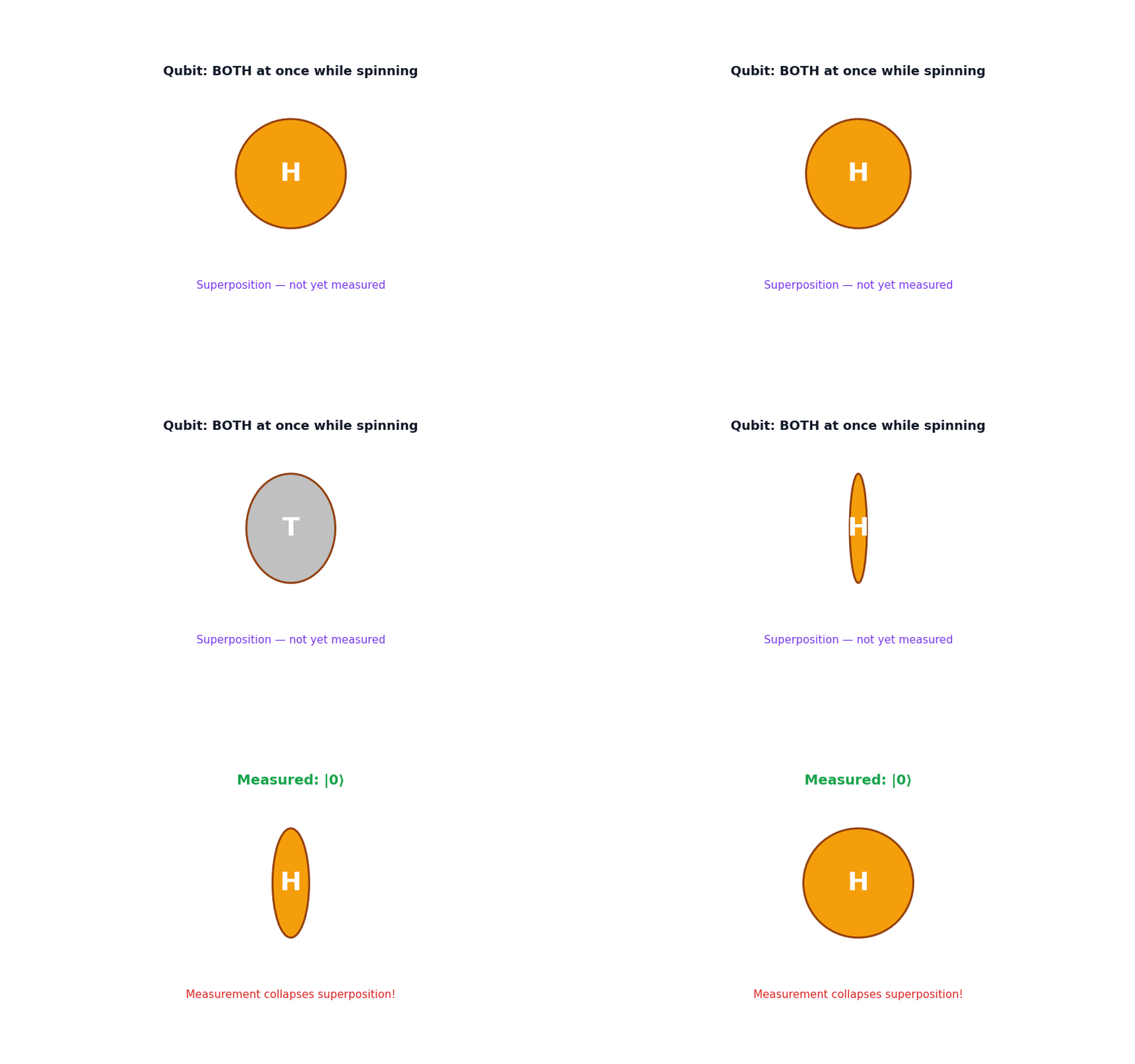
- This is like a spinning coin that is both heads and tails until it lands.
- The 'mix' of 0 and 1 in superposition determines the probabilities of measurement outcomes.
- Measurement collapses the superposition, yielding a definite 0 or 1 based on these probabilities.
- Superposition enables a single qubit to represent more information than a classical bit.
- A system of N qubits in superposition can represent 2^N classical states simultaneously, leading to exponential power.
Why This Matters
In our last topic, 'Bits vs Qubits,' you were introduced to the qubit and its most mind-bending property: superposition. We learned that a qubit isn't just 0 or 1, but can be both simultaneously. This concept is so counter-intuitive to our everyday experience that it often requires a bit more exploration to truly sink in.
This topic is dedicated to building a strong, intuitive understanding of superposition. We'll use more analogies and examples to help you visualize what it means for something to exist in multiple states at once, and how this 'blended' reality is different from simply being unknown or uncertain.
By the end of this topic, you'll feel more comfortable with the idea of superposition and appreciate why it's the first key ingredient in quantum computing's power, allowing quantum systems to explore many possibilities in parallel.
Core Intuition
Imagine a musical chord. When you play a C major chord, you're hearing three notes (C, E, G) simultaneously. It's not that you hear C, then E, then G very quickly; you hear them all at once, blended into a single, richer sound. A qubit in superposition is a bit like that chord: it's a blend of 0 and 1, existing together, not sequentially.
Another way to think about it is a compass needle that hasn't settled yet. While it's spinning, it's not pointing definitively North, South, East, or West. It's in a 'superposition' of all directions. Only when it stops does it pick one. But here's the quantum twist: a qubit can be *manipulated* while it's spinning, and the way it's spinning (its 'bias') can be precisely controlled.
Consider a light that can be red or blue. A classical light is either red OR blue. A qubit in superposition is like a light that is simultaneously purple – a blend of red and blue. It's not just a trick of the eye; the light *is* purple. Only when you put a filter (measurement) that only lets red or blue through, does it definitively become one or the other, based on how 'red' or 'blue' it was in its purple state.
Visualization
Technical Explanation
Superposition is a core principle of quantum mechanics stating that a quantum system, such as a qubit, can exist in multiple states simultaneously until it is measured. Before measurement, the qubit is not in a definite 0 or 1 state; rather, it is in a probabilistic combination of both. This combination is precisely described by what are called 'probability amplitudes,' which determine the likelihood of measuring a 0 or a 1.
Think of a qubit's state as a vector in a special kind of space. This vector can point towards 0, towards 1, or anywhere in between. The 'direction' of this vector determines the probabilities. If it points strongly towards 0, you're very likely to measure 0. If it points equally between 0 and 1, you have an equal chance of measuring either.
This is fundamentally different from classical probability. If you have a classical coin, it's either heads or tails, even if you don't know which. The probability of heads is 50% because you're uncertain. A qubit in superposition, however, is *actually* in both states at once. The probabilities arise from the act of measurement, which forces the qubit to 'choose' a definite state.
The power of superposition comes from its ability to represent and process multiple pieces of information simultaneously. If you have a system of 'N' qubits, and each qubit can be in a superposition of 0 and 1, then the entire system can exist in a superposition of 2 to the power of N classical states. This exponential growth in representable states is what allows quantum computers to tackle problems that overwhelm classical machines.
For example, with just 300 qubits in superposition, you could represent more classical states than there are atoms in the observable universe. This massive parallel information storage is the first step towards quantum advantage, enabling quantum algorithms to explore vast solution spaces in ways impossible for classical computers.