Entanglement Intuition
Entangled qubits share a unified quantum state, so measuring one instantly determines the outcome of measuring the other
Source: mortalapps.com- Entanglement is a quantum phenomenon where two or more qubits become linked, sharing a unified quantum state.
- The state of entangled qubits cannot be described independently; measuring one instantly influences the others.
- This 'spooky action at a distance' is not faster-than-light communication, but a property of their shared quantum reality.
- Unlike classical correlation, entangled qubits don't have definite states until one is measured.
- Entanglement allows for complex, coordinated interactions between qubits, enabling powerful quantum algorithms.
- Together with superposition, entanglement is a core resource that gives quantum computers their exponential power.
Why This Matters
You've just wrapped your head around superposition, the idea that a qubit can be 0 and 1 at the same time. That's pretty mind-bending! But quantum mechanics has another trick up its sleeve, one that Albert Einstein famously called 'spooky action at a distance.' This phenomenon is called entanglement, and it's arguably even stranger and more powerful than superposition.
This topic will introduce you to the concept of entanglement, explaining how two or more qubits can become mysteriously linked, sharing a single fate even when physically separated. It's a connection so profound that measuring one instantly influences the others, no matter the distance.
By the end of this topic, you'll have an intuitive grasp of entanglement and understand why it's the second crucial ingredient, alongside superposition, that gives quantum computers their extraordinary power to solve problems classical computers cannot.
Core Intuition
Imagine you have two coins. You flip them both, but you don't look at them. If they are classical coins, they each landed on either heads or tails independently. If you look at one and it's heads, you still have no idea what the other one is.
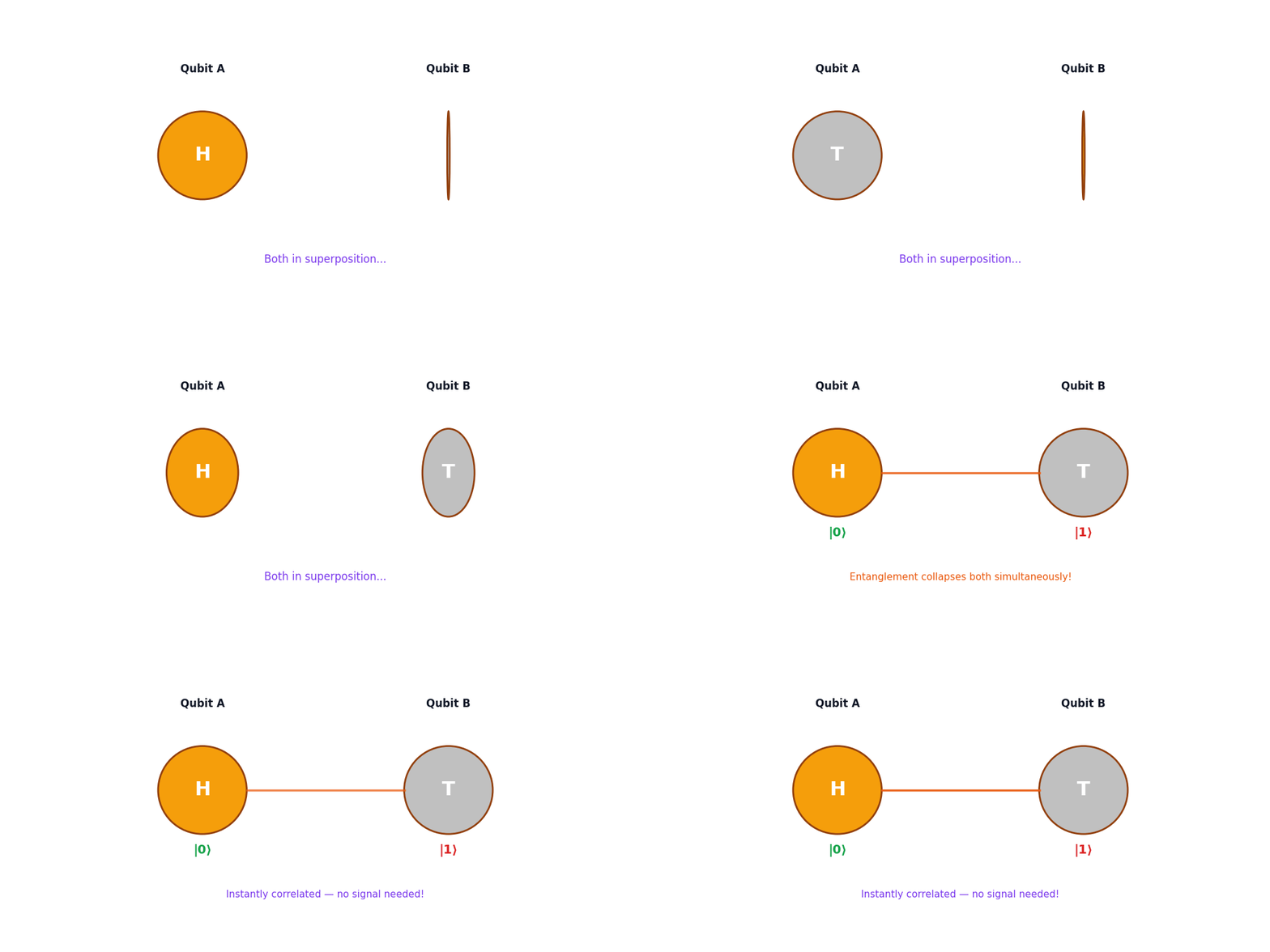
Now, imagine two *magical* coins. You flip them, and again, you don't look. But these coins are 'entangled.' This means that if you look at one and it's heads, you *instantly know* the other one is tails, even if it's miles away. Or if the first is tails, the second is heads. They are perfectly correlated, not because one influenced the other after you looked, but because they were linked from the moment they were flipped.
Think of it like two shoes: a left shoe and a right shoe. If you find a left shoe, you immediately know the other one is a right shoe, even if it's in a different room. They are correlated. Entanglement is similar, but much weirder: the 'shoes' don't even *become* left or right until you look at one of them, and then the other instantly 'decides' its state to match the correlation. It's a shared destiny, where the state of the whole system is more fundamental than the state of its individual parts.
Visualization
Technical Explanation
Entanglement is a quantum mechanical phenomenon where two or more qubits become linked in such a way that the state of each qubit cannot be described independently of the others. Instead, they form a single, unified quantum state. This means that even if the entangled qubits are physically separated by vast distances, a measurement performed on one qubit instantaneously influences the state of the other(s).
Crucially, this isn't about classical correlation, like knowing that if you pick a left shoe, the other is a right shoe. In classical correlation, the shoes *already are* left and right before you look. With entangled qubits, the individual qubits don't have definite states (they are in superposition) until one of them is measured. The act of measuring one qubit forces it to collapse into a definite state (0 or 1), and simultaneously, the other entangled qubit(s) instantly collapse into a correlated state.
For example, if two qubits are entangled such that they must always be opposite (one 0, one 1), and you measure the first qubit to be 0, then the second qubit will instantaneously become 1, no matter how far apart they are. This 'spooky action' doesn't violate the speed of light because no information is actually transmitted faster than light; rather, it's a property of the shared quantum state.
Entanglement is a powerful resource for quantum computing because it allows for complex relationships between qubits that are impossible to achieve with classical bits. When qubits are entangled, operations performed on one qubit can affect the others in a coordinated way, enabling quantum algorithms to perform computations across multiple possibilities simultaneously and efficiently. This creates a much richer computational space than superposition alone, leading to exponential speedups for certain problems.
Together, superposition and entanglement are the two pillars of quantum information processing. Superposition provides the 'parallelism' by allowing qubits to hold multiple values, and entanglement provides the 'connections' that allow these parallel possibilities to interact and influence each other in a coordinated, non-classical way.