Quantum Sensors
Quantum sensors exploit the extreme sensitivity of quantum states to measure fields and time beyond classical precision
Source: mortalapps.com- Quantum sensors use the extreme sensitivity of quantum states to measure physical quantities with high precision.
- Ramsey Interferometry is the primary protocol used to convert environmental fields into measurable phase shifts.
- Unlike classical sensors, quantum sensors rely on fundamental atomic constants and do not require calibration.
- NV centers in diamond enable nanoscale magnetic and temperature sensing at room temperature.
- Cold-atom gravimeters measure tiny changes in gravity, enabling GPS-free navigation and resource exploration.
- Quantum sensors do not require fault tolerance, making them the most commercially mature quantum technology today.
Why This Matters
Throughout this curriculum, we have treated environmental noise as the ultimate enemy of quantum computing. However, in the field of Quantum Sensing, we turn this vulnerability into our greatest strength. Because quantum states are exquisitely sensitive to external disturbances, we can use them to build sensors that measure magnetic fields, gravity, temperature, and time with unprecedented precision.
Core Intuition
To understand quantum sensing, imagine a highly sensitive guitar string. If a tiny draft of wind blows through the room, or if the temperature changes slightly, the string's tension shifts, and its pitch changes. By listening to the pitch, you can detect environmental changes that are invisible to the naked eye. A quantum sensor is like a single atom tuned to a perfect pitch.
Another analogy is a classic balance scale. A standard scale can measure grams or milligrams. A quantum sensor is like a scale so sensitive that a single speck of dust landing on one side tips it completely. By using quantum superposition, we can measure physical forces, like the tiny gravitational pull of underground minerals or the faint magnetic fields of a human brain, at the absolute limits allowed by physics.
Visualization
Technical Explanation
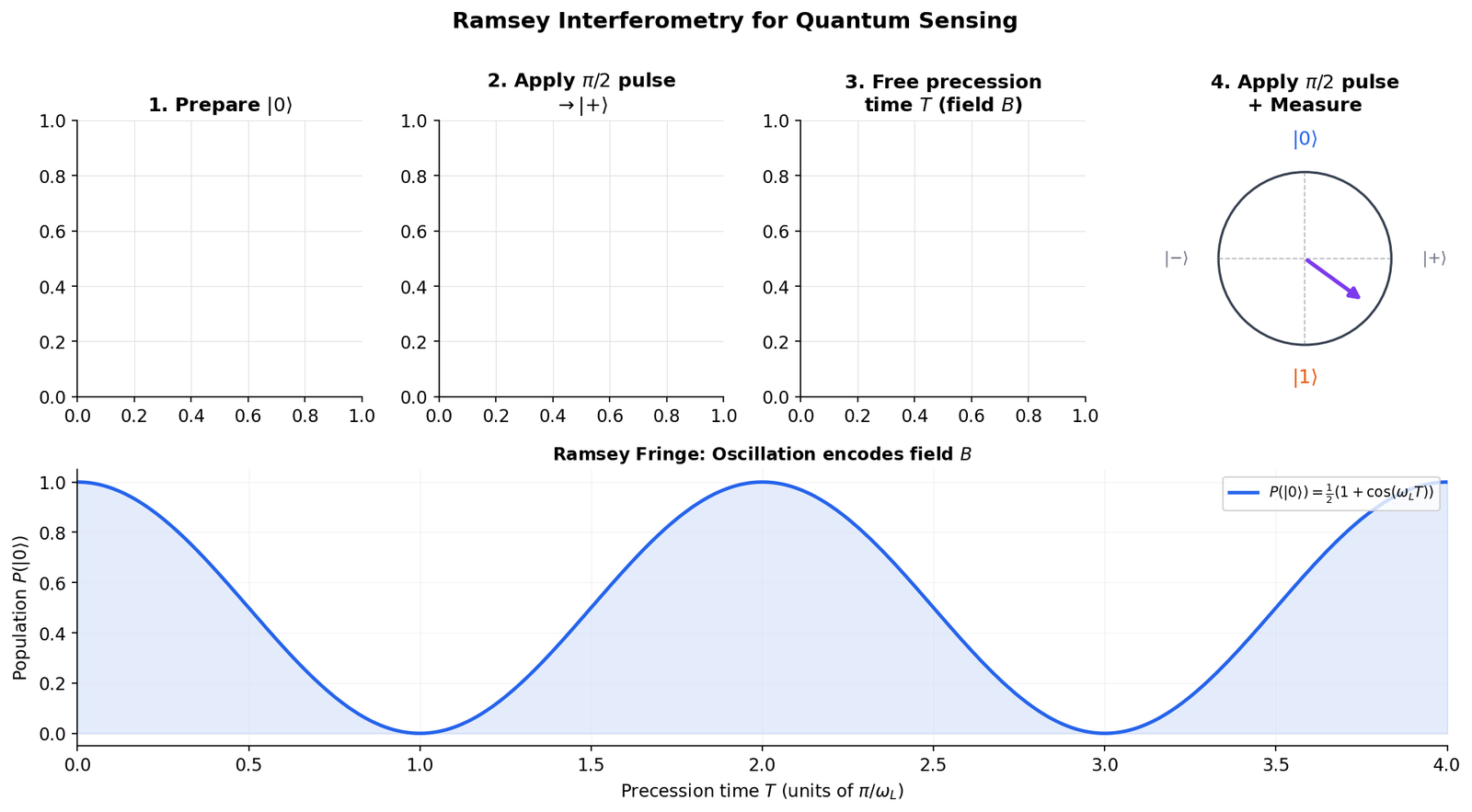
The core mechanism of many quantum sensors is Ramsey Interferometry. We initialize a two-level quantum system (a qubit) in the ground state $|0\rangle$. We apply a $\pi/2$ pulse to prepare a superposition state:
$$| \psi \rangle = \frac{|0\rangle + |1\rangle}{\sqrt{2}}$$
We then let the system evolve freely for a time $\tau$ in the presence of an external field (like a magnetic field $B$). The field causes the energy levels to shift, introducing a phase difference $\Delta \phi$ between $|0\rangle$ and $|1\rangle$:
$$\Delta \phi = \omega \tau = \frac{g \mu_B B \tau}{\hbar}$$
where $g$ is the Landé g-factor and $\mu_B$ is the Bohr magneton. After the evolution time, we apply a second $\pi/2$ pulse and measure the state in the computational basis. The probability of measuring the system in state $|1\rangle$ is:
$$P(1) = \cos^2\left(\frac{\Delta \phi}{2}\right)$$
By measuring $P(1)$, we can extract the phase shift $\Delta \phi$ and calculate the exact strength of the magnetic field $B$. Because this measurement relies on fundamental atomic constants, quantum sensors do not drift over time and do not require calibration, unlike classical sensors. Furthermore, because they do not require complex error correction, quantum sensors are already commercially viable and widely deployed today.