Optimization Problems
Combinatorial optimization problems are encoded as Ising Hamiltonians and attacked using QAOA or quantum annealing
Source: mortalapps.com- Combinatorial optimization problems are mapped to quantum systems by converting cost functions into Ising spin glass Hamiltonians.
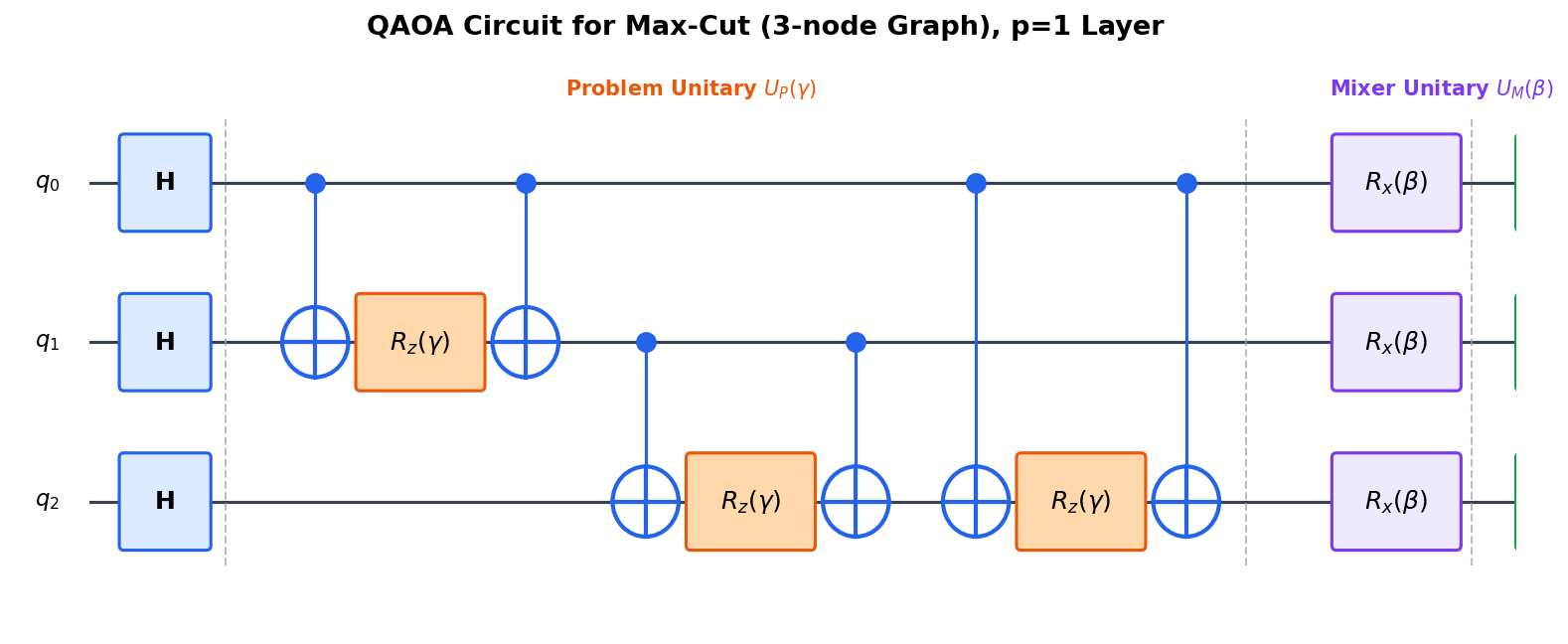
- QAOA is a variational gate-based algorithm that alternates between a problem Hamiltonian and a mixing Hamiltonian.
- Quantum annealing uses physical quantum tunneling to escape local minima in an analog optimization landscape.
- There is no mathematical proof that quantum computers can solve NP-complete problems in polynomial time.
- The performance of quantum optimization must always be benchmarked against highly optimized classical heuristics.
- Increasing the depth $p$ in QAOA improves the approximation ratio but requires higher gate fidelities and longer coherence times.
Why This Matters
Optimization is the process of finding the best possible solution to a problem from a vast set of alternatives. From logistics and supply chain management to financial portfolio design, optimization problems govern the efficiency of our modern world. Many of these problems are NP-hard, meaning classical computers cannot find the absolute best solution efficiently as the problem size grows. Quantum computing offers new paradigms for exploring these vast solution landscapes.
Core Intuition
To understand quantum optimization, imagine a vast, rugged mountain range in the dark. Your goal is to find the absolute lowest valley (the global minimum). A classical optimization algorithm is like a hiker walking down the slopes. If the hiker gets stuck in a small bowl (a local minimum), they might never find the deeper valley on the other side of the mountain because they cannot walk uphill.
Quantum optimization offers two unique ways to solve this. First, quantum annealing is like letting the hiker tunnel directly through the mountain walls using the quantum tunnel effect, allowing them to escape local minima. Second, gate-based algorithms like QAOA use quantum interference to wave-like explore the entire mountain range simultaneously, amplifying the probability of ending up in the deepest valley while canceling out the paths that lead to high peaks.
Visualization
Technical Explanation
Many combinatorial optimization problems can be formulated as finding the ground state of an Ising spin glass model. We map binary variables $x_i \in \{-1, 1\}$ to Pauli-Z operators $Z_i$. The cost function is represented as a problem Hamiltonian $H_P$:
$$H_P = \sum_{i} h_i Z_i + \sum_{i < j} J_{ij} Z_i Z_j$$
In the Quantum Approximate Optimization Algorithm (QAOA), we apply a sequence of alternating unitary operators to an initial uniform superposition state. The two operators are the problem unitary $U(H_P, \gamma) = e^{-i \gamma H_P}$ and the mixer unitary $U(H_M, \beta) = e^{-i \beta H_M}$, where $H_M = \sum_i X_i$. For a depth $p$, the state is prepared as:
$$| \gamma, \beta \rangle = \left( \prod_{k=1}^{p} e^{-i \beta_k H_M} e^{-i \gamma_k H_P} \right) | + \rangle^{\otimes N}$$
We then measure the state in the computational basis, evaluate the cost, and use a classical optimizer to tune the parameters $\gamma$ and $\beta$ to minimize the expectation value $\langle H_P \rangle$. While QAOA is a promising heuristic, the 'No Free Lunch' theorem reminds us that no single algorithm can outperform all others on every problem. Classical heuristics like Lin-Kernighan for the Traveling Salesperson Problem are highly optimized, and proving a definitive quantum speedup over these classical methods remains an active area of research.