Quantum Cryptography
QKD uses the BB84 protocol for information-theoretic security, detecting eavesdroppers through quantum state disturbance
Source: mortalapps.com- Quantum cryptography provides information-theoretic security based on the laws of physics, not computational complexity.
- The BB84 protocol uses two conjugate bases to detect the presence of an eavesdropper.
- The No-Cloning Theorem prevents an eavesdropper from copying quantum states without disturbing them.
- Measurement collapse ensures that any attempt to intercept a quantum key introduces a detectable error rate (QBER).
- QKD is used solely for key distribution, not for transmitting the encrypted message itself.
- Real-world QKD networks exist today, spanning thousands of kilometers via fiber optics and satellite links.
Why This Matters
As quantum computers scale, they threaten the cryptographic foundations of the modern internet. However, quantum mechanics also provides the solution. Quantum Cryptography, specifically Quantum Key Distribution (QKD), uses the fundamental laws of physics to secure communications in a way that is mathematically impossible to intercept without detection. This marks a shift from computational security (based on hard math problems) to information-theoretic security (based on physical laws).
Core Intuition
To understand quantum cryptography, imagine writing a secret message on a delicate soap bubble. If someone tries to grab the bubble to read the message, their touch will pop it, destroying the message and leaving clear evidence of their attempt. In quantum mechanics, measuring a quantum state disturbs it. If an eavesdropper tries to intercept a quantum key, their measurement inevitably alters the state of the photons, alerting the sender and receiver.
Another analogy is a security seal on a physical envelope. A classical envelope can be opened, read, and carefully resealed without anyone knowing. A quantum envelope is made of entangled particles. If someone opens it, the entanglement is instantly broken. Because entanglement cannot be faked or secretly repaired, the receiver can immediately tell if the envelope was tampered with before they even read the message.
Visualization
Technical Explanation
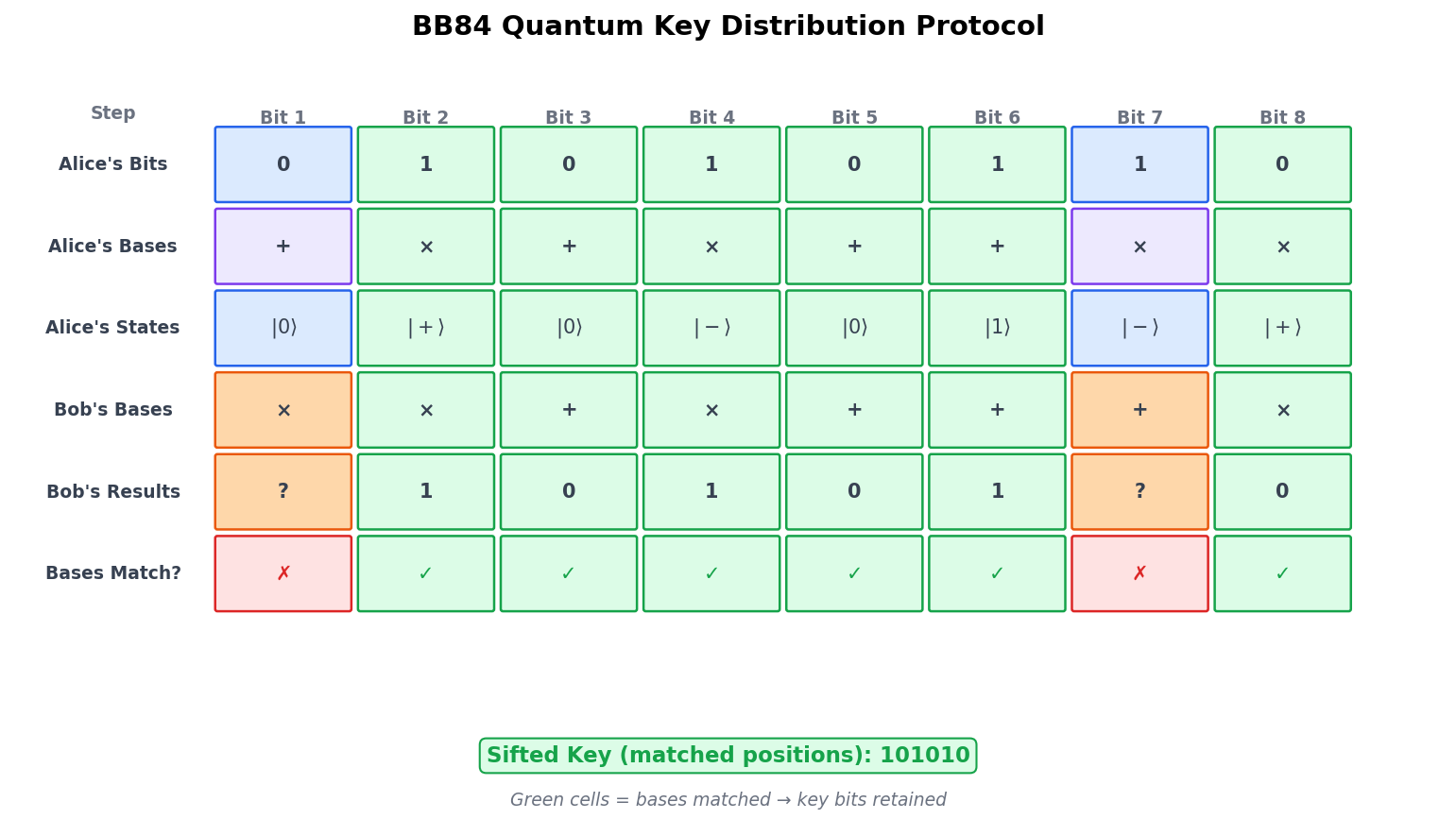
The most famous quantum cryptography protocol is BB84, proposed by Charles Bennett and Gilles Brassard in 1984. The protocol allows two parties, Alice and Bob, to establish a shared, secret random key. Alice prepares single photons in one of four states chosen from two conjugate bases: the rectilinear basis ($Z = \{|0\rangle, |1\rangle\}$) and the diagonal basis ($X = \{|+\rangle, |-\rangle\}$):
$$|0\rangle, \quad |1\rangle, \quad |+\rangle = \frac{|0\rangle + |1\rangle}{\sqrt{2}}, \quad |-\rangle = \frac{|0\rangle - |1\rangle}{\sqrt{2}}$$
Alice sends these photons to Bob over a quantum channel. For each photon, Bob randomly chooses to measure in either the $Z$ or $X$ basis. After the transmission, Alice and Bob communicate over a classical public channel to compare their bases (but not their measurement results). They discard the results where their bases did not match, leaving a 'sifted key'.
If an eavesdropper, Eve, attempts to intercept the transmission, she must perform a measurement. According to the No-Cloning Theorem, Eve cannot copy Alice's photon. If Eve measures in the wrong basis, she disturbs the state. For example, if Alice sends $|0\rangle$ and Eve measures in the $X$ basis, she projects the state to $|+\rangle$ or $|-\rangle$. When Bob measures in the correct $Z$ basis, he now has a 50% chance of getting $|1\rangle$ instead of the correct $|0\rangle$. By comparing a subset of their key, Alice and Bob can calculate the Quantum Bit Error Rate (QBER). If the QBER exceeds a threshold (typically ~11%), they know an eavesdropper is present and discard the key.