Eigenvector Intuition
Eigenvectors are states that only scale under a transformation, corresponding to definite quantum measurement outcomes
Source: mortalapps.com- An eigenvector is a special vector that only scales (doesn't change direction) when a linear transformation is applied.
- The scaling factor by which an eigenvector is multiplied is called its eigenvalue.
- Mathematically, $A\vec{v} = \lambda\vec{v}$, where $A$ is the matrix, $\vec{v}$ is the eigenvector, and $\lambda$ is the eigenvalue.
- In quantum mechanics, measurement outcomes correspond to eigenvalues, and the resulting states are eigenvectors (eigenstates).
- The computational basis states $|0\rangle$ and $|1\rangle$ are eigenvectors of the Pauli-Z measurement operator.
- Eigenvectors are fundamental for understanding quantum measurement and the stable states of quantum systems.
Why This Matters
When we measure a quantum system, it 'collapses' into a specific, definite state. These special states, called 'eigenstates,' are precisely the ones that correspond to definite measurement outcomes. Eigenvectors are the mathematical representation of these stable states, and understanding them is crucial for grasping the physics of quantum measurement.
Eigenvectors are unique because when a linear transformation (like a quantum gate or a measurement operator) acts on them, they don't change their 'direction' – they only get scaled. This property makes them incredibly important for identifying the 'natural' or 'stable' states of a system.
By the end of this topic, you will understand what eigenvectors and eigenvalues are, their geometric meaning, and why they are fundamental to interpreting quantum measurements and the behavior of quantum systems.
Core Intuition
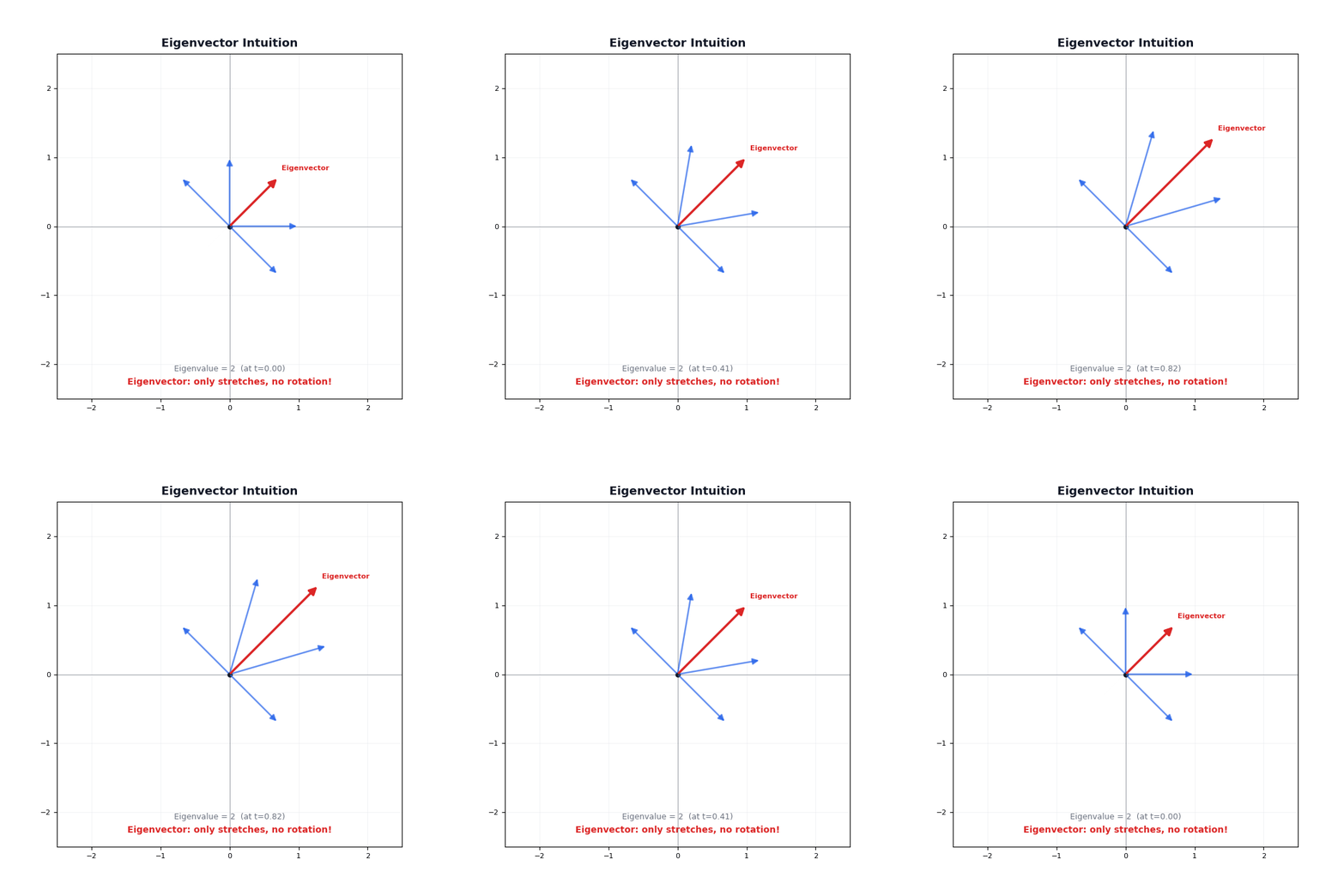
Imagine you have a stretchy rubber sheet, and you're stretching and twisting it (a linear transformation). Most points on the sheet will move and change direction. But imagine there are a few special lines or directions on the sheet that, no matter how you stretch or twist, only get longer or shorter, but *never* change their orientation. These special directions are like eigenvectors.
Think of a dog on a leash. If you pull the leash in a random direction, the dog will change its direction of movement. But if the dog is already running *exactly* in the direction you're pulling, it will only speed up or slow down, but its path (direction) won't change relative to your pull. The dog's direction of movement, in this special case, is an eigenvector of your pulling action.
In quantum mechanics, when we perform a measurement, we're essentially applying a 'pull' (a measurement operator). The states that simply get 'scaled' (i.e., their value is observed) without changing their fundamental quantum 'direction' are the eigenstates (eigenvectors) of that measurement.
Visualization
Technical Explanation
An eigenvector (from German 'eigen' meaning 'own' or 'characteristic') of a linear transformation (represented by a matrix $A$) is a non-zero vector $\vec{v}$ that, when the transformation is applied to it, only changes by a scalar factor. It does not change its direction.
Mathematically, this is expressed as: $$A\vec{v} = \lambda\vec{v}$$ Here:
- $A$ is the matrix representing the linear transformation (e.g., a quantum gate or a measurement operator).
- $\vec{v}$ is the eigenvector.
- $\lambda$ (lambda) is a scalar called the eigenvalue. It represents the factor by which the eigenvector is scaled.
Geometric Interpretation: When a matrix $A$ acts on an eigenvector $\vec{v}$, the resulting vector $A\vec{v}$ lies on the same line as $\vec{v}$. It's either stretched, shrunk, or reversed, but its orientation in space remains the same. Other vectors, in contrast, would typically be rotated or moved off their original line.
Quantum Connection: In quantum mechanics, measurement operators (which are Hermitian matrices) have real eigenvalues. These eigenvalues correspond to the *possible outcomes* of a measurement. The corresponding eigenvectors are the eigenstates (or basis states) into which the quantum system collapses upon measurement.
For example, for a Pauli-Z measurement on a qubit, the measurement operator is $Z = \begin{pmatrix} 1 & 0 \\ 0 & -1 \end{pmatrix}$. Its eigenvectors are $|0\rangle = \begin{pmatrix} 1 \\ 0 \end{pmatrix}$ with eigenvalue $\lambda_0 = 1$, and $|1\rangle = \begin{pmatrix} 0 \\ 1 \end{pmatrix}$ with eigenvalue $\lambda_1 = -1$. This means if you measure a qubit in the $|0\rangle$ state, you get the outcome '1' (or +1), and if you measure it in the $|1\rangle$ state, you get the outcome '-1'. These are the definite, stable states for a Z-measurement.