What Quantum Computers Cannot Do
Quantum computers are specialized co-processors, not general-purpose replacements for classical systems
Source: mortalapps.com- Quantum computers are specialized tools, not general-purpose replacements for classical computers.
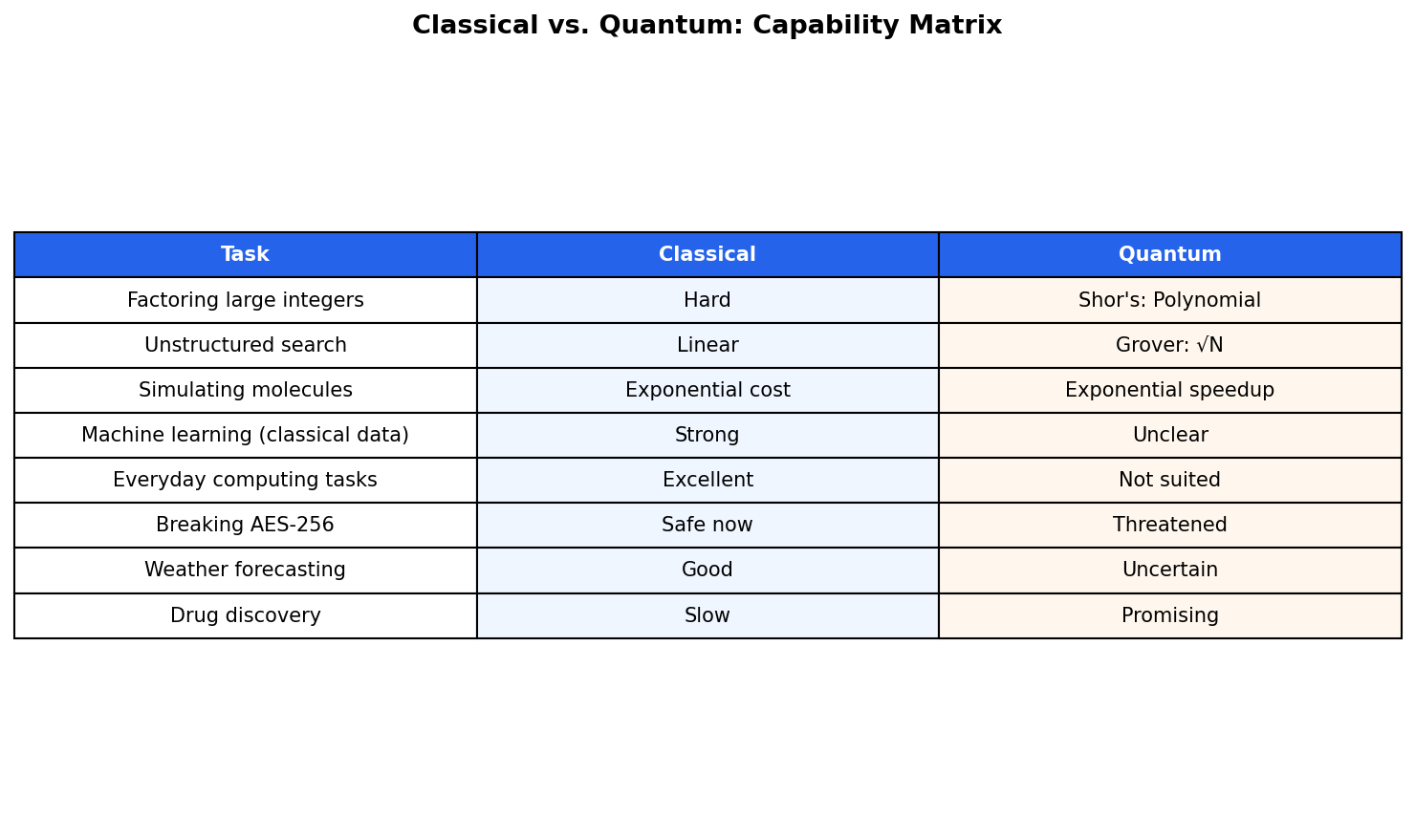
- They will not run your operating system, browse the web, or perform everyday tasks efficiently.
- Quantum computers do not make classical algorithms faster; they use fundamentally new quantum algorithms.
- They cannot solve mathematically undecidable problems or provide instant solutions.
- While they threaten current encryption, new 'post-quantum cryptography' is being developed.
- Classical computers will remain essential for the vast majority of computational tasks.
- A 'hybrid' computing model, combining classical and quantum, is the most likely future.
Why This Matters
In the last topic, we painted an exciting picture of what quantum computers *can* do – solving problems that are currently impossible for classical machines. It's easy to get carried away by the hype and imagine quantum computers as a magical solution to everything. However, a balanced understanding requires knowing their limitations as well.
This topic will focus on clarifying what quantum computers *cannot* do. We'll debunk common myths and set realistic expectations, explaining why they won't replace your laptop or instantly solve every problem. Understanding these boundaries is just as important as understanding their strengths.
By the end of this topic, you'll have a more grounded perspective on quantum computing, recognizing its specialized nature and appreciating the continued importance of classical computers in our technological landscape.
Core Intuition
Imagine a Formula 1 race car. It's incredibly fast and powerful, designed for one specific purpose: winning races on a track. It excels at that. But can it pick up your groceries, drive through heavy snow, or tow a trailer? Absolutely not. It's a specialized tool.
A quantum computer is like that Formula 1 car. It's an incredibly powerful, specialized machine designed to excel at a very specific set of computational 'races' (problems). It's not built for general-purpose tasks. Your everyday laptop, on the other hand, is like a versatile SUV – it might not win a race, but it's fantastic for daily driving, carrying passengers, and handling various conditions.
So, while quantum computers can do amazing things in their niche, they won't be replacing your smartphone for browsing the internet, or your desktop for writing documents. They are not 'better' computers in a universal sense; they are *different* computers, optimized for a different kind of challenge.
Visualization
Technical Explanation
Despite their revolutionary potential, quantum computers have significant limitations and are not a panacea for all computational problems. It's crucial to understand what they are *not* designed for:
1. General-Purpose Computing: Quantum computers are not replacements for classical computers for everyday tasks. They won't run your operating system, browse the web, send emails, or play video games. Classical computers are far more efficient and practical for these general-purpose computations. Quantum computers are specialized accelerators for very specific, hard problems.
2. Faster Classical Algorithms: A quantum computer will not make a classical algorithm run faster if that algorithm is already efficient on a classical machine. For example, adding two numbers or sorting a small list is incredibly fast on a classical computer, and a quantum computer offers no advantage here. The speedups come from fundamentally *new* quantum algorithms that leverage superposition and entanglement, not from simply speeding up classical logic.
3. Solving Unsolvable Problems: Quantum computers cannot solve problems that are mathematically undecidable or intractable even in theory. If a problem cannot be solved by any algorithm (classical or quantum), a quantum computer won't magically find a solution. They can only speed up certain *solvable* problems that are too slow for classical computers.
4. Brute-Force Parallelism: While superposition allows a quantum computer to explore many possibilities simultaneously, it's not a simple 'try all answers at once' machine. You can't just put a problem into superposition and instantly get the answer. Quantum algorithms must be carefully designed to manipulate these superpositions and entanglements in a way that amplifies the correct answer's probability, which is a complex process.
5. Instant Solutions: Even for problems where quantum computers offer exponential speedups, they don't provide instant answers. They still require computation time, and the process of preparing qubits, running quantum gates, and measuring results is complex and can be time-consuming, especially with current noisy hardware.
6. Replacing Human Intelligence: Quantum computers are computational tools. They do not possess consciousness, creativity, or general intelligence. While they can enhance AI algorithms, they are not designed to replicate or replace human cognitive abilities. They are powerful calculators for specific tasks, not sentient beings.
In essence, quantum computers are complementary to classical computers. They are designed to tackle the 'hardest of the hard' problems, leaving the vast majority of computational tasks to the classical machines that excel at them.