Dirac Notation Basics
Dirac bra-ket notation is a compact universal shorthand for quantum states, inner products, and operators
Source: mortalapps.com- Dirac notation (bra-ket notation) is a concise shorthand for quantum states and operations.
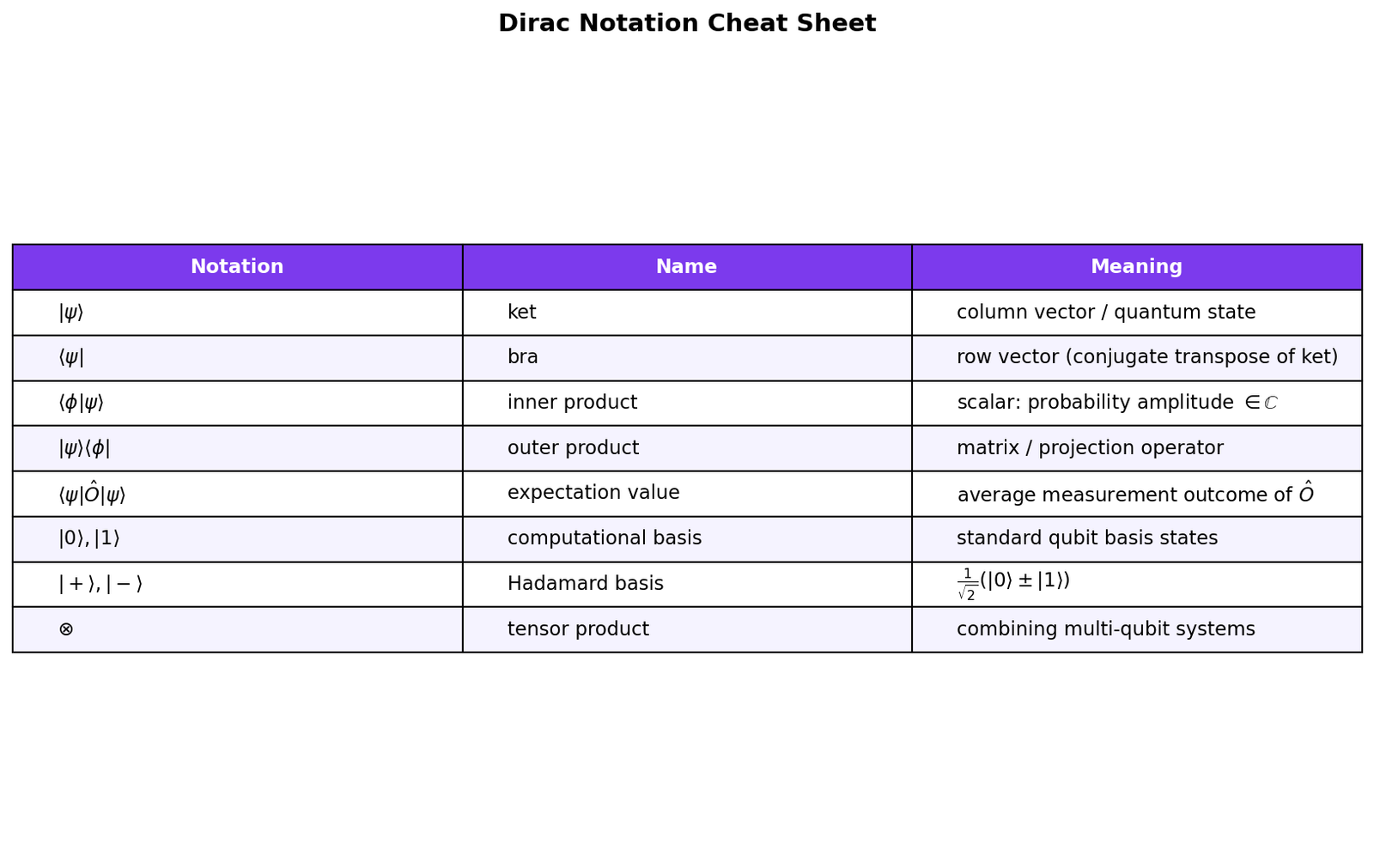
- A 'ket' ($|\psi\rangle$) represents a column vector (quantum state).
- A 'bra' ($\langle \psi |$) represents the conjugate transpose of a ket (a row vector).
- The inner product ($\langle \phi | \psi \rangle$) is a scalar representing the 'overlap' between two states.
- The outer product ($| \psi \rangle \langle \phi |$) is a matrix (an operator) used to construct gates and projectors.
- Dirac notation is the universal language in quantum computing, simplifying complex expressions and concepts.
Why This Matters
While column vectors and matrices are precise for describing quantum states and operations, they can become cumbersome for complex quantum systems. Dirac notation, also known as bra-ket notation, provides an elegant, compact, and universally adopted shorthand that simplifies writing and reasoning about quantum mechanics.
This notation is not just a convenience; it's a powerful conceptual tool that highlights the inner workings of quantum states and measurements. It's the standard language you'll encounter in almost every quantum computing textbook, research paper, and discussion.
By the end of this topic, you will understand the fundamental elements of Dirac notation – kets, bras, inner products, and outer products – and how they relate directly to the vectors and matrices we've already learned, equipping you with the essential language for formal quantum descriptions.
Core Intuition
Imagine you're writing a long sentence like 'the vector representing the state where the qubit is definitely in the zero state.' That's a lot to write! Dirac notation is like a shorthand for this: you just write '$|0\rangle$'. It's a specialized language designed to be efficient and clear for quantum concepts.
Think of it like musical notation. Instead of writing 'play a middle C note for one beat,' you draw a specific symbol on a staff. The symbol is concise, universally understood by musicians, and conveys a lot of information. Dirac notation does the same for quantum states and operations.
It also has a clever structure: the 'ket' ($|\psi\rangle$) represents a quantum state (a column vector), and the 'bra' ($\langle \psi |$) represents its 'conjugate transpose' (a row vector). When you put a bra and a ket together ($\langle \phi | \psi \rangle$), it's like a 'sandwich' that performs an operation (an inner product, giving a scalar). When you put them the other way ($| \psi \rangle \langle \phi |$), it's like a 'spread' that creates an operator (a matrix). This intuitive structure makes complex quantum expressions much more manageable.
Visualization
Technical Explanation
Dirac notation, introduced by Paul Dirac, uses special symbols to represent quantum states and operations.
1. Ket Vector ($|\psi\rangle$): A 'ket' represents a quantum state, which is a column vector in a complex vector space. For example:
- $|0\rangle = \begin{pmatrix} 1 \\ 0 \end{pmatrix}$
- $|1\rangle = \begin{pmatrix} 0 \\ 1 \end{pmatrix}$
- $|+\rangle = \frac{1}{\sqrt{2}}(|0\rangle + |1\rangle) = \begin{pmatrix} 1/\sqrt{2} \\ 1/\sqrt{2} \end{pmatrix}$
2. Bra Vector ($\langle \psi |$): A 'bra' is the conjugate transpose of a ket. If $|\psi\rangle$ is a column vector, then $\langle \psi |$ is a row vector with its elements complex conjugated. For example, if $|\psi\rangle = \begin{pmatrix} \alpha \\ \beta \end{pmatrix}$, then $\langle \psi | = \begin{pmatrix} \alpha^* & \beta^* \end{pmatrix}$, where $^*$ denotes complex conjugation.
- $\langle 0 | = \begin{pmatrix} 1 & 0 \end{pmatrix}$
- $\langle 1 | = \begin{pmatrix} 0 & 1 \end{pmatrix}$
- $\langle + | = \frac{1}{\sqrt{2}}(\langle 0 | + \langle 1 |) = \begin{pmatrix} 1/\sqrt{2} & 1/\sqrt{2} \end{pmatrix}$
3. Inner Product (Bra-Ket) ($\langle \phi | \psi \rangle$): This is the multiplication of a bra by a ket, resulting in a single complex number (a scalar). It represents the 'overlap' or 'similarity' between two states. Mathematically, it's the dot product of the two vectors. If $\langle \phi | \psi \rangle = 0$, the states are orthogonal. $$\langle \phi | \psi \rangle = \begin{pmatrix} \phi_0^* & \phi_1^* \end{pmatrix} \begin{pmatrix} \psi_0 \\ \psi_1 \end{pmatrix} = \phi_0^*\psi_0 + \phi_1^*\psi_1$$ For example, $\langle 0 | 1 \rangle = \begin{pmatrix} 1 & 0 \end{pmatrix} \begin{pmatrix} 0 \\ 1 \end{pmatrix} = 1\cdot 0 + 0\cdot 1 = 0$.
4. Outer Product (Ket-Bra) ($| \psi \rangle \langle \phi |$): This is the multiplication of a ket by a bra, resulting in a matrix (an operator). Outer products are used to construct quantum gates and projection operators. $$| \psi \rangle \langle \phi | = \begin{pmatrix} \psi_0 \\ \psi_1 \end{pmatrix} \begin{pmatrix} \phi_0^* & \phi_1^* \end{pmatrix} = \begin{pmatrix} \psi_0\phi_0^* & \psi_0\phi_1^* \\ \psi_1\phi_0^* & \psi_1\phi_1^* \end{pmatrix}$$
Dirac notation is incredibly versatile for expressing complex quantum operations and multi-qubit states concisely.