Current Breakthroughs
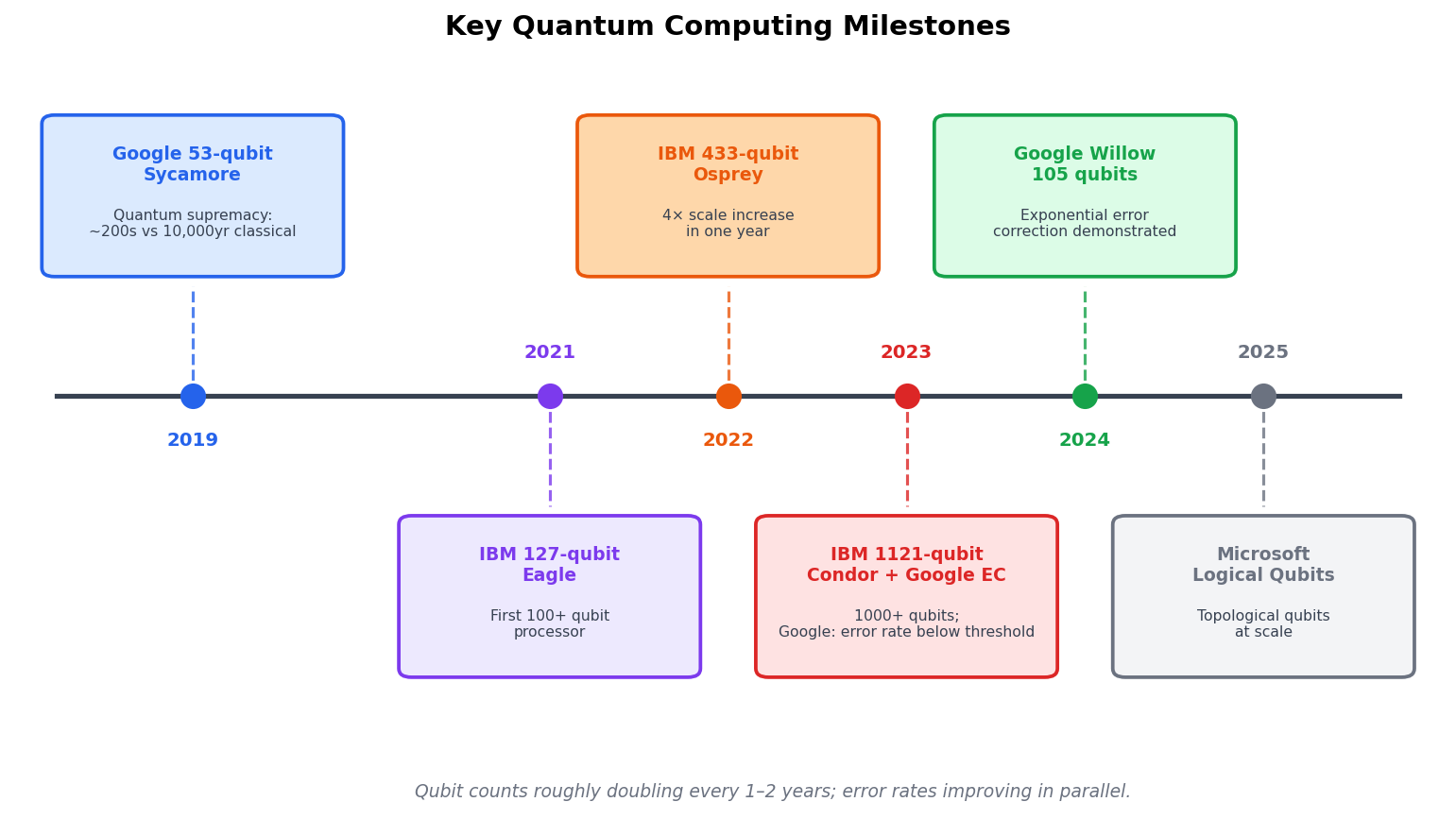
Google's 2019 Sycamore experiment showed quantum supremacy, and logical qubit results now point toward fault tolerance
Source: mortalapps.com- Quantum supremacy is the milestone where a quantum computer solves a problem faster than any classical supercomputer.
- Google's 2019 Sycamore experiment used Random Circuit Sampling to demonstrate quantum supremacy on 53 qubits.
- Google's 2024 Willow processor proved that scaling up surface code distance suppresses logical error rates.
- The threshold theorem states that logical errors decrease exponentially with code distance only if physical errors are below a threshold.
- Quantinuum has achieved record-high 2-qubit gate fidelities exceeding 99.9% using trapped-ion technology.
- Harvard, QuEra, and MIT demonstrated the first execution of algorithms on dozens of error-corrected logical qubits in 2023.
Why This Matters
We are living through an extraordinary period of scientific acceleration. Over the past five years, the quantum computing community has transitioned from demonstrating basic physical principles to achieving historic milestones that many thought were decades away. From the first demonstrations of quantum supremacy to the creation of high-fidelity logical qubits, these breakthroughs are transforming quantum computing from a theoretical dream into an engineering reality.
Core Intuition
To understand the significance of current breakthroughs, think of the Wright brothers' flight at Kitty Hawk in 1903. That first flight lasted only 12 seconds and covered just 120 feet. It had no practical commercial use, it couldn't carry passengers or cargo. But it proved that powered, heavier-than-air flight was physically possible, changing the world forever. Google's 2019 quantum supremacy demonstration was the Kitty Hawk moment for quantum computing.
Another analogy is the transition from vacuum tubes to transistors in classical computing. Early computers like ENIAC were massive, hot, and constantly breaking down because vacuum tubes failed. When scientists developed the solid-state transistor, computers became smaller, faster, and incredibly reliable. Recent breakthroughs in quantum error correction and logical qubits represent the transition from noisy 'vacuum tube' qubits to stable, reliable 'transistor' logical qubits.
Visualization
Technical Explanation
The first major milestone of the modern era occurred in 2019, when Google Quantum AI announced 'quantum supremacy' using its 53-qubit Sycamore superconducting processor. The processor solved a highly specific mathematical problem called Random Circuit Sampling (RCS) in 200 seconds, a task Google estimated would take the world's most powerful supercomputer, Summit, 10,000 years. The task involves sampling from the output distribution of a random quantum circuit, where the probability of measuring a specific bitstring $x$ is given by:
$$P(x) = |\langle x | U | 0 \rangle^{\otimes N}|^2$$
While classical competitors quickly challenged the 10,000-year estimate (demonstrating that tensor network algorithms on supercomputers could solve it in days), Google's experiment proved that a quantum processor could manipulate a state space of $2^{53} \approx 9 \times 10^{15}$ states with high precision.
In 2024, Google Quantum AI achieved another historic milestone with its 'Willow' processor, demonstrating for the first time that scaling up a surface code reduces the logical error rate. By increasing the distance $d$ of a surface code from $d=3$ (17 physical qubits) to $d=5$ (49 physical qubits), they showed that the logical error rate decreased, proving that quantum error correction works in practice and scales as predicted by the threshold theorem:
$$\epsilon_L \propto \left( \frac{p}{p_{th}} \right)^{\frac{d+1}{2}}$$
Simultaneously, companies like Quantinuum have set record gate fidelities using trapped-ion systems, achieving a 2-qubit gate fidelity of 99.914%, while Harvard, QuEra, and MIT demonstrated the execution of complex algorithms on 48 physical-error-corrected logical qubits in late 2023.