Bell States
The four Bell states are maximally entangled two-qubit states with the strongest correlations physics allows
Source: mortalapps.com- The four Bell states are the maximally entangled states of two qubits.
- Bell states represent the strongest possible physical correlations between two systems.
- Mathematically, Bell states are non-separable, meaning they cannot be factored into individual qubit states.
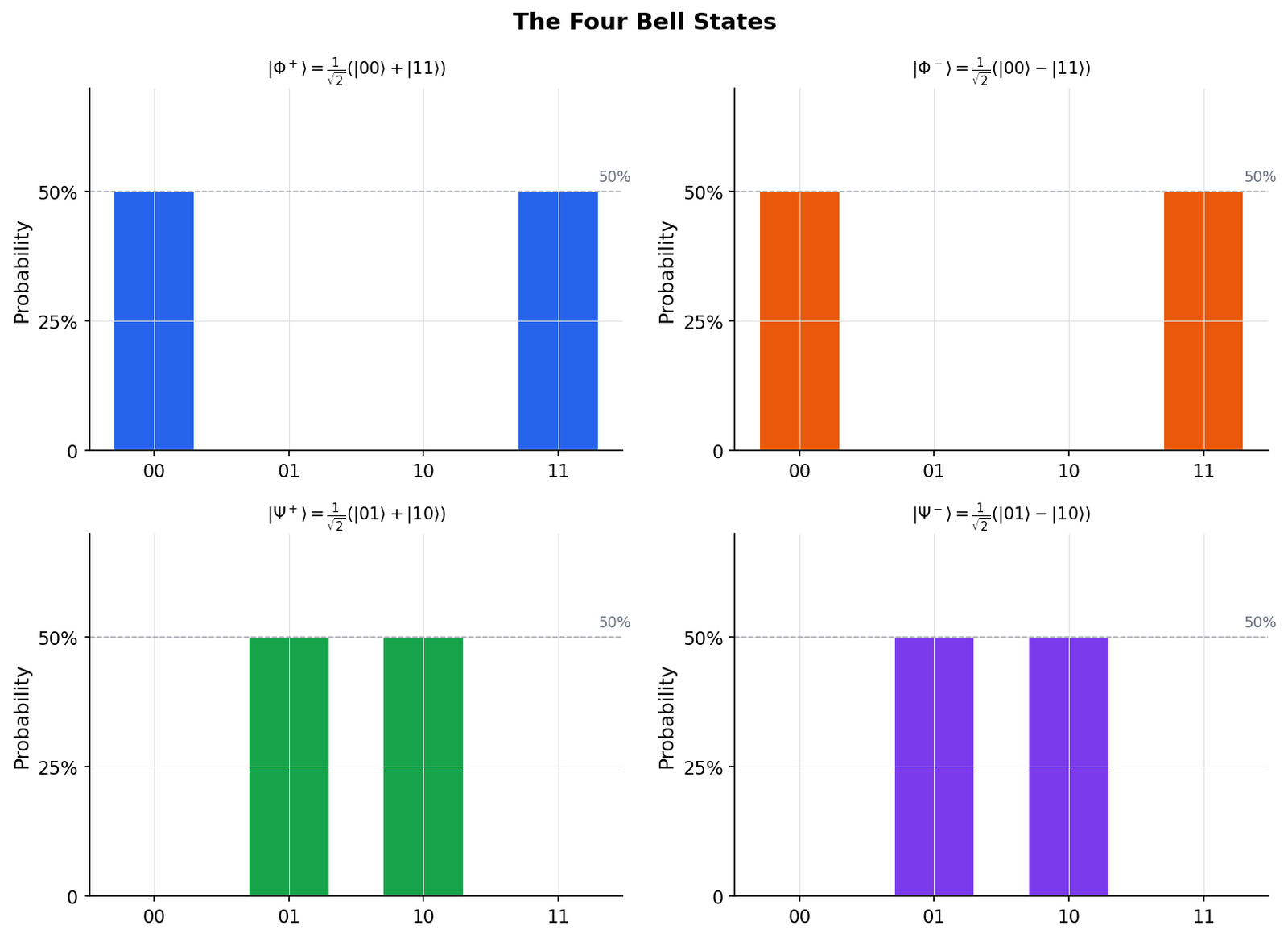
- The states |Φ⁺⟩ and |Φ⁻⟩ exhibit perfect correlation in the computational basis.
- The states |Ψ⁺⟩ and |Ψ⁻⟩ exhibit perfect anti-correlation in the computational basis.
- Bell's Theorem proves that these correlations cannot be explained by local classical physics.
- Bell states are the fundamental resource for quantum teleportation and secure quantum communication.
Why This Matters
Entanglement is the defining feature of quantum mechanics, and the Bell states are its purest expression. Named after physicist John Stewart Bell, the four Bell states (also called EPR pairs) are specific, maximally entangled states of two qubits. They represent the strongest possible correlations allowed by the laws of physics.
In this topic, we will study the four Bell states. You will learn their mathematical definitions, their unique properties, and how they are represented as state vectors. We will explore how these states defy classical intuition, exhibiting correlations that cannot be explained by any local hidden variable theory.
By the end of this topic, you will be able to write down the state vectors for all four Bell states, understand their symmetry properties, and explain how they serve as the fundamental resource for quantum teleportation, superdense coding, and quantum cryptography.
Core Intuition
Imagine you have two magical coins. You give one to Alice and one to Bob, who travel to opposite sides of the universe. When Alice flips her coin, it has a 50% chance of landing heads and a 50% chance of landing tails. The same is true for Bob.
However, because the coins are 'entangled' in a Bell state, the moment Alice looks at her coin and sees Heads, Bob's coin instantly collapses to Heads as well. If Alice sees Tails, Bob's coin instantly becomes Tails. They always match, no matter how far apart they are.
In the classical world, this could be explained if the coins were pre-programmed to land on the same side (like two matching socks). But quantum mechanics proves that the coins do not have a definite state before they are measured. They exist in a genuine superposition of matching states, sharing a single, unified identity across space.
Visualization
Technical Explanation
The four Bell states form an orthonormal basis for the 2-qubit state space, known as the Bell basis. They are defined as:
$$|\Phi^+\rangle = \frac{1}{\sqrt{2}}(|00\rangle + |11\rangle)$$ $$|\Phi^-\rangle = \frac{1}{\sqrt{2}}(|00\rangle - |11\rangle)$$ $$|\Psi^+\rangle = \frac{1}{\sqrt{2}}(|01\rangle + |10\rangle)$$ $$|\Psi^-\rangle = \frac{1}{\sqrt{2}}(|01\rangle - |10\rangle)$$
The states $|\Phi^\pm\rangle$ represent perfect correlation (measuring both qubits in the computational basis yields matching results: $00$ or $11$). The states $|\Psi^\pm\rangle$ represent perfect anti-correlation (measuring both yields opposite results: $01$ or $10$).
The state $|\Psi^-\rangle$ is particularly famous; it is known as the 'singlet state' and is completely invariant under rotations, meaning it exhibits perfect anti-correlation no matter what basis you measure the qubits in. Mathematically, these states cannot be factored into the tensor product of two independent single-qubit states (i.e., they are non-separable).