Simon's Algorithm
Simon's algorithm finds a hidden period of a two-to-one function exponentially faster than any classical algorithm
Source: mortalapps.com- Simon's algorithm finds a hidden period $s$ of a two-to-one function.
- It achieves an exponential speedup over the best possible classical algorithms ($O(n)$ vs $O(2^{n/2})$ queries).
- The quantum circuit produces vectors $y$ that are orthogonal to the hidden period $s$ ($y \cdot s = 0$).
- The final solution is reconstructed classically by solving a system of linear equations.
- It is the direct intellectual precursor to Shor's factoring algorithm.
Why This Matters
Simon's Algorithm, proposed by Daniel Simon in 1994, was the first quantum algorithm to show an exponential speedup over any possible classical algorithm (including probabilistic ones) for a decision problem. It addresses the 'hidden period' or 'hidden subgroup' problem, which serves as the direct mathematical precursor to Shor's factoring algorithm.
Core Intuition
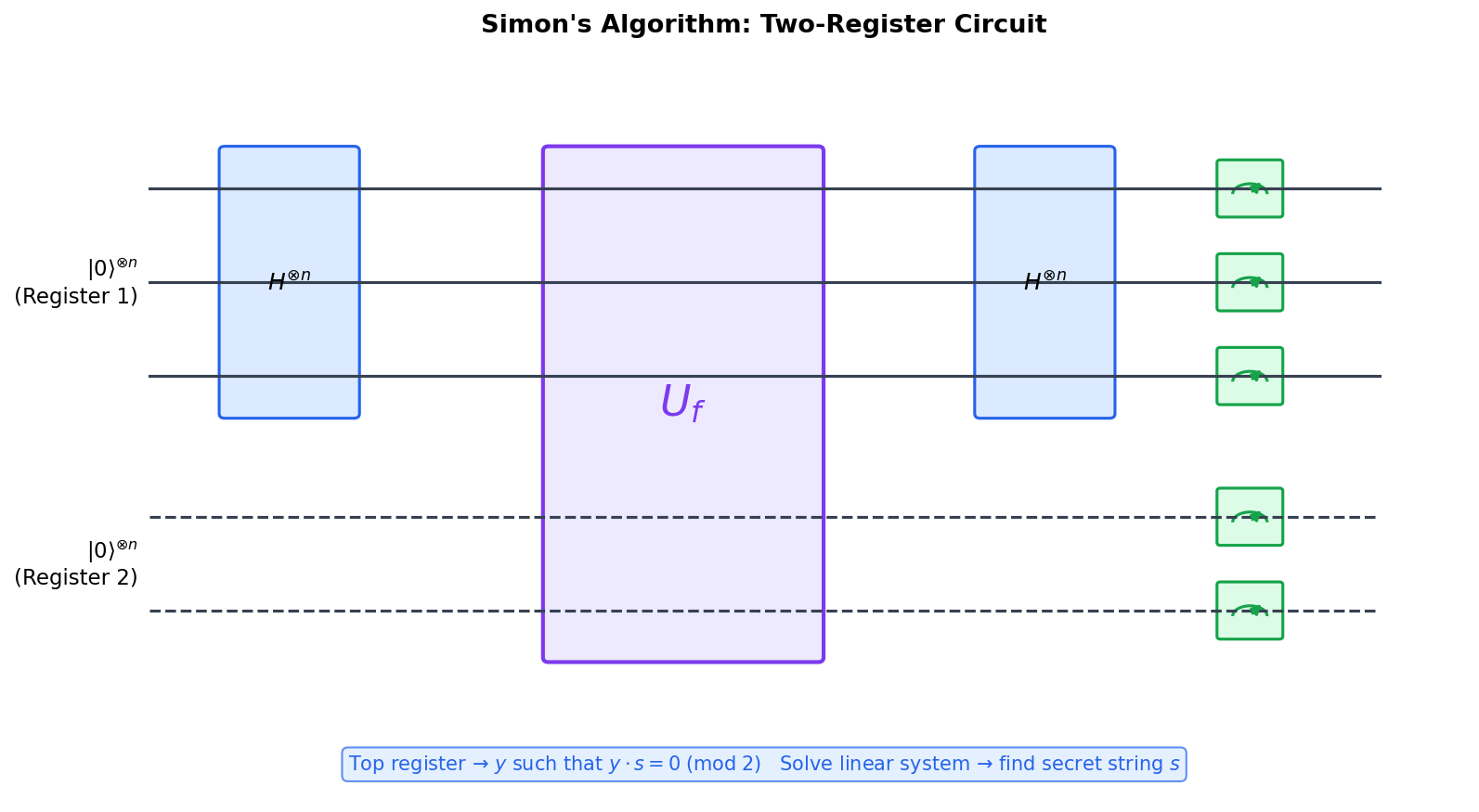
Imagine a function that maps inputs to outputs such that it is 'two-to-one', meaning every output has exactly two inputs that map to it. Furthermore, these two inputs always differ by a secret binary shift $s$ (i.e., $f(x) = f(y)$ if and only if $x \oplus y = s$). Classically, to find this secret shift $s$, you have to search for a collision, two different inputs that yield the same output. By the Birthday Paradox, you would need to query about $\sqrt{2^n}$ inputs before finding a match. Simon's algorithm does not search for collisions directly. Instead, it prepares a quantum superposition, queries the oracle once, and measures a state that is guaranteed to be perpendicular to the secret shift ($y \cdot s = 0$). By repeating this process about $n$ times, we get a system of linear equations that we can easily solve classically to find $s$.
Visualization
Technical Explanation
Let $f: \{0,1\}^n \to \{0,1\}^n$ be a function. We are promised that there exists a hidden bitstring $s \in \{0,1\}^n$ such that for all $x, y \in \{0,1\}^n$:
$$f(x) = f(y) \iff x \oplus y \in \{0, s\}$$
If $s = 0^n$, the function is one-to-one. If $s \neq 0^n$, the function is two-to-one.
Classical Complexity: To find $s$ with high probability, any classical algorithm (even probabilistic) must query the oracle $\Omega(2^{n/2})$ times, due to the birthday bound.
Quantum Complexity: Simon's algorithm finds $s$ using $O(n)$ quantum queries and $O(n^3)$ classical post-processing steps, representing an exponential speedup.
Circuit Construction: Unlike previous algorithms, Simon's algorithm uses an $n$-qubit target register to store the $n$-bit output of $f(x)$. 1. Initialize: Two registers of $n$ qubits, $|0\rangle^{\otimes n} |0\rangle^{\otimes n}$. 2. Superposition: Apply $H^{\otimes n}$ to the first register: $$|\psi_1\rangle = \left( \frac{1}{\sqrt{2^n}} \sum_{x \in \{0,1\}^n} |x\rangle \right) |0\rangle^{\otimes n}$$ 3. Oracle Query: Apply the unitary oracle $U_f |x\rangle|0\rangle = |x\rangle|f(x)\rangle$: $$|\psi_2\rangle = \frac{1}{\sqrt{2^n}} \sum_{x \in \{0,1\}^n} |x\rangle |f(x)\rangle$$ 4. Measurement of Second Register: We measure the second register. Suppose we obtain a specific output value $f(x_0)$. Due to the two-to-one property, the first register collapses to a superposition of the only two inputs that map to $f(x_0)$: $$|\psi_3\rangle = \frac{1}{\sqrt{2}} (|x_0\rangle + |x_0 \oplus s\rangle)$$ 5. Interference: Apply $H^{\otimes n}$ to the first register: $$|\psi_4\rangle = \frac{1}{\sqrt{2^{n+1}}} \sum_{y \in \{0,1\}^n} \left( (-1)^{x_0 \cdot y} + (-1)^{(x_0 \oplus s) \cdot y} \right) |y\rangle$$ Since $(x_0 \oplus s) \cdot y = (x_0 \cdot y) \oplus (s \cdot y)$, we can factor this as: $$|\psi_4\rangle = \frac{1}{\sqrt{2^{n+1}}} \sum_{y \in \{0,1\}^n} (-1)^{x_0 \cdot y} \left( 1 + (-1)^{s \cdot y} \right) |y\rangle$$
- If $s \cdot y = 1 \pmod 2$, then $1 + (-1)^1 = 0$. The amplitude of $|y\rangle$ is 0.
- If $s \cdot y = 0 \pmod 2$, then $1 + (-1)^0 = 2$. The amplitude of $|y\rangle$ is non-zero.