Quantum Error Correction Basics
QEC protects quantum states by measuring parity between qubits rather than individual values, preserving superposition
Source: mortalapps.com- Quantum Error Correction (QEC) protects fragile quantum states without violating the No-Cloning Theorem or collapsing superpositions.
- QEC works by measuring the relationships (parity) between qubits rather than their individual states.
- The Stabilizer Formalism uses group theory to define error-correcting codes as the +1 eigenspace of a set of commuting operators.
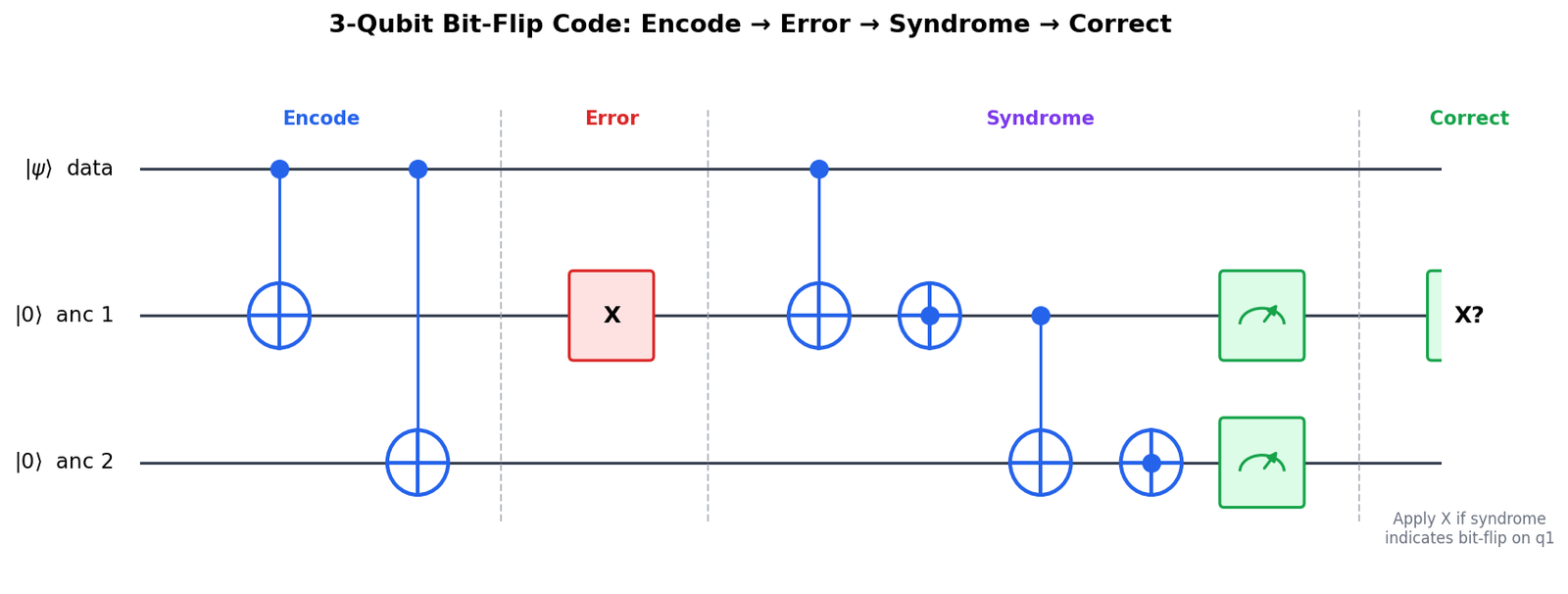
- The 3-qubit bit-flip code uses two stabilizer generators, Z1Z2 and Z2Z3, to detect a single X error.
- Syndrome measurement extracts an 'error signature' (eigenvalues of -1) that uniquely identifies the location of an error.
- If the number of physical errors exceeds the code's capacity, the decoder will misidentify the error and corrupt the state.
- Real-time stabilizer measurement has been experimentally demonstrated in both trapped-ion and superconducting architectures.
Why This Matters
Quantum Error Correction (QEC) is one of the most profound intellectual achievements of modern physics. At first glance, correcting errors in a quantum computer seems fundamentally impossible. According to the laws of quantum mechanics, measuring a quantum state collapses its superposition, destroying the very information we are trying to compute. Furthermore, the No-Cloning Theorem prevents us from making redundant copies of our data, which is the basis of all classical error correction.
To overcome these fundamental barriers, QEC uses highly sophisticated mathematical frameworks to detect and correct errors without ever looking at the encoded data. Instead of measuring the data qubits directly, we measure the relationships between them. This process, known as syndrome measurement, extracts only the 'error information' while leaving the computational superposition completely untouched.
In this topic, we will explore the foundational mechanics of QEC. We will analyze the 3-qubit bit-flip code to see how quantum redundancy is engineered, and we will introduce the Stabilizer Formalism, the mathematical language used to describe modern quantum error-correcting codes. This topic will demystify how we can actively fight entropy in the quantum regime.
Core Intuition
To understand how we can detect an error without looking at the data, imagine you have a valuable, fragile book written in a language you do not understand. You want to make sure no pages have been torn out or damaged, but you are forbidden from opening the book and reading the text (which would be analogous to measuring the quantum state and collapsing it).
Instead of reading the book, you place it on a highly sensitive balance scale and compare its weight to a known, undamaged reference book of the exact same edition. If the scale balances perfectly, you know the book is intact. If the scale tilts, you know a page is missing, and the exact weight difference tells you how many pages are gone. You have successfully detected the 'error' (missing pages) without ever reading a single word of the text.
In quantum error correction, we do something very similar. We use auxiliary qubits, called 'ancilla qubits', to measure the parity (the relative alignment) of our data qubits. For example, we can ask: 'Are qubit 1 and qubit 2 in the same state?' without ever asking 'What state are they in?'. If they are in the same state, the measurement returns a positive result, and the superposition is preserved. If they are different, we know an error has occurred, and the pattern of these parity checks, the syndrome, tells us exactly which qubit flipped.
Visualization
Technical Explanation
To formalize this, let us examine the 3-qubit bit-flip code. We wish to protect an arbitrary state $|\psi\rangle = \alpha|0\rangle + \beta|1\rangle$. We encode this state into three physical qubits using the mapping $|0_L\rangle = |000\rangle$ and $|1_L\rangle = |111\rangle$, yielding:
$$|\psi_L\rangle = \alpha|000\rangle + \beta|111\rangle$$
Suppose a bit-flip error (represented by the Pauli $X$ operator) occurs on the first qubit. The state becomes:
$$|\psi'\rangle = X_1 |\psi_L\rangle = \alpha|100\rangle + \beta|011\rangle$$
To detect this error without measuring the individual qubits, we measure the stabilizers of the code. The stabilizer group $\mathcal{S}$ for this code is generated by two operators:
$$g_1 = Z_1 Z_2 I \quad \text{and} \quad g_2 = I Z_2 Z_3$$
Notice that the error-free logical state $|\psi_L\rangle$ is an eigenstate of both generators with eigenvalue $+1$:
$$g_1 |\psi_L\rangle = (Z_1 Z_2 I)(\alpha|000\rangle + \beta|111\rangle) = +1 |\psi_L\rangle$$ $$g_2 |\psi_L\rangle = (I Z_2 Z_3)(\alpha|000\rangle + \beta|111\rangle) = +1 |\psi_L\rangle$$
However, for the corrupted state $|\psi'\rangle$, we find:
$$g_1 |\psi'\rangle = (Z_1 Z_2 I)(\alpha|100\rangle + \beta|011\rangle) = -1 |\psi'\rangle$$ $$g_2 |\psi'\rangle = (I Z_2 Z_3)(\alpha|100\rangle + \beta|011\rangle) = +1 |\psi'\rangle$$
Measuring these stabilizers yields the syndrome $(-1, +1)$. This unique syndrome tells us that qubit 1 has flipped, while qubits 2 and 3 are still aligned. We can then apply the correction operator $X_1$ to restore the state to $|\psi_L\rangle$ without ever learning the values of $\alpha$ or $\beta$.