Probability vs Amplitude
Probability amplitudes are complex numbers whose squared modulus gives measurement probabilities via the Born Rule
Source: mortalapps.com- Probability amplitudes are complex numbers that describe the 'potential' for a quantum state.
- Probabilities are real numbers between 0 and 1, representing the likelihood of a measurement outcome.
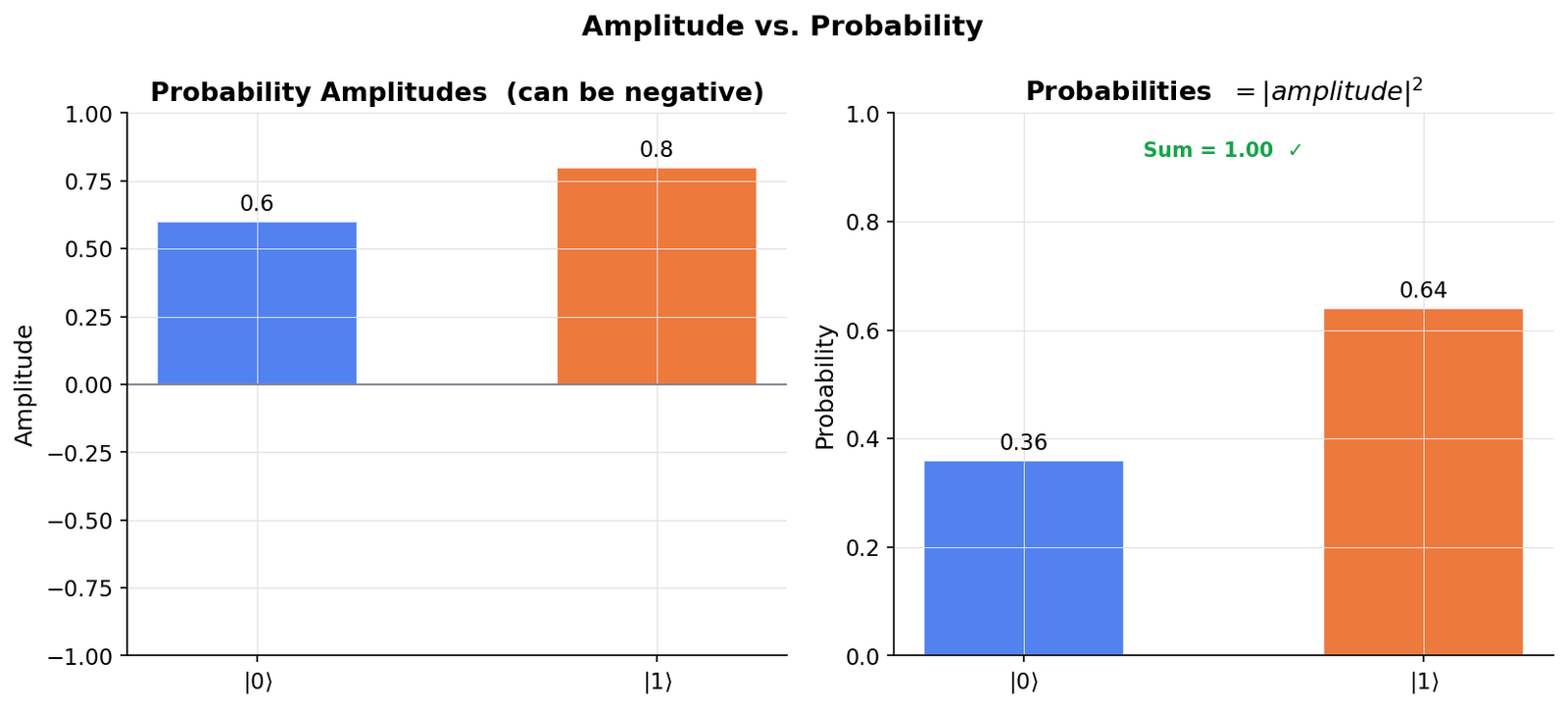
- The Born Rule states that the probability of an outcome is the square of the magnitude of its amplitude ($P = |\alpha|^2$).
- Complex phases of amplitudes are crucial for quantum interference, even if they don't directly change individual probabilities.
- The sum of all probabilities for a quantum state must always equal 1 (normalization).
- This rule is the fundamental bridge between the mathematical description of a quantum state and observable experimental results.
Why This Matters
In quantum mechanics, we cannot directly 'look' at a qubit's state while it's in superposition. Instead, we perform a measurement, which yields a probabilistic outcome. The numbers that govern these probabilities are not probabilities themselves, but rather 'probability amplitudes' – the complex numbers we've been discussing. This distinction is one of the most crucial conceptual leaps in quantum mechanics.
Understanding the difference between a complex amplitude and a real probability, and how to convert between them, is absolutely essential. It's the bridge between the abstract mathematical description of a quantum state and the concrete, observable results we get from a quantum computer.
By the end of this topic, you will clearly differentiate between probability amplitudes and probabilities, and you will master the Born rule, which is the fundamental principle for extracting measurable probabilities from a quantum state's amplitudes.
Core Intuition
Imagine you're baking a cake. The ingredients (flour, sugar, eggs) are like the probability amplitudes. They are complex, distinct components, and their precise quantities and interactions determine the final product. The baked cake itself, with its specific taste and texture, is like the probability of a measurement outcome. You can't eat the raw flour and expect it to taste like cake; you need to process the ingredients.
Another analogy is a blueprint for a building. The blueprint contains all the detailed specifications, dimensions, and materials – it's a rich, complex description. The actual probability of the building standing strong is a single, real number (e.g., 99.9% chance of not collapsing). The blueprint (amplitude) contains more information than just the final probability; it also tells you *how* that probability arises and how it might change if you alter the design.
In quantum mechanics, amplitudes are the 'ingredients' that, when 'processed' (by squaring their magnitude), yield the 'final product' (the probability). The phase of the amplitude, like the precise mixing technique in baking, doesn't always show up in the final taste but is crucial for the process.
Visualization
Technical Explanation
A probability amplitude is a complex number associated with a specific outcome of a quantum measurement. For a qubit in a superposition state $|\psi\rangle = \alpha|0\rangle + \beta|1\rangle$, $\alpha$ is the amplitude for measuring $|0\rangle$, and $\beta$ is the amplitude for measuring $|1\rangle$.
These amplitudes are not probabilities themselves because they are complex numbers and can be negative or even imaginary. Probabilities, by definition, must be real numbers between 0 and 1 (inclusive).
The fundamental rule that connects probability amplitudes to measurable probabilities is the Born Rule. It states that the probability of observing a particular outcome is the square of the magnitude (or modulus) of its corresponding probability amplitude.
For an amplitude $\alpha$, the probability $P$ of observing that outcome is: $$P = |\alpha|^2$$
Recall from 'Complex Numbers' that for a complex number $z = a + bi$, its magnitude squared is $|z|^2 = a^2 + b^2$. So, if $\alpha = a + bi$, then $P = a^2 + b^2$.
For our qubit state $|\psi\rangle = \alpha|0\rangle + \beta|1\rangle$:
- The probability of measuring $|0\rangle$ is $P(|0\rangle) = |\alpha|^2$.
- The probability of measuring $|1\rangle$ is $P(|1\rangle) = |\beta|^2$.
Crucially, the sum of all possible probabilities must always equal 1. This means $P(|0\rangle) + P(|1\rangle) = |\alpha|^2 + |\beta|^2 = 1$. This condition is known as normalization, which we will explore in a later topic. The phase of the complex amplitude, while not directly affecting the individual probability, is vital for phenomena like quantum interference.