Quantum Teleportation
Quantum teleportation transfers an unknown qubit state using a shared Bell pair and two classical bits, no matter moved
Source: mortalapps.com- Quantum teleportation transfers an unknown quantum state using shared entanglement and classical communication.
- The protocol requires three qubits: the unknown state, and a shared two-qubit Bell pair.
- Alice performs a joint measurement on her two qubits, completely destroying the original state.
- Alice's measurement yields two classical bits, which must be sent to Bob classically.
- Bob applies specific correction gates (X, Z, or both) based on Alice's classical bits.
- Teleportation does not violate the speed of light because it relies on classical communication.
- Teleportation obeys the No-Cloning Theorem because the original state is destroyed during the process.
Why This Matters
Quantum teleportation is one of the most counterintuitive protocols in quantum physics. It allows us to transfer an unknown quantum state from one location to another, using a shared entangled state and classical communication. Despite the name, it does not transport physical matter, nor does it violate the speed of light.
In this topic, we will study the complete 3-qubit quantum teleportation circuit. You will learn how Alice can send an arbitrary, unknown state $|\psi\rangle = \alpha|0\rangle + \beta|1\rangle$ to Bob without physically sending the qubit itself. We will trace the state of all three qubits through the entire protocol, analyzing the joint measurements and the classical correction gates.
By the end of this topic, you will understand how entanglement acts as a communication channel, why classical communication is strictly required, and how to read and analyze complex multi-qubit protocols.
Core Intuition
Imagine Alice has a highly fragile, unique vase (an unknown quantum state). She wants to send it to Bob, but there is no shipping service that won't break it. However, they share a pair of magical, entangled clay blocks (a Bell pair).
To send the vase, Alice takes her clay block and smashes it together with the vase, performing a specific joint measurement. This process completely destroys the original vase, but it encodes its unique shape into the shared entanglement. The measurement yields two classical numbers (like coordinates).
Alice calls Bob on a classical phone and reads him the coordinates. Bob takes his matching clay block and, using the coordinates, applies a specific set of tools (correction gates) to mold his block. Instantly, Bob's block transforms into a perfect replica of the original vase. The state has been teleported, the original was destroyed, and no matter traveled between them.
Visualization
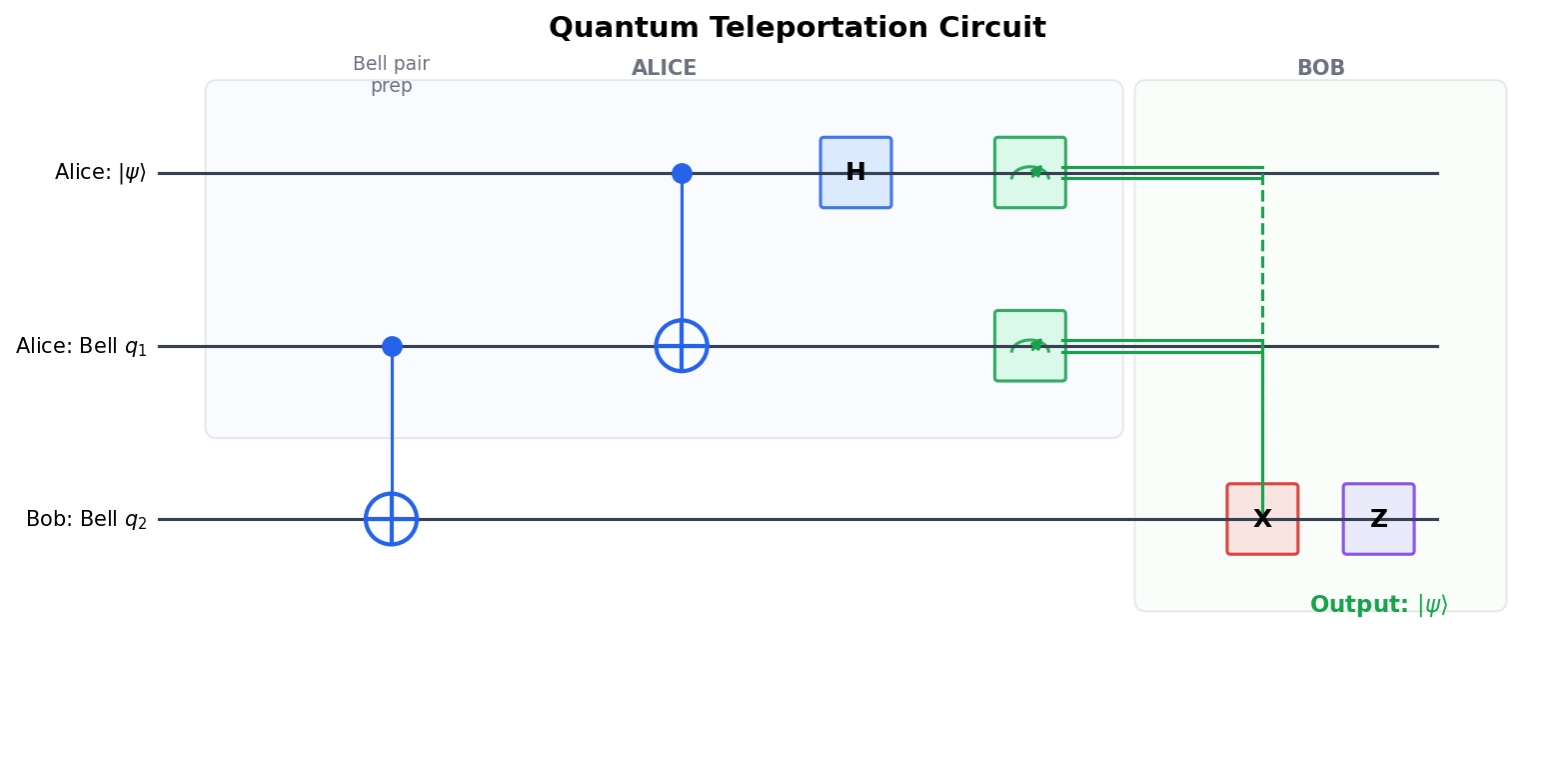
Technical Explanation
The teleportation protocol involves three qubits: Qubit 0 (held by Alice, in an unknown state $|\psi\rangle = \alpha|0\rangle + \beta|1\rangle$), and Qubits 1 and 2 (a Bell pair $|\Phi^+\rangle$ shared between Alice and Bob; Alice holds Qubit 1, Bob holds Qubit 2).
The initial state of the 3-qubit system is: $$|\Psi_0\rangle = (\alpha|0\rangle + \beta|1\rangle) \otimes \frac{1}{\sqrt{2}}(|00\rangle + |11\rangle) = \frac{1}{\sqrt{2}} \left( \alpha|000\rangle + \alpha|011\rangle + \beta|100\rangle + \beta|111\rangle \right)$$
Alice applies a CNOT gate (Qubit 0 as control, Qubit 1 as target), followed by a Hadamard gate on Qubit 0. This entangles her unknown state with her half of the Bell pair. The state becomes: $$|\Psi_2\rangle = \frac{1}{2} \left( |00\rangle(\alpha|0\rangle + \beta|1\rangle) + |01\rangle(\alpha|1\rangle + \beta|0\rangle) + |10\rangle(\alpha|0\rangle - \beta|1\rangle) + |11\rangle(\alpha|1\rangle - \beta|0\rangle) \right)$$
Alice then measures Qubits 0 and 1 in the computational basis, obtaining two classical bits, $b_1 b_2 \in \{00, 01, 10, 11\}$. This measurement collapses Bob's qubit (Qubit 2) into one of four states, depending on Alice's outcome. Alice sends these two bits to Bob classically. Bob applies correction gates based on the bits: if $b_2=1$, he applies $X$; if $b_1=1$, he applies $Z$. This restores Bob's qubit to the exact initial state $|\psi\rangle$.