Scaling Bottlenecks
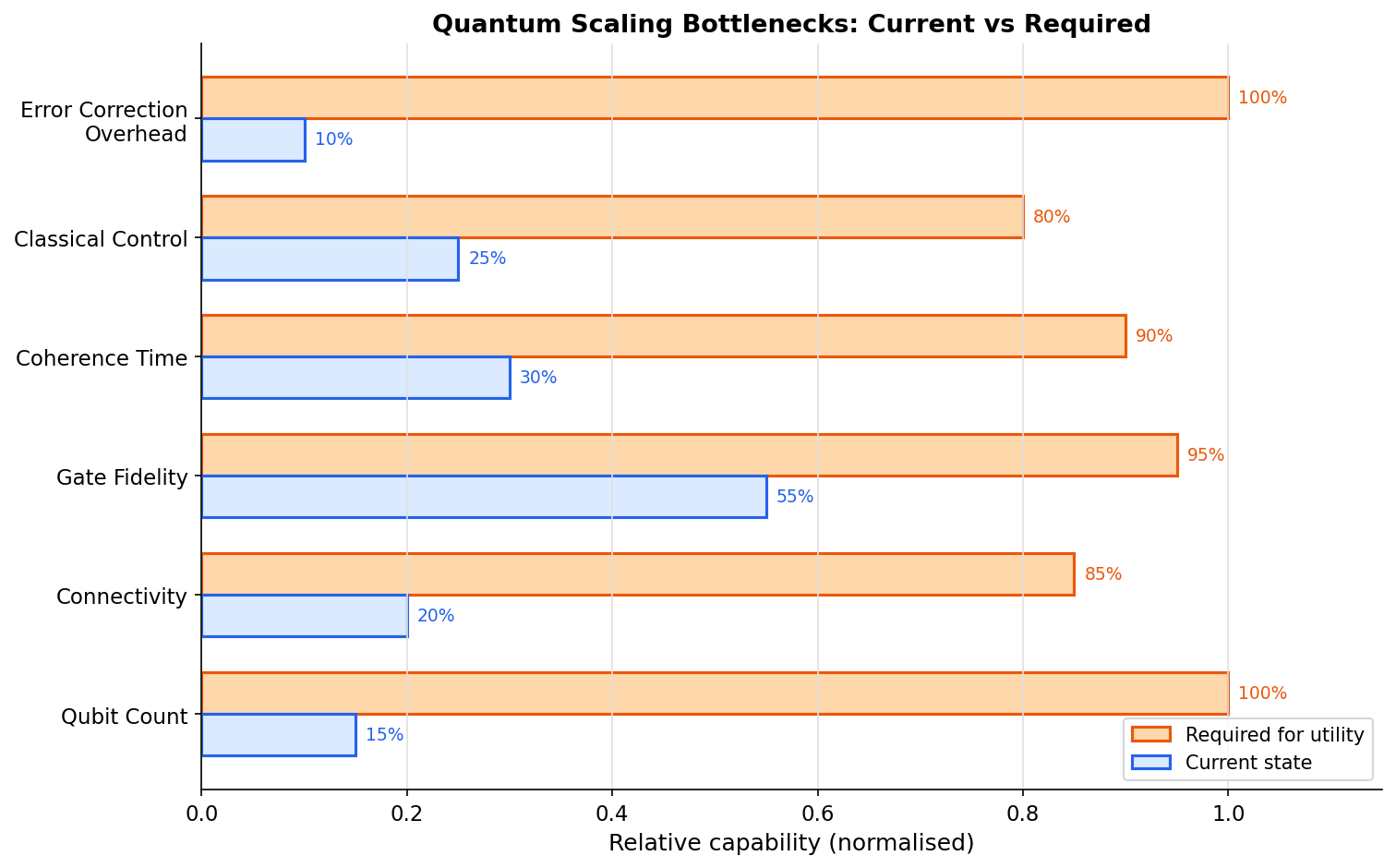
The cryogenic cooling budget, wiring density, and control bandwidth are the three walls blocking fault-tolerant scale-up
Source: mortalapps.com- Scaling to fault-tolerant quantum computing requires solving physical, thermal, and computational bottlenecks.
- Dilution refrigerators have extremely limited cooling power (approx. 20 uW) at the coldest 10mK stage.
- The wiring bottleneck arises because routing millions of metal coaxial cables conducts too much heat into the refrigerator.
- Cryo-CMOS chips operate at 4K to multiplex control signals, placing classical electronics close to the qubits.
- The decoding bottleneck requires classical computers to solve complex error-matching algorithms in less than 1 microsecond.
- If decoding takes longer than the gate cycle time, the system hits a 'decoding wall' and cannot run in real-time.
- Alternative architectures, like photonics, bypass some of these cryogenic bottlenecks by operating at higher temperatures.
Why This Matters
As we transition from the physics of quantum error correction to the engineering of real machines, we encounter a series of formidable physical and classical bottlenecks. Designing a 100-qubit processor is a remarkable scientific achievement, but scaling that system to the 1,000,000 physical qubits required for fault-tolerant computing is not a simple matter of 'making the chip bigger'. It requires solving some of the most complex engineering challenges in human history.
These bottlenecks span multiple disciplines, including thermodynamics, microwave engineering, and classical computer science. At the heart of the scaling problem is the interface between the ultra-cold quantum processor and the room-temperature classical control systems. Managing the heat load, routing millions of high-frequency control cables, and processing terabytes of sensor data in real-time are the true barriers to building a useful quantum computer.
In this topic, we will analyze the primary scaling bottlenecks of modern quantum architectures. We will explore the cryogenic cooling limits of dilution refrigerators, examine the 'wiring bottleneck' of coaxial cables, and analyze the 'decoding bottleneck', the requirement to solve complex error-matching algorithms in microseconds. This topic will ground your understanding of quantum computing in practical engineering reality.
Core Intuition
To understand the scaling bottleneck, imagine trying to scale a single-family home blueprint into a 100-story skyscraper. You cannot simply stack 100 houses on top of each other. If you did, the building would collapse under its own weight, there would be no way to get water to the top floors, and the hallways would be completely blocked by plumbing and electrical wires. To build a skyscraper, you must completely redesign the structural steel, install massive elevator shafts, and engineer centralized heating and cooling systems. The engineering must change qualitatively, not just quantitatively.
In a quantum computer, we face a similar structural challenge. For superconducting qubits, each qubit must be connected to a room-temperature control computer by a dedicated coaxial cable. If we have 1,000,000 qubits, we need 1,000,000 cables. If we tried to route that many cables into a standard dilution refrigerator, the cables would physically block the chamber, and the heat conducting down the metal wires would instantly warm the refrigerator, destroying the delicate quantum states. This is the 'wiring bottleneck'.
Another helpful analogy is a high-speed sorting facility. If a facility receives 1,000 packages a day, a few human workers can easily sort them. But if the facility scales to receive 1,000,000 packages every second, the workers will be completely overwhelmed. You need a massive, automated, ultra-fast robotic sorting system that can process packages in microseconds. In a quantum computer, the 'packages' are the stabilizer syndromes generated every microsecond, and the 'sorting system' is the classical decoding computer. If the decoder cannot keep up, the quantum computer will grind to a halt, choked by its own data. This is the 'decoding bottleneck'.
Finally, we have the 'cryogenic bottleneck'. A dilution refrigerator operates at 10 millikelvin, which is colder than deep space. At this temperature, the cooling power of the refrigerator is incredibly small, often less than a fraction of a milliwatt. Any heat generated by the qubits, the control pulses, or the wires will quickly overwhelm the refrigerator, causing it to warm up. We must design our systems to operate with virtually zero thermal dissipation.
Visualization
Technical Explanation
Let us analyze the scaling bottlenecks quantitatively:
1. Cryogenic Heat Load Limit: A standard dilution refrigerator uses a mixture of Helium-3 and Helium-4 isotopes to achieve temperatures of $T \approx 10$ mK. The cooling power $Q_c$ of a dilution refrigerator scales quadratically with temperature:
$$Q_c \propto T^2$$
At $10$ mK, a state-of-the-art refrigerator has a cooling power of only $Q_c \approx 10$ to $20$ microwatts ($\mu$W) at the coldest stage. If we have $1,000,000$ physical qubits, the allowable heat dissipation per qubit (including control lines, attenuators, and active gates) must be strictly limited to:
$$P_{\text{per-qubit}} < \frac{20 \mu\text{W}}{1,000,000} = 20 \text{picowatts (pW)}$$
Currently, a single physical gate operation dissipates orders of magnitude more heat than this limit, representing a massive thermal bottleneck.
2. The Wiring Bottleneck: Coaxial cables made of copper or niobium-titanium conduct heat from the room-temperature ($300$ K) stage down to the $10$ mK stage. The thermal conduction heat load $Q_{\text{cond}}$ is given by Fourier's Law:
$$Q_{\text{cond}} = \frac{A}{L} \int_{T_{\text{cold}}}^{T_{\text{hot}}} \kappa(T) dT$$
where $A$ is the cross-sectional area of the cable, $L$ is the length, and $\kappa(T)$ is the temperature-dependent thermal conductivity of the material. For $1,000,000$ standard coaxial cables, the thermal conduction would be hundreds of watts, completely overwhelming the refrigerator's cooling capacity.
3. The Decoding Bottleneck: The surface code generates stabilizer syndromes at the rate of the gate cycle time, which is approximately $t_{\text{cycle}} \approx 1$ microsecond for superconducting qubits. The classical decoding algorithm must process these syndromes and identify the error locations within this $1 \mu$s window to prevent 'syndrome backlog'. If the decoding time $t_{\text{decode}} > t_{\text{cycle}}$, the classical computer will fall behind exponentially, a fatal bottleneck known as the decoding wall.