Industry Hardware Comparison
Qubit count is misleading, gate fidelity and qubit connectivity are what actually determine real-world performance
Source: mortalapps.com- The commercial quantum industry is highly diverse, with multiple companies operating physical QPUs in the cloud.
- Physical qubit count is a misleading metric; gate fidelity and connectivity are far more critical to performance.
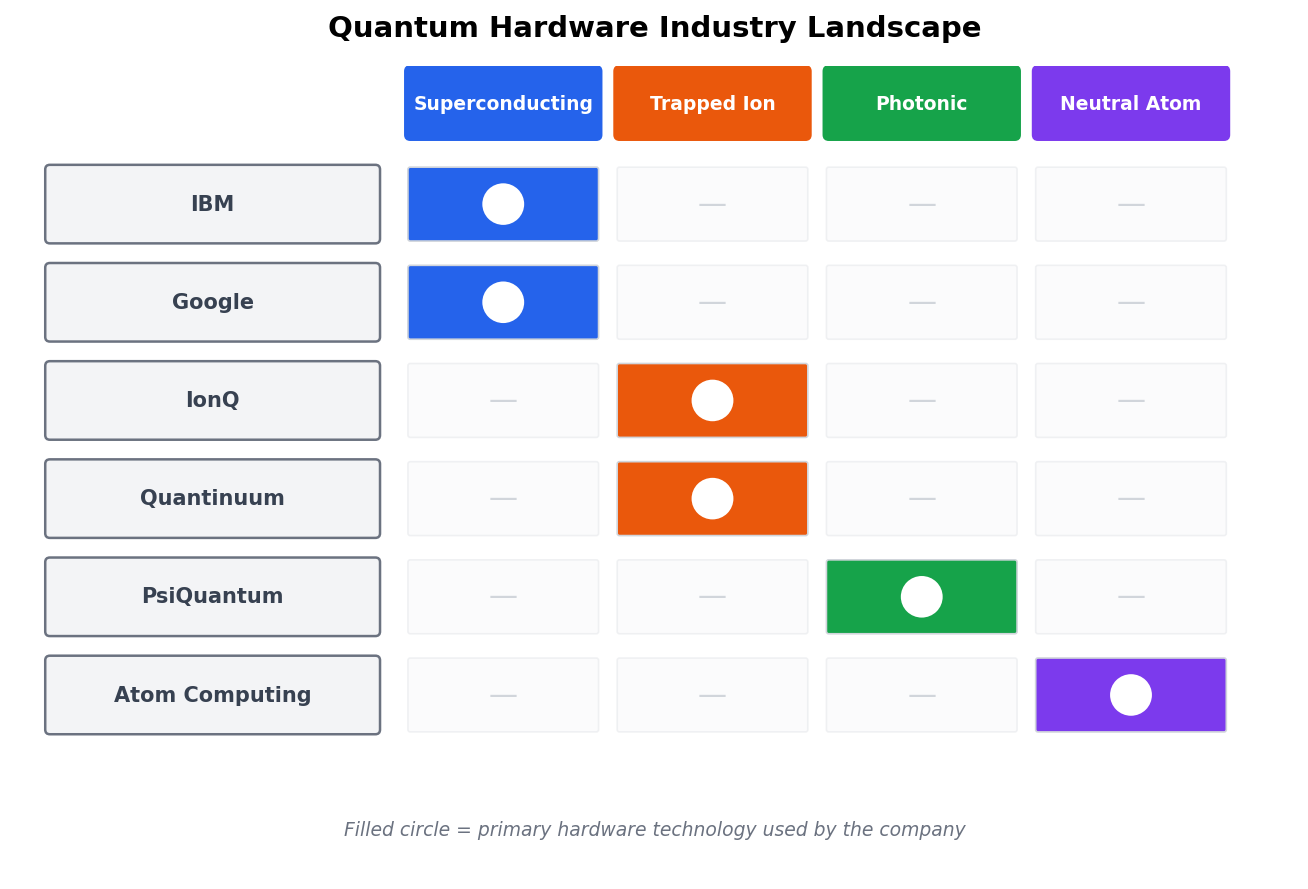
- IBM and Google lead the superconducting market, focusing on fast gate speeds and co-located runtimes.
- Quantinuum and IonQ lead the trapped ion market, offering near-perfect gate fidelities and all-to-all connectivity.
- QuEra leads the neutral atom market, offering dense 2D arrays for analog simulation and reconfigurable digital gates.
- The industry is actively transitioning from the NISQ era to early error-corrected systems, with companies demonstrating physical-to-logical qubit mapping.
Why This Matters
The quantum computing industry has transitioned from academic curiosity to a highly competitive commercial landscape. Today, multiple multi-billion-dollar companies and cutting-edge startups are actively operating physical quantum computers in the cloud. To navigate this landscape as a developer or researcher, we must perform a rigorous, quantitative comparison of the state-of-the-art systems offered by the industry leaders, analyzing their actual performance metrics and architectural choices.
Core Intuition
To understand the current state of the quantum industry, imagine a high-stakes motorsport race where different teams have designed completely different engines. Team IBM and Team Google have built high-revving, turbocharged engines (superconducting) that are incredibly fast but require massive cooling systems and are prone to overheating.
Team Quantinuum and Team IonQ have built highly efficient, naturally aspirated engines (trapped ions) that are slower to accelerate but run with near-perfect reliability and fuel efficiency. Team QuEra has built a modular, reconfigurable off-road vehicle (neutral atoms) that can dynamically change its tire layout depending on the terrain. There is no single 'winner' yet; each team is dominating different segments of the track, and the race is a continuous battle of engineering upgrades.
Visualization
Technical Explanation
To compare commercial quantum processors rigorously, we must analyze their key physical and performance metrics side-by-side. The table below summarizes the state-of-the-art systems operating in the 2023-2024 timeframe:
| Provider | Processor | Qubit Type | Qubit Count | 2-Qubit Gate Fidelity | Coherence Time ($T_2$) | Connectivity | Access Model | | :--- | :--- | :--- | :--- | :--- | :--- | :--- | :--- | | IBM | Heron (2023) | Superconducting Transmon | 133 | $99.9\%$ | $\sim 100 - 200\ \mu\text{s}$ | Heavy-Hex (Planar) | IBM Quantum Platform | | Google | Sycamore / Willow | Superconducting Transmon | 105 | $99.8\%$ | $\sim 50 - 100\ \mu\text{s}$ | Grid (Planar) | Google Cloud / Private | | Quantinuum | H2 (2024) | Trapped Ion (QCCD) | 56 | $99.91\%$ | $\sim 10\text{ s}$ | All-to-All (Shuttled) | Azure Quantum / Private | | IonQ | Forte (2023) | Trapped Ion | 36 (AQ) | $99.4\%$ | $\sim 1\text{ s}$ | All-to-All (Stationary) | AWS Braket / Azure / IonQ | | QuEra | Aquila | Neutral Atom | 256 | $99.5\%$ | $\sim 10\text{ ms}$ | Reconfigurable (2D) | AWS Braket / QuEra | | PsiQuantum | (In Fab) | Silicon Photonics | (Scaling) | (Heralded) | (Loss-limited) | Fusion-Based | Private / Development |
We must analyze these metrics in combination. For example, while IBM's Heron has 133 qubits and Quantinuum's H2 has 56, Quantinuum's all-to-all connectivity and $99.91\%$ gate fidelity allow it to run much deeper, more complex circuits without needing SWAP gates, yielding a higher Quantum Volume or Algorithmic Qubit (AQ) rating. Conversely, IBM's fast gate speeds allow it to execute millions of shots in a fraction of the time, making it highly efficient for variational algorithms.