Measurement in Circuits
Mid-circuit measurement collapses a qubit to a classical bit and can feed back into subsequent gate choices
Source: mortalapps.com- Measurement projects a quantum state onto the computational basis, yielding a classical bit.
- Mid-circuit measurement allows us to use classical feedback to control subsequent gates.
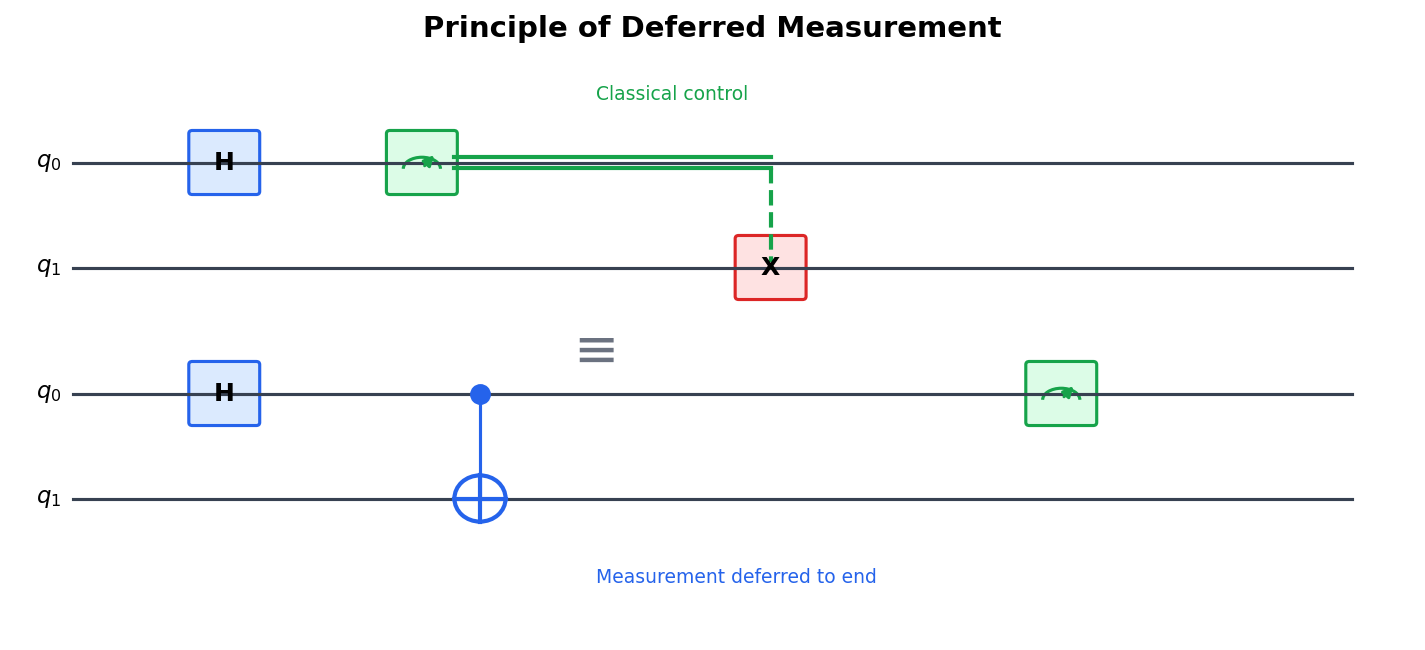
- Classically controlled gates are represented by double lines leading from a meter to a gate.
- The Principle of Deferred Measurement states that mid-circuit measurements can always be postponed to the end.
- Postponing measurement requires replacing classical control with quantum controlled gates.
- Mid-circuit measurement is essential for active quantum error correction and qubit reuse.
- Measuring an entangled qubit collapses the state of the entire joint system.
Why This Matters
Measurement is the bridge between the quantum and classical worlds. In a quantum circuit, measurement is not just something we do at the very end to read out the final answer; it is an active tool that can be applied in the middle of a circuit to guide the computation.
In this topic, we will explore the role of measurement in quantum circuits. You will learn the difference between end-of-circuit measurement and mid-circuit measurement. We will study the 'Principle of Deferred Measurement,' a fundamental theorem that states that any measurement can be postponed to the end of the circuit without changing the final probability distribution.
By the end of this topic, you will understand how to represent classically controlled gates (gates that fire based on a previous measurement result) and how to analyze circuits that combine quantum and classical logic dynamically.
Core Intuition
Imagine you are baking a cake. One approach is to mix all the ingredients, put the cake in the oven, and only check it at the very end (end-of-circuit measurement). If something went wrong, you only find out when it's too late.
Another approach is to check the batter mid-way through (mid-circuit measurement). If the batter is too dry, you add milk; if it's too wet, you add flour (classically controlled correction). This active feedback allows you to correct errors on the fly.
In quantum circuits, mid-circuit measurement allows us to detect and correct errors, or even simplify the circuit. The Principle of Deferred Measurement tells us that, theoretically, we could always wait until the end to measure, but practically, measuring mid-circuit is a powerful tool for real-world hardware.
Visualization
Technical Explanation
Measurement in a quantum circuit is represented by a meter symbol. Mathematically, measuring a qubit in the computational basis is described by the projection operators $P_0 = |0\rangle\langle 0|$ and $P_1 = |1\rangle\langle 1|$.
When a qubit is measured, the state collapses, and a classical bit ($0$ or $1$) is produced. This bit is carried along a double-line classical wire. We can use this classical bit to control subsequent quantum gates. This is called a classically controlled gate, represented by a double line leading from the measurement meter to a gate box.
The Principle of Deferred Measurement states that measuring a qubit mid-circuit and using the classical result to control a gate is mathematically equivalent to replacing the measurement with a fully quantum controlled gate (where the unmeasured qubit acts as the control), and postponing the measurement to the very end of the circuit.
For example, a mid-circuit measurement on qubit 0 followed by a classically controlled X gate on qubit 1 is mathematically identical to applying a quantum CNOT gate between qubit 0 and qubit 1, and then measuring qubit 0 at the end.