Algorithm Limitations
Quantum computers need specific mathematical structure for exponential speedups and cannot solve all NP-hard problems
Source: mortalapps.com- Quantum computers are not universal problem solvers; they require specific mathematical structures to achieve exponential speedups.
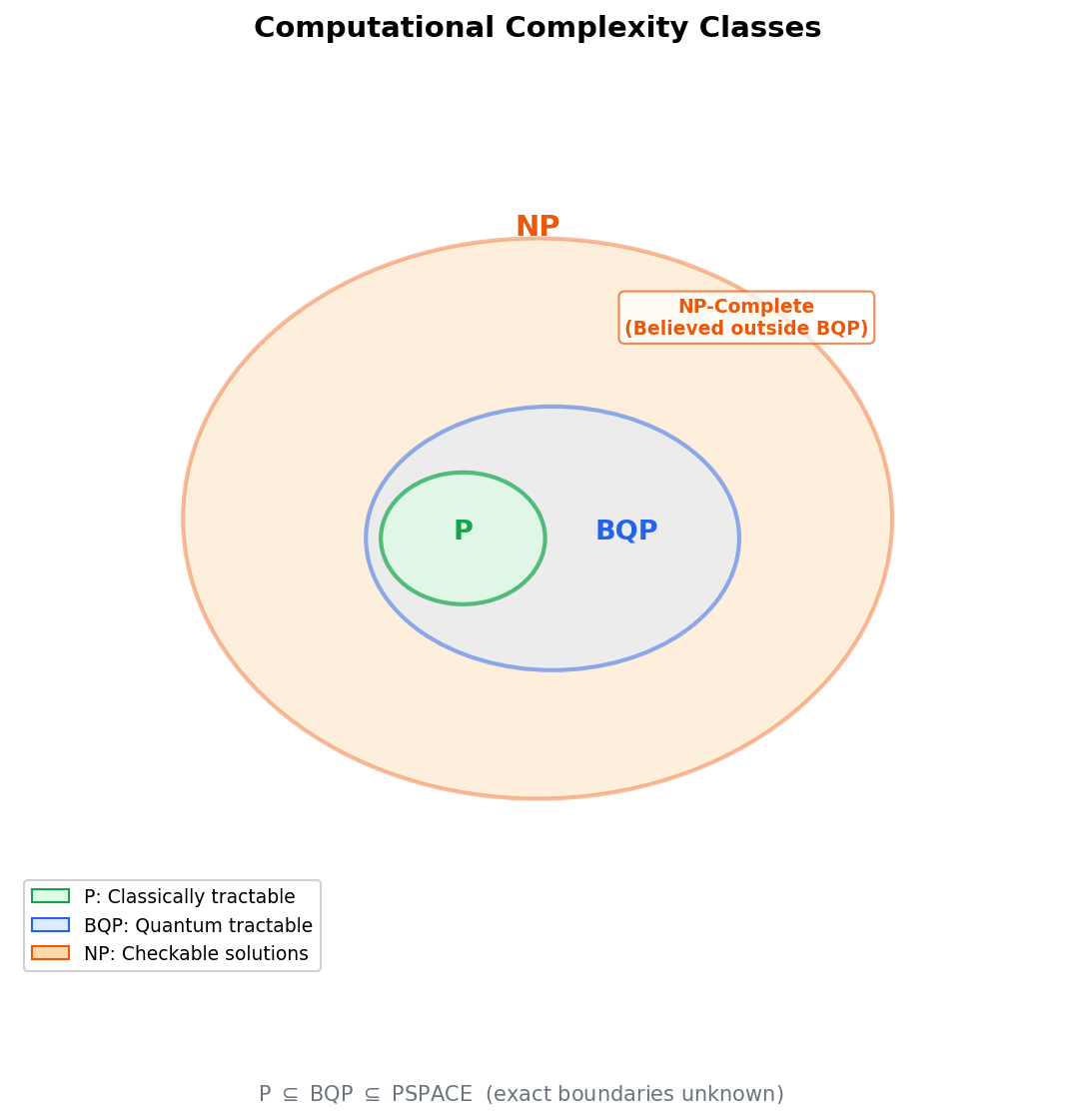
- BQP is the complexity class of problems solvable efficiently by a quantum computer.
- It is highly unlikely that BQP contains NP-complete problems.
- The No-Cloning Theorem prevents the copying of arbitrary quantum states.
- Holevo's Bound limits the amount of classical information we can extract from qubits to 1 bit per qubit.
Why This Matters
To truly master quantum computing, one must understand not only what quantum computers *can* do, but also what they *cannot* do. Quantum computers are not magic machines that can solve any hard problem instantly. They are bound by the laws of quantum mechanics and computational complexity theory.
Core Intuition
Imagine a super-fast sports car. It can travel at incredible speeds on a paved highway, but if you put it in a swamp, it will get stuck just like any other car. Quantum computers are like that sports car: they provide exponential speedups for highly structured mathematical 'highways' (like factoring or period finding), but for unstructured 'swamps' (like NP-complete optimization problems), they offer only modest speedups. A quantum computer cannot solve the Traveling Salesperson Problem instantly; it still faces fundamental physical and mathematical limits.
Visualization
Technical Explanation
To understand quantum limits, we define the key computational complexity classes:
- P: Problems solvable by a classical computer in polynomial time.
- NP: Problems whose solutions can be verified by a classical computer in polynomial time.
- BQP (Bounded-Error Quantum Polynomial-Time): Problems solvable by a quantum computer in polynomial time with an error probability of at most $1/3$.
The Complexity Landscape: It is widely believed by computer scientists that:
$$\text{P} \subseteq \text{BQP} \subsetneq \text{NP}$$
This means that while BQP contains problems outside of P (like factoring), it does not contain NP-complete problems. Quantum computers cannot solve NP-complete problems in polynomial time.
Fundamental Physical Limits: 1. No-Cloning Theorem: We cannot make an identical copy of an unknown quantum state $|\psi\rangle$. This prevents us from duplicating data for classical-style backup or parallel processing. 2. Holevo's Bound: An $n$-qubit system can store an exponential amount of quantum information, but we can extract at most $n$ classical bits of information from it upon measurement. 3. Grover's Bound: It has been mathematically proven that the $O(\sqrt{N})$ query complexity of Grover's algorithm is the absolute physical limit for unstructured search. No quantum algorithm can search an unstructured space in $O(\log N)$ time.