Noise in Circuits
T1 relaxation and T2 dephasing limit qubit coherence, setting an upper bound on the useful depth of any quantum circuit
Source: mortalapps.com- Real-world quantum circuits are highly sensitive to environmental noise and gate imperfections.
- T1 (relaxation) is the spontaneous decay of a qubit from |1⟩ to |0⟩.
- T2 (dephasing) is the loss of phase coherence in a superposition.
- Gate errors accumulate exponentially with circuit depth, limiting the size of runnable algorithms.
- Two-qubit gates (CNOT) have significantly higher error rates than single-qubit gates.
- Circuit fidelity can be estimated as the product of the fidelities of all individual gates.
- Error mitigation and error correction are required to scale quantum computers to practical applications.
Why This Matters
In our theoretical study of quantum circuits, we assume that gates are perfect and qubits remain coherent forever. In the real world, however, quantum computers are highly sensitive to their environment. Every gate we apply has a small probability of failing, and every second a qubit sits idle, it risks losing its quantum information to environmental noise.
In this topic, we will explore the reality of noise in quantum circuits. You will learn about the two primary physical noise mechanisms: relaxation ($T_1$) and dephasing ($T_2$). We will study how gate errors accumulate as a circuit runs, and how to calculate the overall success probability of a circuit based on gate fidelities.
By the end of this topic, you will understand why today's quantum computers are limited to short circuits, how noise corrupts quantum superpositions, and the critical importance of quantum error mitigation.
Core Intuition
Imagine you are playing a game of 'telephone' where a message is whispered down a line of people. If each person has a 99% chance of repeating the message perfectly, a short line of 5 people will likely get the message right. But if the line is 100 people long, the message will almost certainly be corrupted.
In a quantum computer, each gate we apply is like a person repeating the message. If our gates are 99% accurate (a 1% error rate), a circuit with 10 gates will work fine. But a circuit with 500 gates will output complete garbage.
Furthermore, even if we don't apply any gates, the qubits are like people sitting in a noisy room trying to remember a number. Over time, the noise of the room (environmental thermal and electromagnetic fluctuations) will cause them to forget. This is decoherence, and it means our quantum 'memory' has a strict expiration date.
Visualization
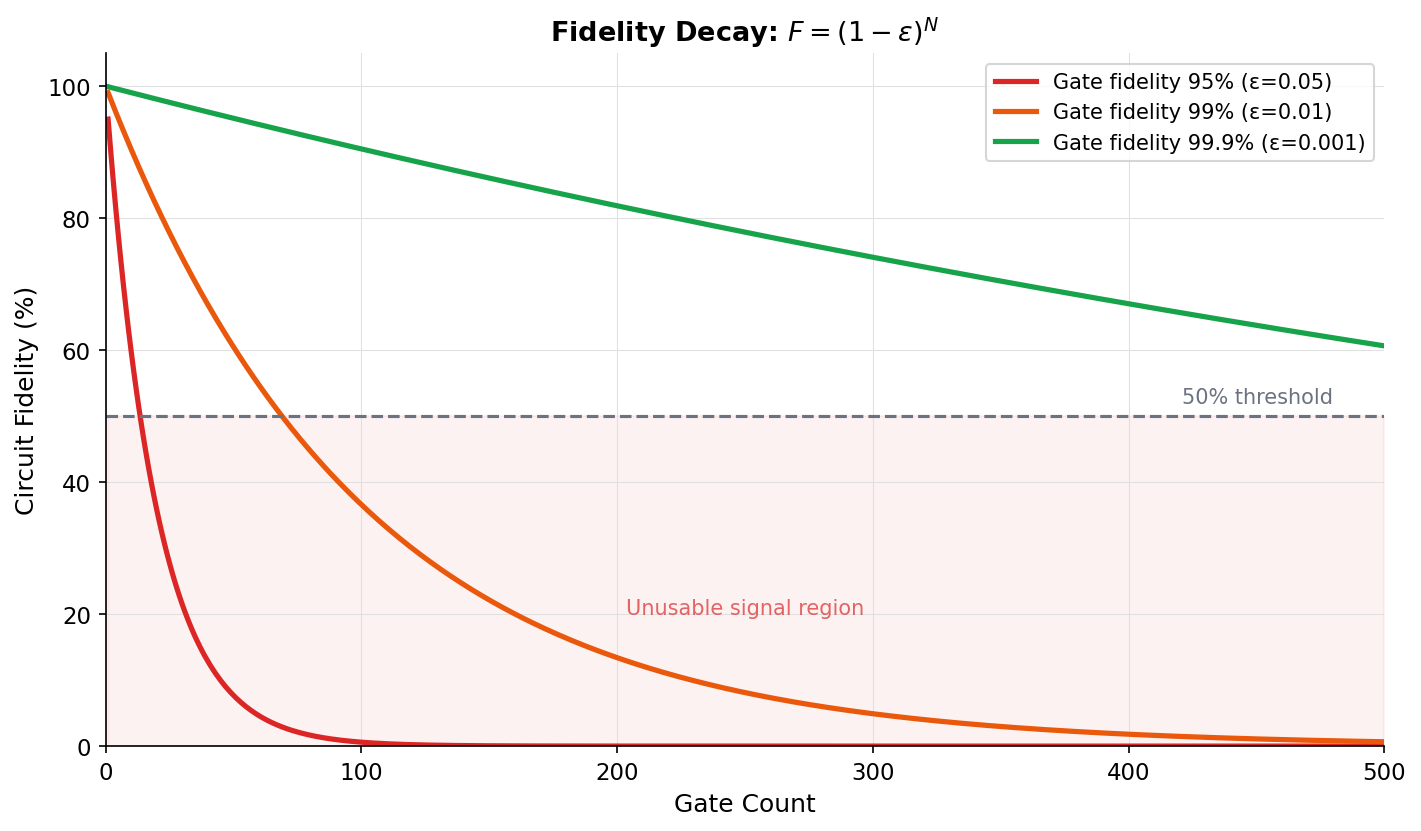
Technical Explanation
Noise in quantum systems is modeled using open quantum systems and quantum channels. The two primary physical relaxation processes are: 1. Thermal Relaxation ($T_1$): The qubit spontaneously loses energy and decays from the excited state $|1\rangle$ to the ground state $|0\rangle$. The probability of decay over time $t$ is $P_{\text{decay}} = 1 - e^{-t/T_1}$. 2. Dephasing ($T_2$): The relative phase between $|0\rangle$ and $|1\rangle$ is randomized by environmental fluctuations, destroying the superposition. The phase coherence decays over time $t$ as $e^{-t/T_2}$.
In addition to idle noise, active gates have a gate fidelity ($F$), which measures how close the physical gate operation is to the ideal unitary. If a circuit has $N$ independent gates, each with an average fidelity $F$, the overall circuit fidelity ($F_{\text{circuit}}$) can be approximated by the product of individual fidelities:
$$F_{\text{circuit}} \approx F^N$$
For example, if we have a circuit with $N = 100$ gates, and each gate has a fidelity of $F = 0.99$ (a 1% error rate), the overall success probability of the circuit is:
$$F_{\text{circuit}} \approx (0.99)^{100} \approx 0.366 \text{ (or 36.6%)}$$
If we scale to $N = 500$ gates, the fidelity drops to $(0.99)^{500} \approx 0.006$ (less than 1%), meaning the output is completely dominated by noise.